Japanese Bond Yields Surge as Bitcoin Falls Below $86,000

Beginner
Quick Reads
Last Updated 2026-03-27 06:51:27
Reading Time: 1m
Japanese government bond yields reached their highest level in 17 years, fueling a sharp rise in investor caution. Bitcoin dropped below $86,000 as market liquidity dried up, leading to a $150 billion capital outflow. This report delivers an in-depth analysis of market dynamics and highlights key factors to watch moving forward.

Market Background and Key Drivers

Recently, Bank of Japan officials indicated a potential interest rate hike this year, fueling expectations of a shift in Japan’s monetary policy. This announcement quickly sent Japanese government bond yields soaring. Short-term yields broke above 1% for the first time in nearly seventeen years, while long-term yields also surged.

Global capital markets responded rapidly, with risk appetite dropping sharply. The cryptocurrency market, which relies heavily on investor sentiment and liquidity, is particularly susceptible to macroeconomic changes. As volatility in Japan’s bond market rippled across global markets, Bitcoin and other crypto assets faced intense selling pressure.

How Surging Bond Yields Impact Crypto Assets

Rising Japanese government bond yields have far-reaching effects on global financial markets. Higher yields make yen-denominated assets more attractive, prompting investors to return to Japan and pull capital from riskier overseas assets. This shift directly triggers forced selling of risk assets, including cryptocurrencies. The increase in yields reflects expectations for higher future interest rates, which typically sparks risk aversion. Globally, investors reduce exposure to volatile, high-risk assets, with cryptocurrencies—given their high volatility—taking the biggest hit.

Additionally, synchronized adjustments across global bond markets have tightened liquidity, causing crypto market liquidity to dry up quickly. In a low-liquidity environment, any significant sell-off can accelerate price declines, creating a self-reinforcing downward spiral.

Bitcoin Drops Below $86,000: Data and Implications


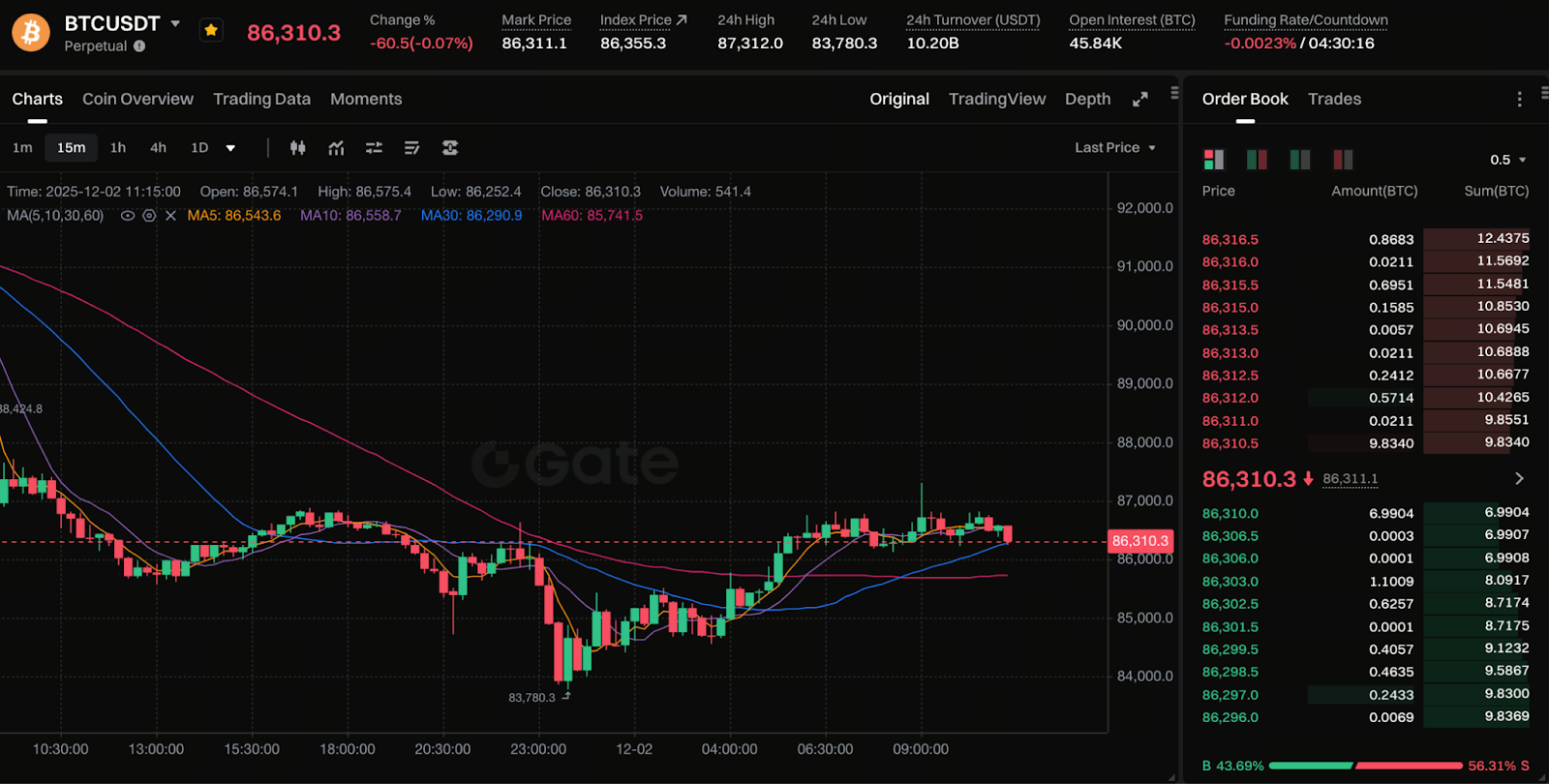
Chart: https://www.gate.com/futures/USDT/BTC_USDT

Amid these macroeconomic shocks, Bitcoin plunged during Asian trading hours, briefly dipping below $86,000. This correction wiped out more than $150 billion from global crypto market capitalization. Beyond Bitcoin, leading tokens such as Ethereum and Solana also posted notable declines, with long positions liquidated and panic spreading quickly throughout the market.

Technically, Bitcoin found short-term support near $86,000. However, with sentiment subdued, this support may face renewed pressure. In the near term, investors should closely monitor trading volume and the resilience of key support levels.

Weak Market Liquidity and Systemic Risk

Crypto market liquidity is currently thin, with limited trading volume and shallow buy-side depth. Large sell-offs can cause prices to drop swiftly. Unlike previous cycles, this downturn has been accompanied by widespread liquidations in leveraged trading, with some exchanges experiencing a wave of forced liquidations, further amplifying market turbulence.

Moreover, rising global interest rates and surging bond yields may trigger cross-market capital flows, transmitting volatility from traditional financial markets to crypto, and increasing systemic risk. Investors must exercise heightened caution in this highly volatile environment to avoid excessive losses driven by market sentiment swings.

What Should Investors Do?

  • Stay calm and avoid chasing highs or bottom-fishing: Extreme volatility makes impulsive trades especially risky.
  • Monitor macro trends and liquidity shifts: Movements in bond markets, interest rates, and exchange rates can all impact the crypto sector.
  • Reduce leverage and manage risk exposure: Steer clear of high-leverage positions that can trigger forced liquidations.
  • Take a long-term view: The crypto market is heavily influenced by macro cycles, so patience is key while waiting for sentiment and liquidity to stabilize.
  • Diversify your portfolio: In times of heightened uncertainty, spreading assets across markets helps mitigate risks from single-market shocks.

In summary, Bitcoin’s latest decline was primarily driven by surging Japanese bond yields that eroded global risk appetite. Insufficient market liquidity and widespread leveraged liquidations intensified the sell-off. In the short term, investors should remain cautious and closely track macroeconomic trends and liquidity conditions to position themselves effectively for the future.

Author: Max
Disclaimer
* The information is not intended to be and does not constitute financial advice or any other recommendation of any sort offered or endorsed by Gate.
* This article may not be reproduced, transmitted or copied without referencing Gate. Contravention is an infringement of Copyright Act and may be subject to legal action.

Related Articles

AI-Native Settlement Layers: How United Stables Is Building the Next Financial Rail
Beginner

AI-Native Settlement Layers: How United Stables Is Building the Next Financial Rail

Stablecoins were originally designed as dollar substitutes within exchanges, primarily used for asset pricing and trade settlement. As on-chain financial ecosystems have matured, their role has expanded beyond simple payments to include collateral assets, cross-chain liquidity mediums, and unified settlement units. In particular, as AI systems and automated agents begin to participate directly in economic activity, demand has risen sharply for programmable value units capable of instant settlement. This shift is pushing stablecoins toward the role of foundational financial infrastructure.
2026-03-25 03:16:17
DePIN Identity Network and Real World Applications: How Humanity Protocol Brings on-chain Identity Into the Physical World
Beginner

DePIN Identity Network and Real World Applications: How Humanity Protocol Brings on-chain Identity Into the Physical World

Most Web3 identity systems remain confined to on-chain environments and struggle to achieve meaningful adoption in real world settings. Through a DePIN architecture and physical verification hardware, Humanity Protocol aims to bring decentralized identity into access control systems, hospitality, public services, and offline events, allowing on-chain identity to function not just as a digital credential, but as foundational infrastructure for real world access.
2026-03-25 07:40:53
Gold Price Forecast for the Next Five Years: 2026–2030 Trend Outlook and Investment Implications, Could It Reach $6,000?
Beginner

Gold Price Forecast for the Next Five Years: 2026–2030 Trend Outlook and Investment Implications, Could It Reach $6,000?

Analyze current gold price trends alongside authoritative five-year forecasts, integrating an evaluation of market risks and opportunities. This gives investors insight into the potential trajectory of gold prices and the main drivers expected to shape the market over the next five years.
2026-03-25 18:13:30
Aster vs Hyperliquid: Which Perp DEX Will Prevail?
Beginner

Aster vs Hyperliquid: Which Perp DEX Will Prevail?

Aster and Hyperliquid are the two representative protocols of the "purpose-built L1 path" within the current decentralized perpetual exchange (Perp DEX) sector. As a pioneer in the field, Hyperliquid has built a deep liquidity moat through its highly mature order book architecture and strong community consensus. Conversely, Aster, as a rising challenger, seeks to leapfrog the competition in high-performance trading through more aggressive multi-chain aggregation logic, private transaction modules, and an underlying execution environment optimized for 2026 market demands.
2026-03-24 11:58:33
Aerodrome Tokenomics: How ve(3,3) Powers Base's Most Profitable DEX
Beginner

Aerodrome Tokenomics: How ve(3,3) Powers Base's Most Profitable DEX

AERO is the native token of Aerodrome Finance, a core decentralized exchange and liquidity protocol in the Base ecosystem. It is primarily used for liquidity incentives and ecosystem operations. veAERO is a governance NFT that users receive by locking AERO, representing both voting power and the right to share protocol revenue. Through a dual track structure of AERO as a utility token and veAERO as a governance credential, Aerodrome separates liquidity usage value from long term governance power, allowing participants to act as liquidity providers, governance decision makers, and revenue sharers within the same system.
2026-03-25 06:40:31
The ve(3,3) Flywheel Explained: How AERO Tokenomics Powers Aerodrome’s DeFi Economy
Beginner

The ve(3,3) Flywheel Explained: How AERO Tokenomics Powers Aerodrome’s DeFi Economy

In the competition for DeFi liquidity, high-inflation mining alone is no longer enough to build lasting advantages. Aerodrome applies the ve(3,3) economic model to redesign token emissions, voting mechanisms, and revenue distribution, creating a liquidity flywheel centered on governance and cash flow. This article examines AERO tokenomics, the veAERO locking mechanism, and protocol revenue models to explain how Aerodrome builds a sustainable DeFi economic system.
2026-03-25 06:41:58