Tradoor Latest Developments and Price Analysis: Why $TRADOOR Deserves Attention

Beginner
Quick Reads
Last Updated 2026-03-27 05:56:32
Reading Time: 1m
Gain deep insights into the latest developments and market trends of Tradoor (TRADOOR). This analysis integrates on-chain whale movements with price analysis to enable evaluation of Tradoor's future prospects.

Overview: What Is Tradoor


Image: https://tradoor.io/

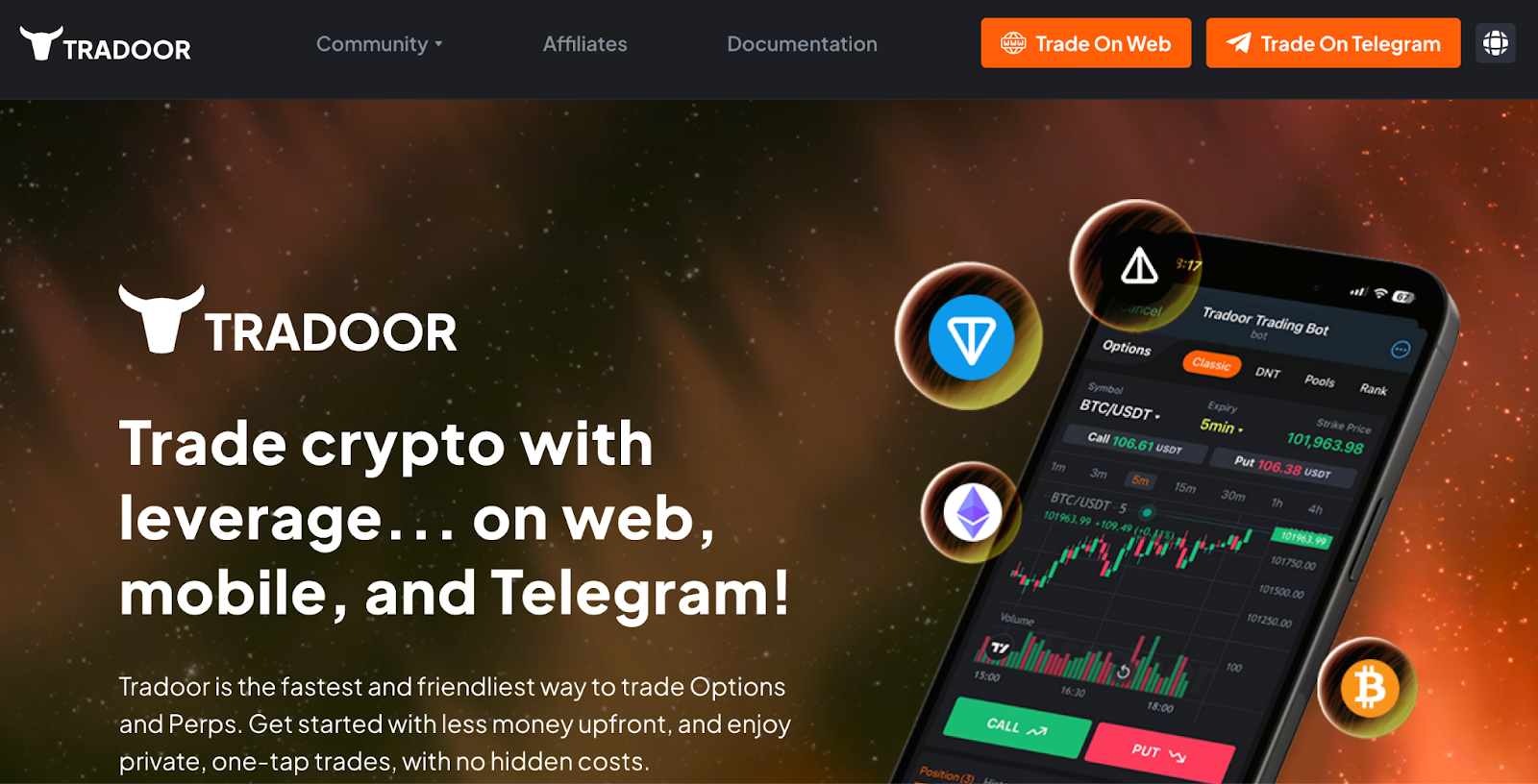
Tradoor is a decentralized exchange (DEX) built on the TON blockchain. It is distinguished by its integration of perpetual contracts, options, and SocialFi features. Leveraging “Turbo Mode + Turbo Accounts,” Tradoor aims to deliver a trading experience nearly identical to centralized exchanges (CEX)—offering high speed, minimal slippage, multi-chain asset support, and seamless one-click execution. For users who prefer the familiarity of CEX platforms but seek the benefits of decentralization, on-chain asset management, and DeFi flexibility, Tradoor presents a compelling middle ground. Tradoor offers a solution for those users.

Tradoor’s Latest Milestones

  • In May 2025, Tradoor secured approximately $3.2 million in funding—including $1.5 million in token subscription commitments—to advance its development roadmap. The goal is to introduce CEX-like trading experience to the Telegram and TON ecosystem.
  • Concurrently, Tradoor launched “Turbo Mode,” which reportedly delivers 10,000 TPS, transaction confirmation times as low as 50 milliseconds, and effectively zero slippage. This feature is particularly appealing to users seeking fast, high-frequency, and low-cost trading.
  • Tradoor’s multi-chain deposit capability further enhances its DeFi flexibility. Combined with SocialFi and copy trading functions, the platform targets users interested in both trading and participating in community-driven or social trading activities.

Together, these advancements position Tradoor as more than a standard DEX. Tradoor aims to connect CEX platforms and traditional DeFi by combining trading speed, user experience, and SocialFi community elements.

Current Price and Market Performance


Image: https://www.gate.com/futures/USDT/TRADOOR_USDT

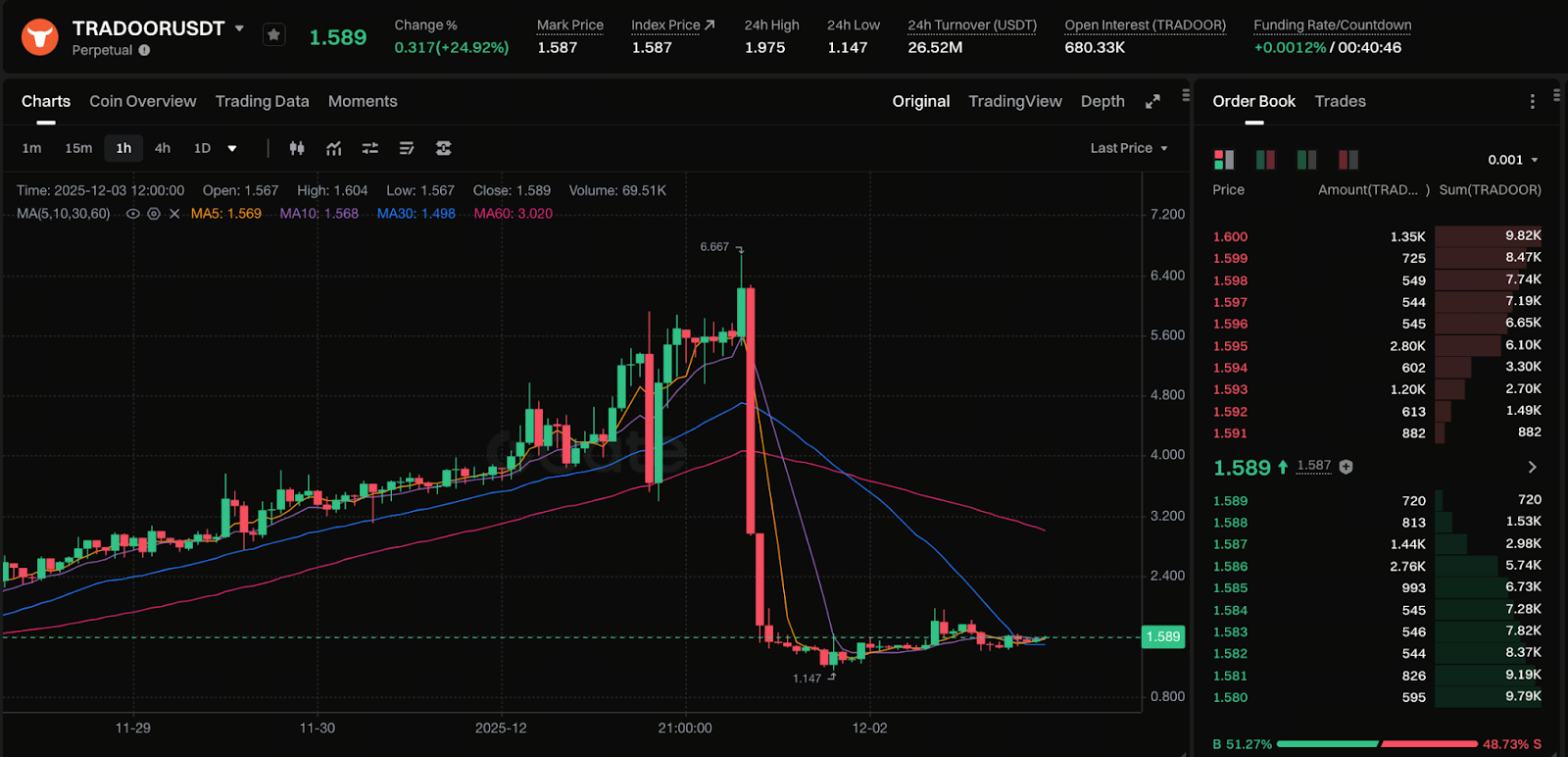
Recent public data shows that Tradoor (TRADOOR) has experienced notable price volatility, with its overall performance in the spotlight. On December 3, 2025, TRADOOR traded at approximately $1.60.

On-Chain Whale Activity & Market Sentiment Analysis

Although Tradoor’s price has declined at certain points, major holders (the top 100 wallets) have continued to accumulate—boosting their positions by approximately 11.1% over the past 30 days. At the same time, whale wallet balances have surged, signaling capital concentration. Exchange balances of TRADOOR have dropped, indicating that many users are withdrawing tokens to private wallets. This pattern of “price declines while large holders accumulate and circulating supply tightens” is sometimes viewed as a potential bottoming signal. If demand rebounds, the upside could be significant.

This environment may be particularly appealing to investors who embrace high-risk, high-reward scenarios and can tolerate volatility. Additionally, both community engagement and exchange activity reflect growing momentum for Tradoor.

Key Considerations for Investors

When evaluating Tradoor, keep the following factors in mind:

  • Overall market volatility: Broader crypto market cycles, macroeconomic trends, and regulatory shifts could all adversely affect Tradoor.
  • Platform delivery: The timely and stable rollout of features like “Turbo Mode,” SocialFi, and multi-chain support—and their acceptance by users—are critical.
  • Liquidity and trading volume: While current trading activity appears robust, maintaining sufficient long-term liquidity is essential to prevent slippage and liquidity risks.
  • Long-term competition: The DeFi and DEX space is highly competitive, with other projects likely to introduce similar features. Tradoor must continually differentiate itself and foster strong community engagement.

If you are considering a long-term position or investment in Tradoor, build your position gradually, monitor project developments, and stay attuned to the broader crypto market landscape.

Summary

In summary, Tradoor presents both significant potential and notable risks. It aims to merge fast trading, DeFi, and SocialFi, appealing to users who value the CEX experience alongside on-chain freedom and transparency. Its recent fundraising, product architecture, and on-chain whale activity all contribute to its attractiveness as an investment opportunity. If Tradoor delivers future features as promised and user adoption is strong, it could emerge as a significant project within the TON ecosystem.

For those able to tolerate volatility and experienced in diversification, Tradoor may warrant consideration for your investment watchlist. It is advisable to diversify your portfolio rather than concentrate it in a single project.

Author:  Max
Disclaimer
* The information is not intended to be and does not constitute financial advice or any other recommendation of any sort offered or endorsed by Gate.
* This article may not be reproduced, transmitted or copied without referencing Gate. Contravention is an infringement of Copyright Act and may be subject to legal action.

Related Articles

AI-Native Settlement Layers: How United Stables Is Building the Next Financial Rail
Beginner

AI-Native Settlement Layers: How United Stables Is Building the Next Financial Rail

Stablecoins were originally designed as dollar substitutes within exchanges, primarily used for asset pricing and trade settlement. As on-chain financial ecosystems have matured, their role has expanded beyond simple payments to include collateral assets, cross-chain liquidity mediums, and unified settlement units. In particular, as AI systems and automated agents begin to participate directly in economic activity, demand has risen sharply for programmable value units capable of instant settlement. This shift is pushing stablecoins toward the role of foundational financial infrastructure.
2026-03-25 03:16:17
Gold Price Forecast for the Next Five Years: 2026–2030 Trend Outlook and Investment Implications, Could It Reach $6,000?
Beginner

Gold Price Forecast for the Next Five Years: 2026–2030 Trend Outlook and Investment Implications, Could It Reach $6,000?

Analyze current gold price trends alongside authoritative five-year forecasts, integrating an evaluation of market risks and opportunities. This gives investors insight into the potential trajectory of gold prices and the main drivers expected to shape the market over the next five years.
2026-03-25 18:13:30
Aster vs Hyperliquid: Which Perp DEX Will Prevail?
Beginner

Aster vs Hyperliquid: Which Perp DEX Will Prevail?

Aster and Hyperliquid are the two representative protocols of the "purpose-built L1 path" within the current decentralized perpetual exchange (Perp DEX) sector. As a pioneer in the field, Hyperliquid has built a deep liquidity moat through its highly mature order book architecture and strong community consensus. Conversely, Aster, as a rising challenger, seeks to leapfrog the competition in high-performance trading through more aggressive multi-chain aggregation logic, private transaction modules, and an underlying execution environment optimized for 2026 market demands.
2026-03-24 11:58:33
DePIN Identity Network and Real World Applications: How Humanity Protocol Brings on-chain Identity Into the Physical World
Beginner

DePIN Identity Network and Real World Applications: How Humanity Protocol Brings on-chain Identity Into the Physical World

Most Web3 identity systems remain confined to on-chain environments and struggle to achieve meaningful adoption in real world settings. Through a DePIN architecture and physical verification hardware, Humanity Protocol aims to bring decentralized identity into access control systems, hospitality, public services, and offline events, allowing on-chain identity to function not just as a digital credential, but as foundational infrastructure for real world access.
2026-03-25 07:40:53
Aerodrome Tokenomics: How ve(3,3) Powers Base's Most Profitable DEX
Beginner

Aerodrome Tokenomics: How ve(3,3) Powers Base's Most Profitable DEX

AERO is the native token of Aerodrome Finance, a core decentralized exchange and liquidity protocol in the Base ecosystem. It is primarily used for liquidity incentives and ecosystem operations. veAERO is a governance NFT that users receive by locking AERO, representing both voting power and the right to share protocol revenue. Through a dual track structure of AERO as a utility token and veAERO as a governance credential, Aerodrome separates liquidity usage value from long term governance power, allowing participants to act as liquidity providers, governance decision makers, and revenue sharers within the same system.
2026-03-25 06:40:31
Hybrid Collateral Stablecoins: Inside United Stables' Stability and Yield Architecture
Beginner

Hybrid Collateral Stablecoins: Inside United Stables' Stability and Yield Architecture

In the early stages of the crypto market, traditional stablecoins mainly relied on single-reserve or single-collateral models. Their primary focus was price stability and payment convenience, which allowed them to become foundational tools for on-chain trading and capital flows. As the market has entered a more mature financial phase, however, this structure has begun to reveal limitations, including high concentration risk and the difficulty of balancing liquidity with yield. These constraints have driven the evolution toward multi-layer collateral and portfolio-based designs, such as the dual-layer hybrid collateral architecture proposed by United Stables, which seeks to redefine the underlying logic of stable assets.
2026-03-25 03:17:39