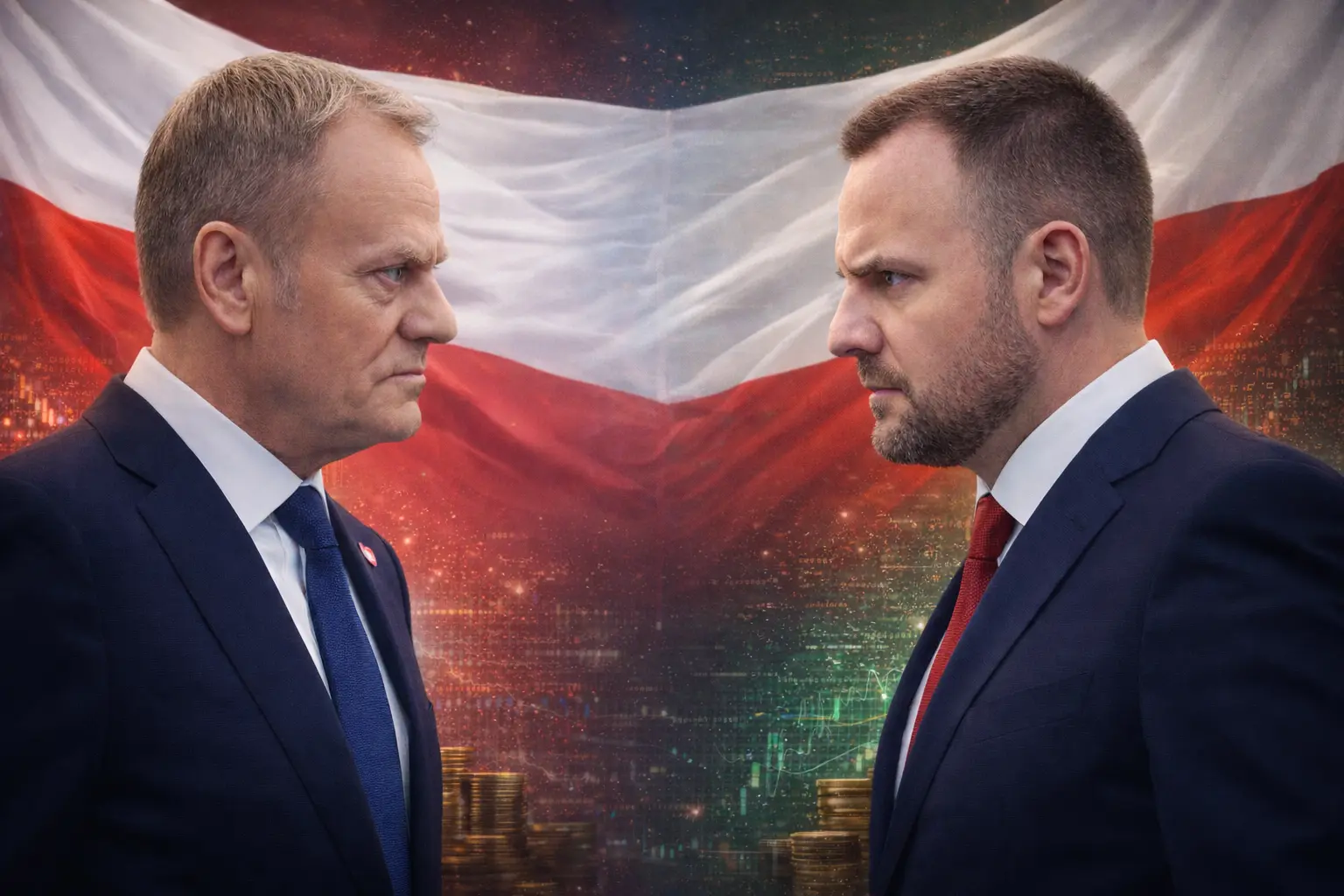
Left image shows Polish Prime Minister Donald Tusk, right image shows President Karol Nawrocki (AI generated)
Author: Zen, PANews
As the year comes to an end, Poland has begun a fierce struggle over cryptocurrency regulation legislation.
On December 9, the Polish government resubmitted the crypto bill, and on December 10, it was again submitted to the Sejm (lower house). The content of the bill is exactly the same as the version recently vetoed by the president, with not a single word changed.
This move has caused a huge stir in Polish politics: the government led by liberal Prime Minister Donald Tusk insists that the bill relates to national security and cannot be delayed, while President Karol Nawrocki, with nationalist overtones, strongly opposes it citing the need to protect citizens’ freedoms and market vitality.
This contest over the crypto asset market legislation will keep Poland among the few EU countries that have not yet enacted domestic laws to implement the MiCA regulation.
Why Poland’s Cryptocurrency Law is “Strictly Regulated”
Poland’s crypto legislation aims to align its national laws with the EU’s MiCA regulation.
The bill establishes a unified regulatory framework for the crypto industry, including clear scope and licensing requirements, anti-money laundering and transparency obligations, consumer protection measures, and the setting of regulatory fees and industry standards.
Specifically, the bill designates the Polish Financial Supervision Authority (KNF) as the primary regulator for the crypto market, requiring all Crypto Asset Service Providers (CASP) to register with and obtain a license from KNF to operate legally. This covers crypto exchanges, custody wallet providers, token issuers, and stablecoin issuers. Service providers must declare their business activities to KNF, undergo regulatory review, and those in violation face sanctions. The bill even introduces criminal liability, with penalties for unlicensed issuance of tokens or provision of crypto services.
Additionally, the bill explicitly incorporates crypto service providers into the anti-money laundering and counter-terrorist financing framework, requiring compliance with AML regulations. This means CASPs must implement KYC (Know Your Customer), suspicious transaction reporting, and other obligations to prevent crypto from being used for illegal financial activities. The bill also enhances reporting and transparency, such as requiring crypto businesses to report transaction data to tax and law enforcement agencies, with strict limits on information obtained from other EU countries, which can only be used for tax, law enforcement, and AML purposes. Through these measures, regulators aim to improve market transparency and strengthen cross-border supervision.
Given the popularity of crypto investment in Poland and frequent risk events, the bill emphasizes investor protection, including stricter rules for crypto advertising and disclosure, requiring tokens to provide clear whitepapers or risk warnings (aligned with MiCA), to prevent false advertising and scams. KNF can swiftly act against suspicious platforms, including blocking related websites. Lawmakers believe these measures help curb scams in the crypto space and protect investor rights and market confidence.
To support regulatory efforts, the bill establishes a fee system for crypto service providers, with licensed firms paying a certain percentage of fees to fund KNF’s daily supervision. However, this provision has been controversial during legislation: the fee levels are set quite high, with the president and opponents questioning whether this will threaten startups’ survival and favor large foreign financial institutions, thereby stifling competition and harming innovation.
The bill runs over 100 pages, detailing compliance requirements and penalties for all aspects such as issuance, trading, and custody of crypto assets, making it notably more detailed than neighboring countries’ shorter legislation. Supporters say this “strict regulation” helps prevent systemic risks, while opponents worry that overly complex rules will increase compliance burdens on businesses.
Historical Context: How the Legislation Deadlock Formed
Public reports suggest Poland’s earliest efforts to incorporate MiCA into its legal system date back to February 2024, when the Ministry of Finance released an initial draft of the crypto market law, opening it for public consultation on the government legislative portal.
Six months later, in August 2024, the government published an updated draft. The new draft adjusted transition periods and license application procedures, such as moving the transition deadline from the original end of 2025 to June 30, 2025, aiming to expedite MiCA’s implementation.
In June this year, the Polish coalition government officially approved the draft of the crypto market law and submitted it to parliament for review. At that time, the ruling coalition was led by Prime Minister Donald Tusk, advocating for quick adoption of EU regulations. The right-wing opposition parties, including Law and Justice (PiS) and the Confederation, were reserved about the bill, but since they were not in power, the legislation proceeded smoothly.
In November 2025, the Sejm voted on and passed the bill. The ruling coalition members, spanning left, center, and right factions, supported it with a stable majority; although the right-wing opposition voted against, they lacked enough seats to block its passage. The bill was then submitted for presidential signature to become law.
However, President Karol Nawrocki announced vetoes of the crypto market law earlier this month. In his official statement, he harshly criticized the bill for threatening citizens’ freedoms, property, and national stability, especially criticizing the vague and easily abused “website blocking” measures, which could infringe on legitimate businesses.
Nawrocki also questioned the length and high regulatory fees of the Polish version, deeming it “overly broad” compared to simpler approaches in neighboring countries, and expressed concern that it could push innovative firms out of Poland. This is a rare case of a Polish president exercising veto power over economic legislation, causing an impasse.
In response to the president’s strong opposition and criticism, the Sejm immediately held a special session to try to override the veto, but failed to secure the three-fifths supermajority required. In the vote, only 243 lawmakers supported overturning the veto, short of the at least 276 votes needed.
Before and after the vote, debates on the bill were heated. Prime Minister Tusk briefed legislators in a closed-door meeting before the vote, warning of “urgent national security concerns,” and posted on X (Twitter) that the vote was a “battle between Russian-backed funds and the safety of the state and citizens.” Tusk stated in parliament: “There is no doubt that this market is highly susceptible to foreign influence, intelligence agencies, and the mafia. The state’s challenge is to provide the necessary tools to ensure it cannot be helpless.”
The pro-government side accused the prime minister of binary thinking, with Zbigniew Bogucki, head of the Presidential Office, stating that opposing the bill should not be equated with supporting Russia’s mafia. Despite intense mobilization by the ruling camp, opposition parties and some hesitant legislators ultimately maintained the veto. Bogucki called for cooperation between the government and the presidency to draft new legislation.
Tusk’s side clearly refused to concede. Just days after the veto, on December 9, the government-led Council of Ministers once again submitted the original bill to parliament for a new legislative process, ignoring presidential objections. Notably, this new version was claimed to be “unchanged,” with no amendments.
The government’s move essentially challenged the president outright, and through media channels called on the president to sign the new law promptly, claiming that continued delays would expose Poland to greater crypto security threats from Russia and other hostile forces. This rare standoff has made the crypto regulation bill a focal point of political rivalry, injecting uncertainty into legislative prospects for the coming months.
Ice and Fire: Behind the Crypto Regulation Dispute
Similar to US President Trump, Polish President Karol Nawrocki pledged during the 2025 presidential campaign to build a crypto-friendly economy, oppose excessive regulation, and gained support from some crypto investors and liberal voters.
Thus, the pro-crypto stance of the president and his supporters (mainly right-wing opposition) is understandable. Their core concern is that overregulation will stifle the market and infringe on freedoms. Nawrocki emphasized in his veto statement that the bill grants regulators overly broad powers, such as allowing KNF to easily block accounts or domains, which he sees as threatening economic freedoms.
The presidential office pointed out that Poland’s version is complex and lengthy, with strict requirements, inconsistent with the simplified approach neighboring countries use when implementing MiCA. Zbigniew Bogucki criticized the bill as “burdensome and contrary to EU legislative intentions.” They cite the Czech Republic, Slovakia, and others, which only produce a few dozen pages to align with MiCA, whereas Poland’s regulations run into hundreds of pages, seen as creating unnecessary bureaucratic hurdles.
Economically, the presidential camp fears high regulatory costs and cumbersome demands that could force local crypto startups to move to Lithuania, Malta, and other more lenient environments. This view is also supported by far-right parties like the Confederation. Sławomir Mentzen, leader of the Confederation, publicly stated that the bill would destroy Poland’s emerging crypto market, and saw the president’s veto as a victory for protecting innovation.
Prime Minister Donald Tusk and the ruling coalition advocate for immediate strengthened regulation to ensure national security and fulfill EU obligations. Tusk repeatedly emphasized that an unregulated crypto market provides opportunities for criminals and hostile actors, easily exploited by foreign intelligence and mafia organizations. He proposed elevating the bill to a national security issue, stating, “Either you stand with Russia’s dirty money and spies, or you support my bill.”
In parliamentary debates, Tusk pointed out that intelligence reports indicate hundreds of crypto companies registered in Poland are connected to Russia and other former Soviet states, claiming that Poland’s crypto market has been infiltrated by Russian influence. He fears that unregulated capital flows could be used for money laundering, supporting sabotage, or sanctions evasion.
The ruling camp also repeatedly cited the high incidence of domestic scams: government officials revealed that since early 2024, over 5,800 crypto-related fraud cases have occurred, with regulatory vacuum leading to a chaotic market resembling the Wild West. They argue that legislative lag equals neglecting consumer safety.
Another major point from Tusk’s government is the EU’s MiCA uniform process: all member states must designate national regulators and issue CASP licenses on time, or their domestic firms will not be able to operate legally within the EU. Deputy Finance Minister Jurand Drop warned that if Poland cannot establish a MiCA framework by July 2026, Polish crypto companies will have to register abroad, and taxes and fees generated from services to Polish customers will flow out of the country. Furthermore, if Polish users encounter issues with foreign licensed exchanges, cross-border legal enforcement will be difficult.
The debate between Poland’s president and prime minister over the crypto law reflects deep divisions on economic regulation orientation, security concepts, and EU integration. The president and right-wing factions prioritize market freedom and oppose excessive government intervention, fearing that such regulation will weaken Poland’s potential as a crypto-friendly market. Conversely, Tusk and the ruling coalition favor strict regulation to ensure stability, believing that properly rigorous rules can purify the market and promote healthy industry development in the long run.
Overall, the controversy over Poland’s crypto law transcends technical details, becoming a political struggle between the ruling coalition and conservative presidential office. Tusk’s government emphasizes maintaining financial order and national security, while President Nawrocki champions protecting free markets and citizens’ rights, wielding veto power as a counterbalance.
The ongoing dispute over the crypto legislation continues. The ruling camp may try to persuade some opposition lawmakers to pass a new version or make concessions in details to secure presidential approval. Conversely, whether the president can balance principles and international pressure remains uncertain.
Regardless of the outcome, this conflict has become a landmark event in Poland’s digital policy history, highlighting the delicate and crucial balance between regulation and freedom, between national sovereignty and EU integration.
View Original
This page may contain third-party content, which is provided for information purposes only (not representations/warranties) and should not be considered as an endorsement of its views by Gate, nor as financial or professional advice. See Disclaimer for details.
Polish Cryptocurrency Regulation Bill "Stalled," Pro-Crypto President and Strict Regulator Prime Minister Engage in Intense "Internal Conflict"
As the year comes to an end, Poland has begun a fierce struggle over cryptocurrency regulation legislation.
On December 9, the Polish government resubmitted the crypto bill, and on December 10, it was again submitted to the Sejm (lower house). The content of the bill is exactly the same as the version recently vetoed by the president, with not a single word changed.
This move has caused a huge stir in Polish politics: the government led by liberal Prime Minister Donald Tusk insists that the bill relates to national security and cannot be delayed, while President Karol Nawrocki, with nationalist overtones, strongly opposes it citing the need to protect citizens’ freedoms and market vitality.
This contest over the crypto asset market legislation will keep Poland among the few EU countries that have not yet enacted domestic laws to implement the MiCA regulation.
Why Poland’s Cryptocurrency Law is “Strictly Regulated”
Poland’s crypto legislation aims to align its national laws with the EU’s MiCA regulation.
The bill establishes a unified regulatory framework for the crypto industry, including clear scope and licensing requirements, anti-money laundering and transparency obligations, consumer protection measures, and the setting of regulatory fees and industry standards.
Specifically, the bill designates the Polish Financial Supervision Authority (KNF) as the primary regulator for the crypto market, requiring all Crypto Asset Service Providers (CASP) to register with and obtain a license from KNF to operate legally. This covers crypto exchanges, custody wallet providers, token issuers, and stablecoin issuers. Service providers must declare their business activities to KNF, undergo regulatory review, and those in violation face sanctions. The bill even introduces criminal liability, with penalties for unlicensed issuance of tokens or provision of crypto services.
Additionally, the bill explicitly incorporates crypto service providers into the anti-money laundering and counter-terrorist financing framework, requiring compliance with AML regulations. This means CASPs must implement KYC (Know Your Customer), suspicious transaction reporting, and other obligations to prevent crypto from being used for illegal financial activities. The bill also enhances reporting and transparency, such as requiring crypto businesses to report transaction data to tax and law enforcement agencies, with strict limits on information obtained from other EU countries, which can only be used for tax, law enforcement, and AML purposes. Through these measures, regulators aim to improve market transparency and strengthen cross-border supervision.
Given the popularity of crypto investment in Poland and frequent risk events, the bill emphasizes investor protection, including stricter rules for crypto advertising and disclosure, requiring tokens to provide clear whitepapers or risk warnings (aligned with MiCA), to prevent false advertising and scams. KNF can swiftly act against suspicious platforms, including blocking related websites. Lawmakers believe these measures help curb scams in the crypto space and protect investor rights and market confidence.
To support regulatory efforts, the bill establishes a fee system for crypto service providers, with licensed firms paying a certain percentage of fees to fund KNF’s daily supervision. However, this provision has been controversial during legislation: the fee levels are set quite high, with the president and opponents questioning whether this will threaten startups’ survival and favor large foreign financial institutions, thereby stifling competition and harming innovation.
The bill runs over 100 pages, detailing compliance requirements and penalties for all aspects such as issuance, trading, and custody of crypto assets, making it notably more detailed than neighboring countries’ shorter legislation. Supporters say this “strict regulation” helps prevent systemic risks, while opponents worry that overly complex rules will increase compliance burdens on businesses.
Historical Context: How the Legislation Deadlock Formed
Public reports suggest Poland’s earliest efforts to incorporate MiCA into its legal system date back to February 2024, when the Ministry of Finance released an initial draft of the crypto market law, opening it for public consultation on the government legislative portal.
Six months later, in August 2024, the government published an updated draft. The new draft adjusted transition periods and license application procedures, such as moving the transition deadline from the original end of 2025 to June 30, 2025, aiming to expedite MiCA’s implementation.
In June this year, the Polish coalition government officially approved the draft of the crypto market law and submitted it to parliament for review. At that time, the ruling coalition was led by Prime Minister Donald Tusk, advocating for quick adoption of EU regulations. The right-wing opposition parties, including Law and Justice (PiS) and the Confederation, were reserved about the bill, but since they were not in power, the legislation proceeded smoothly.
In November 2025, the Sejm voted on and passed the bill. The ruling coalition members, spanning left, center, and right factions, supported it with a stable majority; although the right-wing opposition voted against, they lacked enough seats to block its passage. The bill was then submitted for presidential signature to become law.
However, President Karol Nawrocki announced vetoes of the crypto market law earlier this month. In his official statement, he harshly criticized the bill for threatening citizens’ freedoms, property, and national stability, especially criticizing the vague and easily abused “website blocking” measures, which could infringe on legitimate businesses.
Nawrocki also questioned the length and high regulatory fees of the Polish version, deeming it “overly broad” compared to simpler approaches in neighboring countries, and expressed concern that it could push innovative firms out of Poland. This is a rare case of a Polish president exercising veto power over economic legislation, causing an impasse.
In response to the president’s strong opposition and criticism, the Sejm immediately held a special session to try to override the veto, but failed to secure the three-fifths supermajority required. In the vote, only 243 lawmakers supported overturning the veto, short of the at least 276 votes needed.
Before and after the vote, debates on the bill were heated. Prime Minister Tusk briefed legislators in a closed-door meeting before the vote, warning of “urgent national security concerns,” and posted on X (Twitter) that the vote was a “battle between Russian-backed funds and the safety of the state and citizens.” Tusk stated in parliament: “There is no doubt that this market is highly susceptible to foreign influence, intelligence agencies, and the mafia. The state’s challenge is to provide the necessary tools to ensure it cannot be helpless.”
The pro-government side accused the prime minister of binary thinking, with Zbigniew Bogucki, head of the Presidential Office, stating that opposing the bill should not be equated with supporting Russia’s mafia. Despite intense mobilization by the ruling camp, opposition parties and some hesitant legislators ultimately maintained the veto. Bogucki called for cooperation between the government and the presidency to draft new legislation.
Tusk’s side clearly refused to concede. Just days after the veto, on December 9, the government-led Council of Ministers once again submitted the original bill to parliament for a new legislative process, ignoring presidential objections. Notably, this new version was claimed to be “unchanged,” with no amendments.
The government’s move essentially challenged the president outright, and through media channels called on the president to sign the new law promptly, claiming that continued delays would expose Poland to greater crypto security threats from Russia and other hostile forces. This rare standoff has made the crypto regulation bill a focal point of political rivalry, injecting uncertainty into legislative prospects for the coming months.
Ice and Fire: Behind the Crypto Regulation Dispute
Similar to US President Trump, Polish President Karol Nawrocki pledged during the 2025 presidential campaign to build a crypto-friendly economy, oppose excessive regulation, and gained support from some crypto investors and liberal voters.
Thus, the pro-crypto stance of the president and his supporters (mainly right-wing opposition) is understandable. Their core concern is that overregulation will stifle the market and infringe on freedoms. Nawrocki emphasized in his veto statement that the bill grants regulators overly broad powers, such as allowing KNF to easily block accounts or domains, which he sees as threatening economic freedoms.
The presidential office pointed out that Poland’s version is complex and lengthy, with strict requirements, inconsistent with the simplified approach neighboring countries use when implementing MiCA. Zbigniew Bogucki criticized the bill as “burdensome and contrary to EU legislative intentions.” They cite the Czech Republic, Slovakia, and others, which only produce a few dozen pages to align with MiCA, whereas Poland’s regulations run into hundreds of pages, seen as creating unnecessary bureaucratic hurdles.
Economically, the presidential camp fears high regulatory costs and cumbersome demands that could force local crypto startups to move to Lithuania, Malta, and other more lenient environments. This view is also supported by far-right parties like the Confederation. Sławomir Mentzen, leader of the Confederation, publicly stated that the bill would destroy Poland’s emerging crypto market, and saw the president’s veto as a victory for protecting innovation.
Prime Minister Donald Tusk and the ruling coalition advocate for immediate strengthened regulation to ensure national security and fulfill EU obligations. Tusk repeatedly emphasized that an unregulated crypto market provides opportunities for criminals and hostile actors, easily exploited by foreign intelligence and mafia organizations. He proposed elevating the bill to a national security issue, stating, “Either you stand with Russia’s dirty money and spies, or you support my bill.”
In parliamentary debates, Tusk pointed out that intelligence reports indicate hundreds of crypto companies registered in Poland are connected to Russia and other former Soviet states, claiming that Poland’s crypto market has been infiltrated by Russian influence. He fears that unregulated capital flows could be used for money laundering, supporting sabotage, or sanctions evasion.
The ruling camp also repeatedly cited the high incidence of domestic scams: government officials revealed that since early 2024, over 5,800 crypto-related fraud cases have occurred, with regulatory vacuum leading to a chaotic market resembling the Wild West. They argue that legislative lag equals neglecting consumer safety.
Another major point from Tusk’s government is the EU’s MiCA uniform process: all member states must designate national regulators and issue CASP licenses on time, or their domestic firms will not be able to operate legally within the EU. Deputy Finance Minister Jurand Drop warned that if Poland cannot establish a MiCA framework by July 2026, Polish crypto companies will have to register abroad, and taxes and fees generated from services to Polish customers will flow out of the country. Furthermore, if Polish users encounter issues with foreign licensed exchanges, cross-border legal enforcement will be difficult.
The debate between Poland’s president and prime minister over the crypto law reflects deep divisions on economic regulation orientation, security concepts, and EU integration. The president and right-wing factions prioritize market freedom and oppose excessive government intervention, fearing that such regulation will weaken Poland’s potential as a crypto-friendly market. Conversely, Tusk and the ruling coalition favor strict regulation to ensure stability, believing that properly rigorous rules can purify the market and promote healthy industry development in the long run.
Overall, the controversy over Poland’s crypto law transcends technical details, becoming a political struggle between the ruling coalition and conservative presidential office. Tusk’s government emphasizes maintaining financial order and national security, while President Nawrocki champions protecting free markets and citizens’ rights, wielding veto power as a counterbalance.
The ongoing dispute over the crypto legislation continues. The ruling camp may try to persuade some opposition lawmakers to pass a new version or make concessions in details to secure presidential approval. Conversely, whether the president can balance principles and international pressure remains uncertain.
Regardless of the outcome, this conflict has become a landmark event in Poland’s digital policy history, highlighting the delicate and crucial balance between regulation and freedom, between national sovereignty and EU integration.