The article explores the investment comparison between Ramifi Protocol (RAM) and Stacks (STX) in the cryptocurrency market, evaluating historical price trends, supply mechanisms, and market performance to guide investors on the better buy. It addresses key factors such as AI-driven demand, storage sector dynamics, and export controls affecting these cryptocurrencies. Tailored for both new and experienced investors, the article discusses long-term and short-term strategies, risk management, and provides price predictions for 2025-2030. Designed for quick reading, it highlights the core differences and advantages of each investment.
Introduction: RAM vs STX Investment Comparison
In the cryptocurrency market, the comparison between Ramifi Protocol (RAM) and Stacks (STX) has been an unavoidable topic for investors. The two not only show significant differences in market cap ranking, application scenarios, and price performance, but also represent different positioning in the crypto asset space.
Ramifi Protocol (RAM): Launched in 2021, it has gained market recognition for its algorithmic stablecoin approach that maintains dynamic balance without anchoring to any asset.
Stacks (STX): Introduced in 2019, it has been hailed as a new decentralized internet for applications, aiming to become the "Google" of blockchain with its three-layer architecture.
This article will comprehensively analyze the investment value comparison between RAM and STX, focusing on historical price trends, supply mechanisms, institutional adoption, technical ecosystems, and future predictions, attempting to answer the question investors care about most:
"Which is the better buy right now?"
I. Price History Comparison and Current Market Status
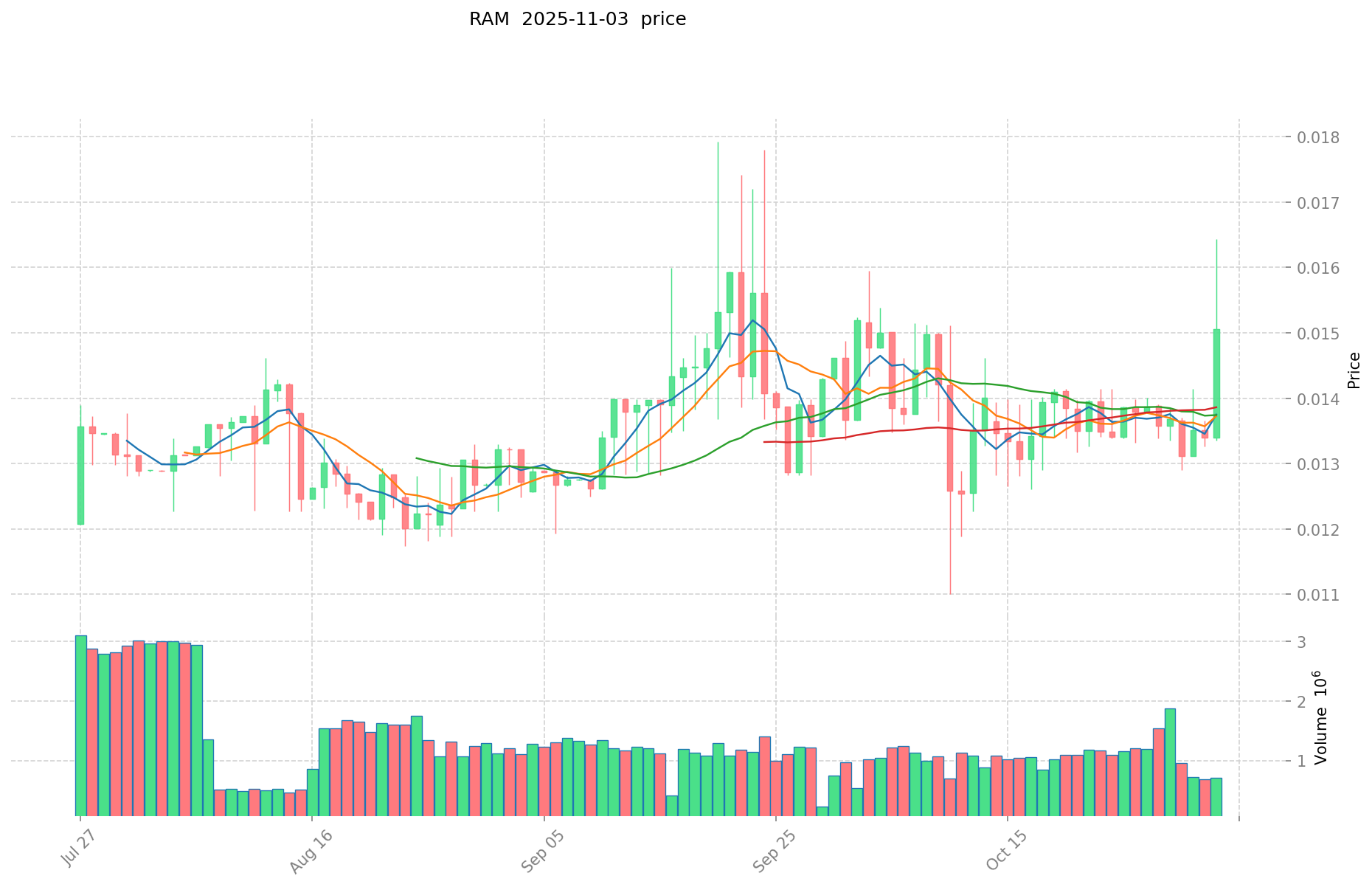
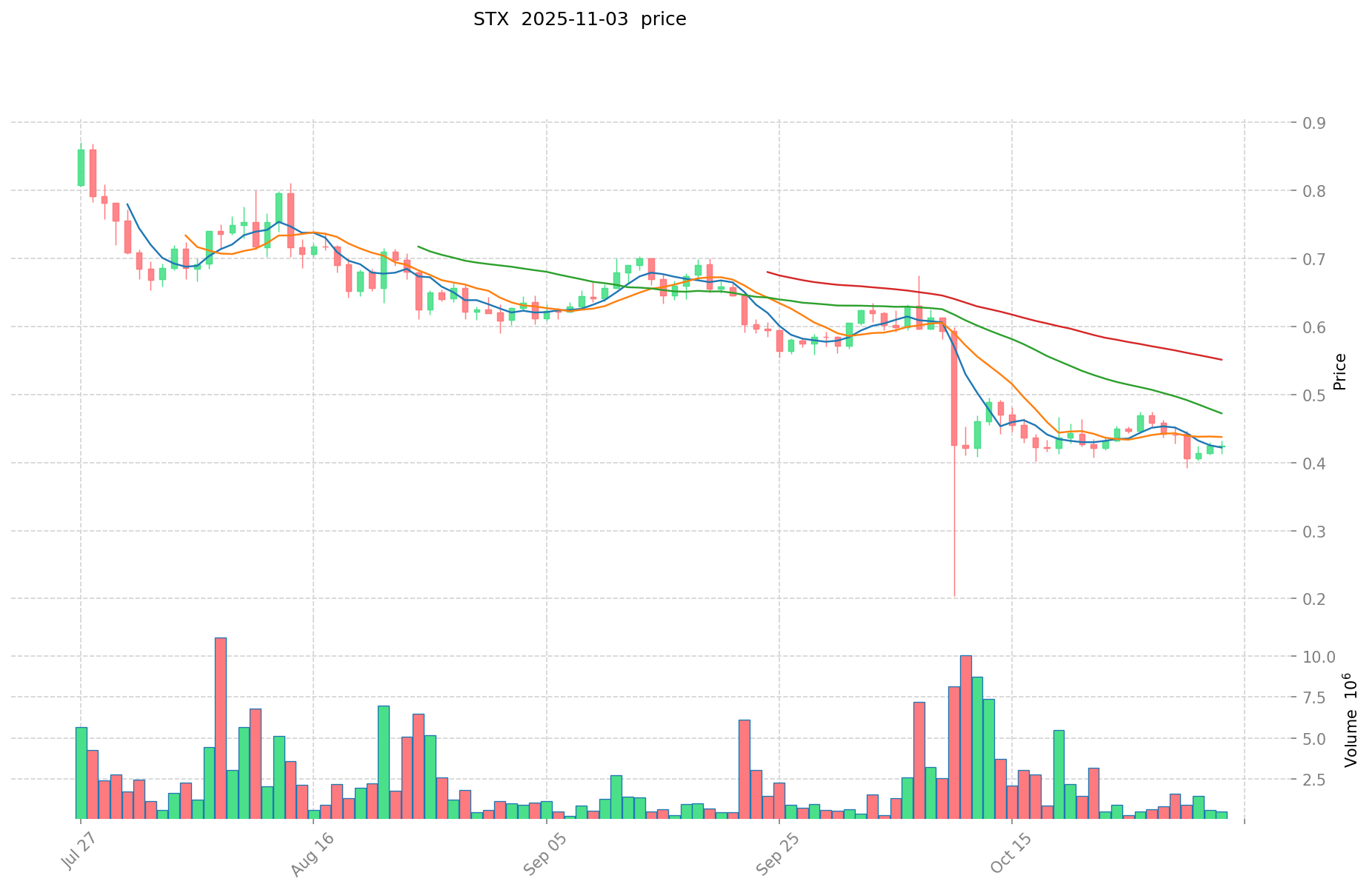
RAM and STX Historical Price Trends
- 2021: STX reached its all-time high of $3.86 due to increased adoption and market optimism.
- 2024: RAM hit its all-time high of $3.85, likely influenced by broader market trends.
- Comparative analysis: During the recent market cycle, STX dropped from $3.86 to a low of $0.31, while RAM fell from $3.85 to $0.0053, showing more significant volatility.
Current Market Situation (2025-11-04)
- RAM current price: $0.013599
- STX current price: $0.3727
- 24-hour trading volume: RAM $8,427 vs STX $598,551
- Market Sentiment Index (Fear & Greed Index): 42 (Fear)
Click to view real-time prices:
- Check RAM current price Market Price
- Check STX current price Market Price
II. Core Factors Influencing Storage Sector Investment Value
AI-Driven Demand and Market Dynamics
- Seagate (STX): Hard drive advantages in price, supply, and workload capabilities position it strongly in AI-dominated markets
- Storage Industry: Memory chip sector performing strongly due to AI boom, with structural opportunities emerging especially for AI server storage
- 📌 Historical Pattern: Storage market has completed its 2023 inventory adjustment period and entered a phase of inventory growth
Price Trends and Supply Constraints
- Price Increases: SanDisk announced 10%+ price hikes from April 2023, with quarterly increases planned, triggering industry-wide price increases
- Production Cuts: Major NAND manufacturers implementing 10-15% production cuts in H1 2025 to drive prices up
- Supply Shortages: Analysts predict NAND supply shortages will continue until late 2025 or 2026
- Stock Performance: Significant growth across the sector - SanDisk (+365%), Seagate (+122%), Western Digital (+107%), Micron (+56%)
- Market Share: In NAND flash market, five companies (Samsung, SK Hynix, Western Digital, Kioxia, Micron) control approximately 95% of market share
- Technical Advantages: Companies with technological edges like Western Digital and Seagate expected to outperform industry average growth
Export Controls and Global Supply Chain
- US Export Restrictions: Creating supply-demand imbalances in the storage industry
- Production Disruption: Samsung and SK Hynix facing risks at their NAND factories in China
- Market Opportunity: Companies like SanDisk and Micron positioned to capture market share from competitors facing production constraints
III. 2025-2030 Price Prediction: RAM vs STX
Short-term Prediction (2025)
- RAM: Conservative $0.0076384 - $0.01364 | Optimistic $0.01364 - $0.0189596
- STX: Conservative $0.215934 - $0.3723 | Optimistic $0.3723 - $0.443037
Mid-term Prediction (2027)
- RAM may enter a growth phase, with expected price range of $0.0143682737 - $0.01954753515
- STX may enter a bullish market, with expected price range of $0.3972321864 - $0.6757513056
- Key drivers: Institutional capital inflow, ETF, ecosystem development
Long-term Prediction (2030)
- RAM: Base scenario $0.02304492959947 - $0.027884364815359 | Optimistic scenario $0.027884364815359+
- STX: Base scenario $0.403008873831244 - $0.71965870327008 | Optimistic scenario $0.71965870327008 - $1.014718771610812
View detailed price predictions for RAM and STX
Disclaimer: The above predictions are based on historical data and market analysis. Cryptocurrency markets are highly volatile and subject to change. This information should not be considered as financial advice.
RAM:
| 年份 |
预测最高价 |
预测平均价格 |
预测最低价 |
涨跌幅 |
| 2025 |
0.0189596 |
0.01364 |
0.0076384 |
0 |
| 2026 |
0.01711479 |
0.0162998 |
0.01385483 |
19 |
| 2027 |
0.01954753515 |
0.016707295 |
0.0143682737 |
22 |
| 2028 |
0.02012143073325 |
0.018127415075 |
0.0134142871555 |
33 |
| 2029 |
0.026965436294816 |
0.019124422904125 |
0.015108294094258 |
40 |
| 2030 |
0.027884364815359 |
0.02304492959947 |
0.020740436639523 |
69 |
STX:
| 年份 |
预测最高价 |
预测平均价格 |
预测最低价 |
涨跌幅 |
| 2025 |
0.443037 |
0.3723 |
0.215934 |
0 |
| 2026 |
0.50550894 |
0.4076685 |
0.36690165 |
9 |
| 2027 |
0.6757513056 |
0.45658872 |
0.3972321864 |
22 |
| 2028 |
0.696389115744 |
0.5661700128 |
0.407642409216 |
51 |
| 2029 |
0.80803784226816 |
0.631279564272 |
0.58708999477296 |
69 |
| 2030 |
1.014718771610812 |
0.71965870327008 |
0.403008873831244 |
93 |
IV. Investment Strategy Comparison: RAM vs STX
Long-term vs Short-term Investment Strategy
- RAM: Suitable for investors focused on algorithmic stablecoin approaches and potential ecosystem growth
- STX: Suitable for investors interested in decentralized internet applications and blockchain infrastructure
Risk Management and Asset Allocation
- Conservative investors: RAM: 20% vs STX: 80%
- Aggressive investors: RAM: 40% vs STX: 60%
- Hedging tools: Stablecoin allocation, options, cross-currency combinations
V. Potential Risk Comparison
Market Risk
- RAM: Higher volatility and potential for significant price swings
- STX: Exposure to overall blockchain and decentralized application market trends
Technical Risk
- RAM: Scalability, network stability, and algorithmic stablecoin mechanism reliability
- STX: Adoption rate of decentralized internet applications, network congestion
Regulatory Risk
- Global regulatory policies may have differing impacts on algorithmic stablecoins (RAM) and blockchain infrastructure projects (STX)
VI. Conclusion: Which Is the Better Buy?
📌 Investment Value Summary:
- RAM advantages: Innovative algorithmic stablecoin approach, potential for high growth
- STX advantages: Established ecosystem, focus on decentralized internet applications, potential for long-term adoption
✅ Investment Advice:
- New investors: Consider a smaller allocation to RAM and a larger position in STX for better stability
- Experienced investors: Balanced approach with both RAM and STX, adjusting based on risk tolerance
- Institutional investors: Focus on STX for its more established ecosystem and potential integration with traditional internet infrastructure
⚠️ Risk Warning: Cryptocurrency markets are highly volatile. This article does not constitute investment advice.
None
VII. FAQ
Q1: What are the key differences between RAM and STX?
A: RAM is an algorithmic stablecoin project launched in 2021, while STX is a decentralized internet platform introduced in 2019. RAM focuses on maintaining a dynamic balance without asset anchoring, whereas STX aims to become the "Google" of blockchain with its three-layer architecture for decentralized applications.
Q2: Which cryptocurrency has shown better price stability?
A: Based on historical data, STX has demonstrated relatively better price stability. During the recent market cycle, STX dropped from $3.86 to a low of $0.31, while RAM fell from $3.85 to $0.0053, showing more significant volatility.
Q3: What are the current market prices and trading volumes for RAM and STX?
A: As of 2025-11-04, RAM's price is $0.013599 with a 24-hour trading volume of $8,427. STX's price is $0.3727 with a 24-hour trading volume of $598,551.
Q4: What are the long-term price predictions for RAM and STX by 2030?
A: For RAM, the base scenario predicts a range of $0.02304492959947 - $0.027884364815359, with an optimistic scenario above $0.027884364815359. For STX, the base scenario predicts $0.403008873831244 - $0.71965870327008, with an optimistic scenario of $0.71965870327008 - $1.014718771610812.
Q5: How should investors allocate their portfolio between RAM and STX?
A: Conservative investors might consider allocating 20% to RAM and 80% to STX, while aggressive investors could opt for 40% RAM and 60% STX. The exact allocation should be based on individual risk tolerance and investment goals.
Q6: What are the main risks associated with investing in RAM and STX?
A: Key risks include market volatility, technical challenges (such as scalability and network stability), and regulatory uncertainties. RAM may face higher volatility and risks related to its algorithmic stablecoin mechanism, while STX is exposed to risks associated with the adoption rate of decentralized internet applications.
Q7: Which cryptocurrency is recommended for new investors?
A: For new investors, STX may be a more suitable option due to its more established ecosystem and relatively better stability. It's recommended to allocate a larger position to STX and a smaller allocation to RAM if considering both.
Q8: How do global regulatory policies affect RAM and STX differently?
A: Regulatory policies may have differing impacts on RAM and STX. As an algorithmic stablecoin, RAM might face more scrutiny from regulators concerned about stablecoin oversight. STX, being a blockchain infrastructure project, may be affected by broader cryptocurrency regulations but might be viewed more favorably due to its focus on decentralized internet applications.
* The information is not intended to be and does not constitute financial advice or any other recommendation of any sort offered or endorsed by Gate.












