WAT vs ETH: Comparing Two Leading Blockchain Tokens in the Crypto Market

Introduction: WAT vs ETH Investment Comparison
In the cryptocurrency market, WAT vs ETH comparison has always been an unavoidable topic for investors. The two assets not only exhibit significant differences in market capitalization ranking, use cases, and price performance, but also represent different positioning in the crypto asset landscape. WAT (WAT): A community-first token built on TON and backed by TON Ventures, it functions as a meme-powered IP designed to build the next major Web3 brand by leveraging Telegram's massive user base through a combination of casual gaming and meme culture. ETH (Ethereum): Since its inception in 2015, Ethereum has been recognized as a decentralized, open-source blockchain platform that supports smart contracts and decentralized applications (DApps). It operates via Ether and facilitates both the functioning of various cryptocurrencies and the execution of decentralized smart contracts. This article will provide a comprehensive analysis of the investment value comparison between WAT and ETH across historical price trends, supply mechanisms, market positioning, and technical ecosystems, while attempting to address the question that investors care most about:
"Which is the better buy right now?"
I. Price History Comparison and Current Market Status
WatBird (WAT) and Ethereum (ETH) Historical Price Trends
- September 2024: WatBird (WAT) launched on Gate Startup platform, with initial distribution price of $0.000717. The token experienced significant volatility following its debut.
- August 2025: Ethereum (ETH) reached an all-time high of $4,946.05, demonstrating strong market momentum driven by institutional adoption and ETF inflows.
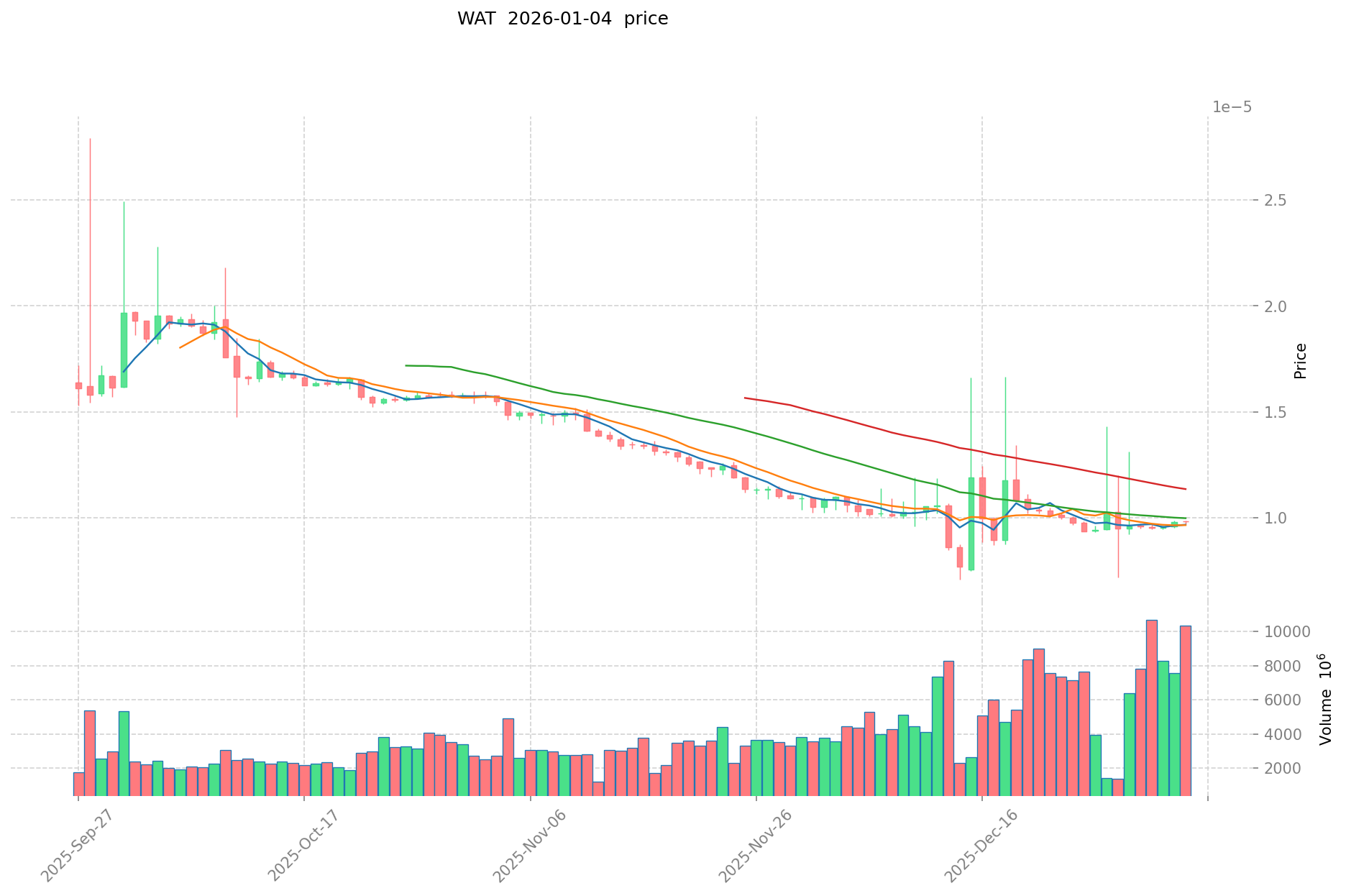
- Comparative Analysis: From its inception through December 2025, WAT declined from its historical peak of $0.00217 (September 23, 2024) to a low of $0.000007084 (December 14, 2025), representing a 94.25% yearly decline. In contrast, ETH experienced a -13.020% change over one year but maintained substantially higher absolute value and market capitalization.
Current Market Status (January 4, 2026)
- WAT current price: $0.000009879.
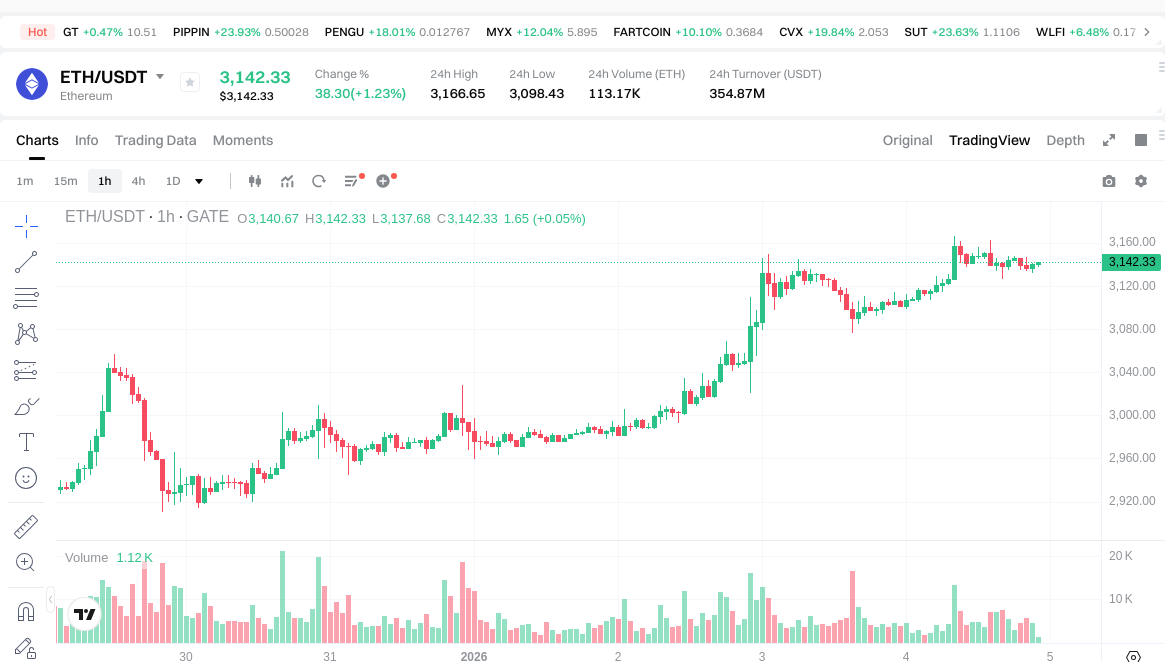
- ETH current price: $3,140.05.
- 24-hour trading volume: WAT $140,066.50 vs ETH $353,658,488.68.
- Market Sentiment Index (Fear & Greed Index): 29 (Fear).
Check real-time prices:
- View WAT current price Market Price.
- View ETH current price Market Price.
二、影响 WAT vs ETH 投资价值的核心因素
供应机制对比(Tokenomics)
Based on the reference materials provided, specific tokenomics details for WAT and ETH are not comprehensively documented. This section would require additional technical documentation to complete accurately.
机构采用与市场应用
Ethereum (ETH) 机构持仓与应用: Ethereum demonstrates significant institutional adoption through its extensive DeFi ecosystem and smart contract infrastructure. According to valuation analysis from ultrasound.money, ETH currently trades at approximately 92x P/E ratio, compared to 48x at the beginning of the year, indicating shifts in market valuation relative to network revenue generation.
WAT 协议应用特性: WAT protocol establishes a Real-World Assets (RWA) value exchange protocol layer through heterogeneous multi-chain architecture. The protocol integrates dynamic pricing mechanisms with zero-knowledge verification frameworks, enabling efficient liquidity conversion of traditional assets and on-chain yield verifiability.
技术发展与生态建设
ETH 技术与生态: Ethereum maintains a robust ecosystem supporting DeFi protocols, NFT infrastructure, and smart contract applications. Network activity and application development directly influence ETH's value proposition and adoption rates.
WAT 技术创新: WAT's technical breakthrough is characterized by:
I. Integration of dynamic pricing mechanisms and zero-knowledge verification frameworks for efficient traditional asset liquidity conversion II. On-chain yield verifiability for RWA transactions III. Heterogeneous multi-chain architecture enabling cross-chain value exchange
WAT's value proposition primarily depends on liquidity protocol efficiency and continuous technological innovation within the RWA sector.
宏观经济与市场周期
Cryptocurrency token values are influenced by multiple macroeconomic factors including market conditions, investor sentiment, regulatory developments, and technological advances. Supply-demand dynamics determine pricing, with values potentially experiencing significant volatility based on these varied influencing factors.
III. 2026-2031 Price Prediction: WAT vs ETH
Short-term Prediction (2026)
- WAT: Conservative $0.00000923 - $0.00001478 | Bullish $0.00001478 - $0.00001478
- ETH: Conservative $1,788.84 - $3,138.31 | Bullish $3,138.31 - $3,295.23
Medium-term Prediction (2027-2029)
- WAT may enter early growth phase, estimated price range $0.00000964 - $0.00002041
- ETH may enter accumulation phase, estimated price range $1,833.56 - $4,907.38
- Key drivers: institutional capital inflows, ETF products, ecosystem development
Long-term Prediction (2030-2031)
- WAT: Base case $0.000013624 - $0.000022334 | Bullish case $0.000027248 - $0.000027248
- ETH: Base case $3,626.47 - $4,669.08 | Bullish case $4,995.92 - $4,995.92
WAT:
| 年份 | 预测最高价 | 预测平均价格 | 预测最低价 | 涨跌幅 |
|---|---|---|---|---|
| 2026 | 0.00001478378 | 0.000009922 | 0.00000922746 | 0 |
| 2027 | 0.0000142058235 | 0.00001235289 | 0.0000096352542 | 25 |
| 2028 | 0.00001912227372 | 0.00001327935675 | 0.000010889072535 | 34 |
| 2029 | 0.000020413027196 | 0.000016200815235 | 0.000009882497293 | 63 |
| 2030 | 0.00002636196655 | 0.000018306921215 | 0.000010434945092 | 85 |
| 2031 | 0.000027248021537 | 0.000022334443883 | 0.000013624010768 | 126 |
ETH:
| 年份 | 预测最高价 | 预测平均价格 | 预测最低价 | 涨跌幅 |
|---|---|---|---|---|
| 2026 | 3295.2255 | 3138.31 | 1788.8367 | 0 |
| 2027 | 4310.468785 | 3216.76775 | 1833.5576175 | 2 |
| 2028 | 4553.978103675 | 3763.6182675 | 3500.164988775 | 19 |
| 2029 | 4907.38185899325 | 4158.7981855875 | 3826.0943307405 | 32 |
| 2030 | 4805.0754236277975 | 4533.090022290375 | 3626.4720178323 | 44 |
| 2031 | 4995.918513566222287 | 4669.08272295908625 | 3968.720314515223312 | 48 |
WAT vs ETH Investment Comparison
IV. Investment Strategy Comparison: WAT vs ETH
Long-term vs Short-term Investment Strategy
- WAT: Suitable for investors focused on emerging RWA (Real-World Assets) protocol opportunities and seeking exposure to early-stage meme-powered Web3 projects leveraging Telegram's ecosystem
- ETH: Suitable for investors seeking established smart contract infrastructure exposure, institutional adoption benefits, and DeFi ecosystem maturity with relatively lower volatility
Risk Management and Asset Allocation
- Conservative Investors: WAT 0% vs ETH 70-80% allocation, with remaining portfolio in stablecoins and traditional assets
- Aggressive Investors: WAT 10-20% vs ETH 50-60% allocation, with remaining portfolio allocated to emerging protocols or diversified altcoins
- Hedging Tools: Stablecoin positioning for volatility management, options strategies for downside protection, cross-asset diversification between established layer-1 protocols and emerging RWA solutions
V. Potential Risk Comparison
Market Risk
- WAT: Extreme price volatility with 94.25% yearly decline from peak to December 2025; limited trading liquidity ($140,066.50 daily volume); high susceptibility to sentiment shifts and community-driven volatility
- ETH: Moderate market risk with -13.020% yearly change; substantial trading liquidity ($353,658,488.68 daily volume); exposure to macro cryptocurrency market cycles and regulatory developments
Technology Risk
- WAT: Reliance on TON blockchain infrastructure; dependency on continuous RWA protocol innovation; heterogeneous multi-chain architecture complexity; limited historical track record and protocol maturation
- ETH: Smart contract vulnerabilities and potential security exploits; network congestion during high activity periods; dependency on ongoing technical upgrades and layer-2 scaling solutions
Regulatory Risk
- Global regulatory frameworks increasingly scrutinizing meme tokens and community-driven assets, potentially impacting WAT's positioning
- Ethereum faces regulatory clarity opportunities through ETF approvals and institutional frameworks, though DeFi and staking mechanisms remain subject to evolving regulatory interpretation across jurisdictions
VI. Conclusion: Which Is the Better Buy?
📌 Investment Value Summary
- WAT Advantages: Early-stage RWA protocol exposure with dynamic pricing and zero-knowledge verification innovations; community-first token positioning backed by TON Ventures; potential upside from 126% cumulative growth projected through 2031; lower absolute entry price enabling larger position sizes
- ETH Advantages: Established smart contract platform with proven institutional adoption; robust DeFi ecosystem generating consistent network revenue; significantly higher trading liquidity and price stability; institutional infrastructure maturity demonstrated through ETF inflows and enterprise applications; projected 48% cumulative growth through 2031 with lower volatility profile
✅ Investment Recommendations
- Beginner Investors: Prioritize ETH for ecosystem stability, institutional credibility, and reduced execution risk; WAT involvement should be limited to small exploratory positions (under 5% of crypto portfolio) given extreme volatility and market immaturity
- Experienced Investors: Consider WAT as speculative allocation (10-20% of high-risk portfolio segment) for RWA protocol exposure; maintain ETH as core holding for portfolio stability and institutional market participation; employ stop-loss strategies for WAT positions given downside volatility
- Institutional Investors: ETH represents primary allocation given regulatory clarity, liquidity infrastructure, and institutional custody solutions; WAT may warrant small exploratory positions only after comprehensive RWA protocol due diligence and risk assessment
⚠️ Risk Disclaimer: Cryptocurrency markets exhibit extreme volatility, and token values are subject to significant fluctuations based on market conditions, regulatory developments, and technological advances. This analysis does not constitute investment advice. All cryptocurrency investments carry substantial risk of loss. Conduct independent research and consult financial advisors before making investment decisions.
FAQ
WAT是什么?与以太坊(ETH)有什么区别?
WAT是以太坊网络的实用代币,主要用于支付交易费用和参与生态治理。ETH是以太坊区块链的原生加密货币,二者在用途、供应量和功能上存在差异。WAT更专注于特定应用场景,而ETH是整个以太坊生态的基础资产。
WAT和ETH在交易费用(Gas费)上有什么差异?
WAT使用本币计费Gas费,而ETH的Gas费以ETH计价且价格波动。WAT的交易费用相对稳定透明,ETH则受网络拥堵影响较大。
WAT和ETH的性能和交易速度对比如何?
ETH作为以太坊主链,交易速度稳定但受网络拥堵影响。WAT在性能优化后,交易速度和吞吐量均有显著提升,处理能力更强,交易确认更快。
WAT和ETH各自的生态应用和项目支持情况如何?
ETH生态应用最为成熟,支持智能合约和数千个去中心化应用。WAT支持跨链迁移和DAO治理,专注于现实资产上链。两者都有活跃的生态项目支撑。
从安全性角度,WAT和ETH有什么区别?
WAT基于以太坊区块链,继承ETH的安全性优势。ETH作为原生资产,具有最高的网络共识保障。WAT作为智能合约代币,安全性取决于合约代码质量和审计程度。两者均受益于以太坊的去中心化安全机制。
作为投资者,应该如何选择WAT还是ETH?
ETH具有更成熟的市场基础和广泛的生态应用,WAT作为新兴资产缺乏充分的市场验证。若追求稳健收益选ETH,若看好新兴潜力可配置WAT,建议根据风险承受能力合理配置。
Share
Content
How to Buy Cryptocurrency


Trending Cryptocurrencies



Moonshot Crypto Coins

Will Crypto Recover in 2025?

Mog Coin Whitepaper Analysis: From Meme to $1.5B Market Cap in 2024

Laser Eyes Meme: The Bullish Signal Crypto Traders Still Watch

What Is Copium? And Why Crypto Traders Keep Inhaling It

Best Crypto To Buy: List 2025

Gibt es Steuern auf Krypto in der Türkei?

10 NFT Games to Play-to-Earn in Recent Years

All About NFT Whitelists and How to Get Whitelisted in 3 Easy Steps

Marina Protocol Daily Quiz Answer for 8 january 2026

Spur Protocol Daily Quiz Answer Today 8 january 2026