What is OBOL: Exploring the Decentralized Staking Protocol for Ethereum

2025-11-21 14:42:53
Blockchain
Crypto staking
Ethereum
Layer 2
Web 3.0
Article Rating : 4.6
half-star
0 ratings
Explore Obol's decentralized staking protocol, transforming Ethereum validation through distributed validators. Addressing decentralization challenges, Obol enhances security, performance, and rewards within Web3. Key topics include its technical architecture, market performance, and ecosystem applications. Obol's significant adoption and strategic partnerships establish it as a pivotal player in decentralized infrastructure. Whether you aim to participate in validation or access its secure solutions, this article provides valuable insights into Obol's role in shaping blockchain innovations. Purchase OBOL on Gate and dive deep into the future of crypto infrastructure.
What is OBOL: Exploring the Decentralized Staking Protocol for Ethereum

Obol's Positioning and Significance

In 2025, Obol (OBOL) was launched to address the challenges of decentralizing and democratizing digital infrastructure, starting with Ethereum and expanding to all of Web3. As the foundation for Layer 1 blockchains and decentralized infrastructure networks, Obol plays a crucial role in the realm of decentralized systems and blockchain infrastructure.

As of 2025, Obol has become a key player in the decentralized operator ecosystem, with over 800 operators globally running Obol Distributed Validators (DVs) to secure more than $1B on mainnet. This article will delve into its technical architecture, market performance, and future potential.

Origins and Development History

Birth Background

Obol was created in 2025 to solve the challenges of centralized digital infrastructure and the need for more robust, decentralized validator systems. It emerged during the expanding Web3 ecosystem, aiming to empower anyone to run high-performance, slashing-resistant validators.

Obol's introduction brought new possibilities for decentralized operators and blockchain networks seeking enhanced security and performance.

Important Milestones

  • 2025: Mainnet launch, achieving the implementation of Distributed Validators (DVs) for enhanced blockchain security.
  • 2025: Major adoption milestone, with over 800 decentralized operators globally running Obol DVs.
  • 2025: Ecosystem expansion, securing more than $1B on mainnet through its distributed validator technology.

With the support of its collective and growing ecosystem, Obol continues to optimize its technology, security, and real-world applications in decentralized infrastructure.

How Does Obol Work?

No Central Control

Obol operates on a decentralized network of computers (nodes) spread across the globe, free from control by any single entity. These nodes collaborate to validate transactions, ensuring system transparency and attack resistance, granting users greater autonomy and enhancing network resilience.

Blockchain Core

Obol's blockchain is a public, immutable digital ledger that records every transaction. Transactions are grouped into blocks and linked through cryptographic hashes to form a secure chain. Anyone can view the records, establishing trust without intermediaries.

Obol's unique Distributed Validator technology further enhances performance and security of the underlying blockchain networks it supports.

Ensuring Fairness

Obol employs a distributed consensus mechanism through its Distributed Validators (DVs) to validate transactions and prevent fraudulent activities. Operators maintain network security by running DVs, which offer better performance, fewer risks, and greater rewards compared to traditional validators.

Its innovation includes enabling high-performance, slashing-resistant validators accessible to a wider range of participants.

Secure Transactions

Obol utilizes public-private key encryption to protect transactions:

  • Private keys (like secret passwords) are used to sign transactions
  • Public keys (like account numbers) are used to verify ownership

This mechanism ensures fund security while transactions maintain a level of pseudonymity. Obol's Distributed Validator technology adds an extra layer of security by distributing the validation process across multiple operators.

OBOL's Market Performance

Circulation Overview

As of November 21, 2025, OBOL's circulating supply is 132,700,000 tokens, with a total supply of 500,000,000. The maximum supply is capped at 500,000,000 tokens, indicating a fixed supply model.

Price Fluctuations

OBOL reached its all-time high of $0.4211 on May 7, 2025, likely driven by broader market trends or significant project developments.

Its lowest price of $0.05659 occurred on November 21, 2025, possibly due to market-wide corrections or specific project-related factors.

These fluctuations reflect market sentiment, adoption trends, and external factors impacting the cryptocurrency space.

Click to view the current market price of OBOL
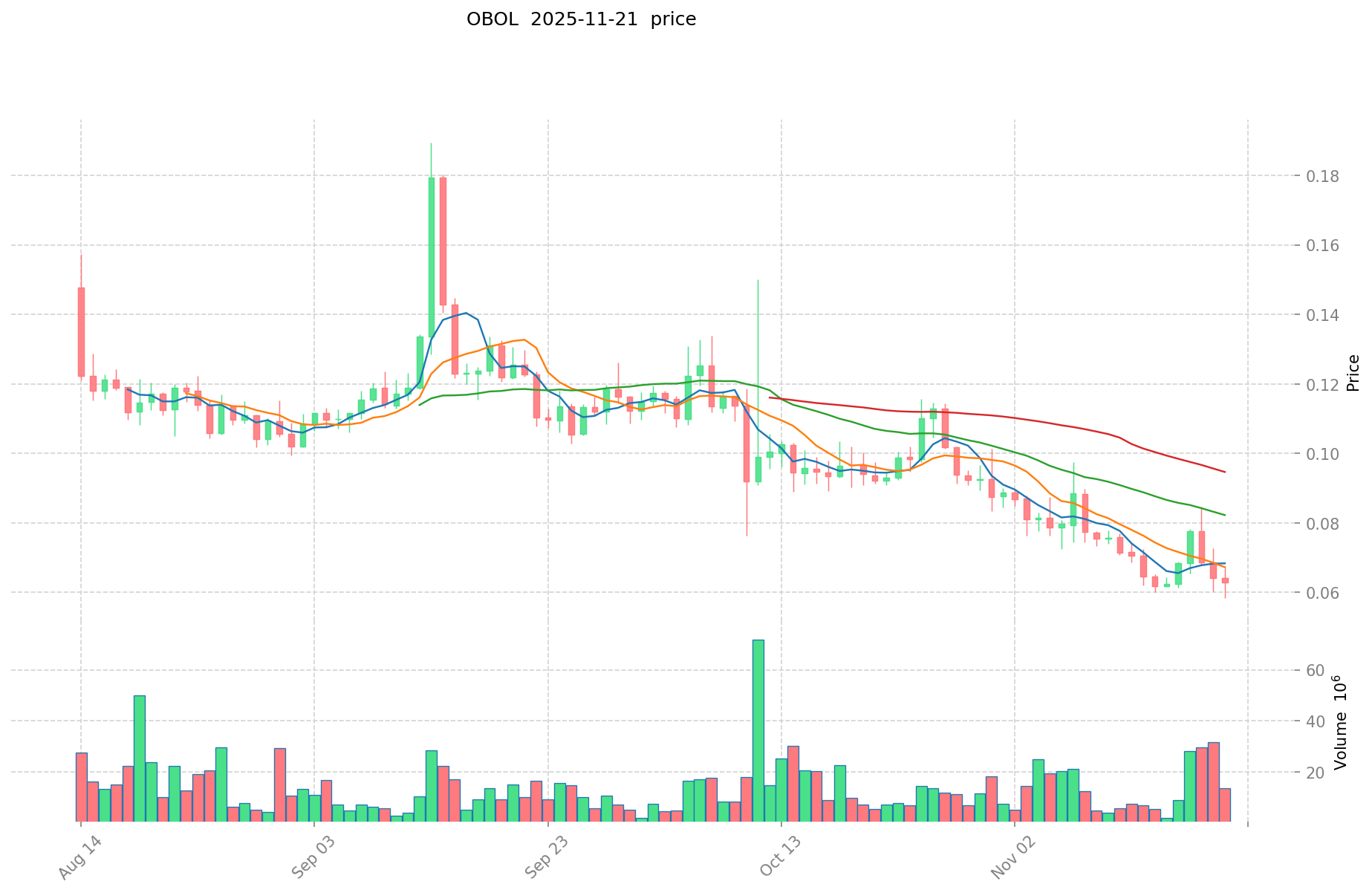
price-image

On-Chain Metrics

  • Daily Transaction Volume: $1,009,365 (indicating network activity)
  • Active Addresses: 5,674 (reflecting user engagement)

OBOL's Market Performance

Obol Ecosystem Applications and Partnerships

Core Use Cases

Obol's ecosystem supports various applications:

  • Distributed Validation: Obol Distributed Validators (DVs), providing high-performance, slashing-resistant validation for Ethereum.
  • Decentralized Infrastructure: Obol Stack, offering a modular framework for deploying and managing Ethereum nodes, AI agents, and AVSs.

Strategic Collaborations

Obol has established partnerships with over 800 decentralized operators globally, enhancing its network security and decentralization. These partnerships have solidified Obol's foundation for ecosystem expansion in the Web3 space.

Controversies and Challenges

Obol faces the following challenges:

  • Technical Hurdles: Ensuring consistent performance across distributed validators.
  • Regulatory Risks: Potential scrutiny of decentralized validation services.
  • Competitive Pressure: Emergence of other distributed validator technologies.

These issues drive ongoing discussions within the community and market, propelling Obol's continuous innovation.

Obol Community and Social Media Atmosphere

Fan Enthusiasm

Obol's community is vibrant, with over $1 billion secured on mainnet through its distributed validators. On X, posts and hashtags related to Obol frequently gain traction, reflecting the growing interest in decentralized infrastructure. Improved validator performance and increased rewards have ignited community enthusiasm.

Social Media Sentiment

Sentiment on X shows a mix of opinions:

  • Supporters praise Obol's enhanced security and decentralization features, viewing it as the "foundation for next-generation decentralized systems."
  • Critics focus on potential complexities in setup and operation of distributed validators.

Recent trends indicate growing interest in decentralized infrastructure solutions.

Hot Topics

X users actively discuss Obol's role in enhancing Ethereum's security, scalability of distributed validation, and the future of decentralized infrastructure, showcasing both its transformative potential and the challenges in mainstream adoption.

More Information Sources for Obol

  • Official Website: Visit Obol's official website for features, use cases, and latest updates.
  • X Updates: On X, Obol uses @Obol_Collective, covering technical upgrades, community events, and partnership news.

Obol's Future Roadmap

  • Ecosystem Goal: Support the growth of decentralized operators and expand to other Layer 1 and Layer 2 networks.
  • Long-term Vision: Become the standard for distributed validation and decentralized infrastructure across Web3.

How to Participate in Obol?

  1. Purchase Channels: Buy OBOL on Gate.com
  2. Storage Solutions: Use secure wallets compatible with ERC-20 tokens
  3. Participate in Validation: Learn about running Obol Distributed Validators
  4. Build on Ecosystem: Visit Obol's developer documentation to contribute or build on the Obol Stack

Summary

Obol is redefining decentralized infrastructure through its distributed validator technology, offering enhanced security, performance, and rewards for Ethereum validation. Its active community, rich resources, and strong market presence set it apart in the cryptocurrency landscape. Despite facing technical and operational challenges, Obol's innovative spirit and clear roadmap position it as a key player in the future of decentralized technologies. Whether you're a newcomer or an experienced player, Obol is worth watching and participating in the evolution of Web3 infrastructure.

FAQ

What is an obol used for?

Obol is used as a governance token in the Obol Network, enabling holders to participate in decision-making and protocol upgrades.

What were obols made of?

Obols were ancient Greek coins typically made of silver. They were small, weighing about 0.72 grams, and often used for everyday transactions in ancient Greece.

How much is an obol worth?

As of 2025, an OBOL token is valued at approximately $0.75. The price has shown steady growth since its launch, reflecting increased adoption in the Web3 ecosystem.

What replaced the obol?

The drachma replaced the obol in ancient Greece. The obol was a small silver coin used as currency, but it was eventually phased out in favor of the larger drachma denomination.

* The information is not intended to be and does not constitute financial advice or any other recommendation of any sort offered or endorsed by Gate.
Related Articles
Ethereum Mainnet Guide: How to Use and Benefit from the Network in 2025

Ethereum Mainnet Guide: How to Use and Benefit from the Network in 2025

The article "Ethereum Mainnet Guide: How to Use and Benefit from the Network in 2025" provides a comprehensive overview of Ethereum's mainnet and its pivotal role in the Web3 era. It covers the transition to Proof-of-Stake, scalability improvements, transaction fee reduction, and interoperability advancements. This guide addresses the needs of new users, developers, and ETH investors by offering step-by-step instructions on transactions, exploring mainnet versus testnet environments, and outlining strategies for minimizing gas fees. Targeted keywords enhance SEO, ensuring optimized discoverability for those interested in Ethereum's dynamic ecosystem.
2025-08-31 20:05:20
What is ZK in Crypto

What is ZK in Crypto

This article explores the transformative impact of zero-knowledge proofs (ZK) in cryptocurrency, highlighting their role in enhancing privacy, security, and scalability of blockchain transactions. It unveils how ZK technology allows verification without revealing sensitive data, solving a major privacy concern in decentralized systems. The piece details the adoption of zk-SNARKs by privacy-centric cryptocurrencies like Zcash, discusses efficiency gains for blockchain scalability, and delves into applications within DeFi, gaming, and decentralized identity management. Furthermore, it examines the emergence of ZK rollups as a critical scaling solution, emphasizing their benefits for the Ethereum ecosystem.
2025-09-01 08:09:49
What Does ZK Mean? Zero-Knowledge Explained for Blockchain Users

What Does ZK Mean? Zero-Knowledge Explained for Blockchain Users

This article explores the concept of zero-knowledge proofs (ZKPs) and their revolutionary impact on blockchain technology, emphasizing their role in enhancing privacy, security, and scalability. It addresses the privacy concerns of traditional blockchains by allowing transaction validation without revealing sensitive information, benefiting users seeking confidentiality. The article details how ZKPs facilitate secure identity verification and improve blockchain scalability through zk rollups. Real-world applications in finance, healthcare, supply chain, and gaming further demonstrate its versatility. Ideal for blockchain users and industries prioritizing privacy, security, and efficiency, it incorporates insights on Gate's offerings in ZKPs.
2025-09-04 17:47:46
Top Ethereum Layer 2 Projects to Watch in 2025

Top Ethereum Layer 2 Projects to Watch in 2025

The article explores the pivotal role of Ethereum Layer 2 projects in transforming the scaling landscape of Ethereum by 2025. It covers the leading Layer 2 solutions that address high gas fees and enhance transaction throughput, contributing to the widespread adoption of dApps and DeFi. Readers will benefit from a detailed comparison of top projects based on transaction speed and cost efficiency, with emphasis on their performance metrics. The text highlights adoption trends, institutional integration, and innovative use cases, underscoring the significance of Layer 2 technologies in shaping Ethereum's ecosystem, supported by Gate's platform for user accessibility.
2025-10-13 17:45:53
ETH Fusaka Upgrade: The Next Step for Ethereum Evolution

ETH Fusaka Upgrade: The Next Step for Ethereum Evolution

The Ethereum Fusaka Upgrade is a pivotal evolution step, significantly enhancing scalability, efficiency, and performance. This in-depth analysis breaks down the November 2025 update, highlighting key innovations like PeerDAS and Verkle Trees aimed at boosting transaction capacity, reducing costs, and supporting DeFi and Layer 2 solutions. The upgrade resolves scalability issues, appealing to developers, investors, and enterprises seeking advanced blockchain solutions. Structured across multiple sections, the article details the technical advancements, expanded gas limits, and broader ecosystem impacts, while emphasizing Gate's essential role in facilitating access to these Ethereum advancements.
2025-09-29 22:45:58
What is SSV: Understanding the Fundamentals of Staked Synchronous Validators in Blockchain Technology

What is SSV: Understanding the Fundamentals of Staked Synchronous Validators in Blockchain Technology

Explore the fundamentals of Staked Synchronous Validators (SSV) in blockchain technology through a comprehensive analysis of the SSV Network. Gain insights into its role in enhancing Ethereum's proof-of-stake security and decentralization since its launch by Blox in 2021. Delve into its technical architecture, market performance, and strategic partnerships while addressing challenges like technical hurdles and regulatory risks. Learn how SSV operates with decentralized control and secure transactions, and discover participation avenues via SSV token acquisition on Gate. Uncover the network's vibrant community and its digital footprint on X platform.
2025-09-30 07:59:41
Recommended for You
What Are Multi-Party Computation (MPC) Wallets?

What Are Multi-Party Computation (MPC) Wallets?

# Article Introduction Multi-Party Computation (MPC) wallets represent a sophisticated security solution for cryptocurrency storage, splitting private keys across multiple parties to eliminate single points of failure. This comprehensive guide explores how MPC technology works, comparing it with traditional and multisig wallets while examining its advantages in enhanced data protection and convenience. Designed for institutions and crypto users seeking stronger security without sacrificing accessibility, the article addresses critical concerns about key management, operational efficiency, and practical implementation. Discover whether MPC wallets align with your digital asset protection strategy through real-world use cases and detailed security analysis.
2026-01-05 22:33:57
2025 PRARE Price Prediction: Expert Analysis and Market Forecast for the Coming Year

2025 PRARE Price Prediction: Expert Analysis and Market Forecast for the Coming Year

# 2025 PRARE Price Prediction: Expert Analysis and Market Forecast for the Coming Year ## Article Overview This comprehensive PRARE price prediction report provides crypto investors with professional analysis spanning 2026-2031. The article delivers detailed price forecasts, market sentiment evaluation, and actionable investment strategies for PolkaRARE (PRARE), a multi-chain NFT platform token currently trading at $0.0007812 on Gate. By examining historical price trajectories, supply dynamics, and ecosystem development factors, this guide helps investors make informed decisions on this emerging digital asset with 99.94% decline from all-time highs. ## Article Structure & Logic Flow **Market Foundation**: Historical price review from May 2021 launch to current recovery phase, current market status with $78,120 fully diluted valuation, and Fear & Greed Index analysis revealing market sentiment at 26 (Fear). **Price Forecasts 2026-2031**: Conservative, neutral, and optimistic scenarios projecting potential
2026-01-05 22:33:22
2025 FTR Price Prediction: Expert Analysis and Market Forecast for the Year Ahead

2025 FTR Price Prediction: Expert Analysis and Market Forecast for the Year Ahead

# 2025 FTR Price Prediction: Expert Analysis and Market Forecast - Article Overview Fautor (FTR) is a blockchain-based creator-fan economy token that declined 95.95% over the past year, currently trading at $0.0008791 with extreme volatility and concentration risks. This comprehensive analysis combines historical price patterns, market dynamics, and macroeconomic factors to deliver professional price forecasts through 2031, ranging from $0.00069 to $0.00263 depending on adoption scenarios. The guide addresses critical investor questions: risk assessment, optimal portfolio allocation strategies, and secure trading methods on Gate. Designed for beginners seeking foundational understanding through institutional investors requiring detailed due diligence, this report provides actionable investment methodologies, including dollar-cost averaging strategies and position-sizing frameworks. By examining FTR's liquidity constraints, holder concentration (62.44% single address), and ecosystem development potential, rea
2026-01-05 22:32:15
2025 VTG Price Prediction: Expert Analysis and Market Forecast for Volkswagen's Stock Performance

2025 VTG Price Prediction: Expert Analysis and Market Forecast for Volkswagen's Stock Performance
# 2025 VTG Price Prediction: Expert Analysis and Market Forecast **Article Overview** This comprehensive analysis examines Victory Gem (VTG), a Binance Smart Chain gaming token powering the nWayPlay platform and Olympic Games Jam ecosystem. The report delivers professional price forecasts from 2026-2031, integrating historical price patterns, market dynamics, and macroeconomic factors. Designed for GameFi investors, active traders, and institutional stakeholders, this guide addresses critical questions about VTG's investment potential, risk management strategies, and technical performance. Readers will gain actionable insights into long-term holding approaches, active trading methodologies, and comprehensive risk mitigation frameworks through detailed market sentiment analysis and holder distribution assessment on Gate.
2026-01-05 22:32:01
2025 KCAL Price Prediction: Expert Analysis and Market Forecast for the Coming Year
2025 KCAL Price Prediction: Expert Analysis and Market Forecast for the Coming Year

# 2025 KCAL Price Prediction: Expert Analysis and Market Forecast for the Coming Year This comprehensive guide analyzes KCAL token's investment potential within the Step.app GameFi ecosystem, providing data-driven price forecasts from 2026-2031. The article examines KCAL's dramatic 97.98% price decline, current market fundamentals, and recovery catalysts while addressing key concerns for beginner to institutional investors. Through technical analysis, risk assessment, and supply-demand dynamics, readers gain actionable investment strategies and secure trading methods on Gate. Whether you're exploring fitness-based gaming tokens or diversifying into GameFi assets, this report delivers critical market intelligence and professional recommendations for navigating KCAL's volatile landscape.
2026-01-05 22:31:16
Is $biso (BISO) a good investment?: A Comprehensive Analysis of Risk, Potential Returns, and Market Outlook

Is $biso (BISO) a good investment?: A Comprehensive Analysis of Risk, Potential Returns, and Market Outlook

# Article Overview: Is BISO (BisoSwap) a Good Investment? Comprehensive Analysis **BISO Investment Guide: Risk Assessment, Market Analysis & Price Predictions** This comprehensive analysis evaluates BISO, a BRC20-based liquidity protocol token trading at $0.0001676 (January 2026), addressing critical investment decisions for cryptocurrency participants. The article examines BISO's market fundamentals, historical performance (95.8% decline from ATH), tokenomics, and ecosystem positioning within Bitcoin's DeFi landscape. It resolves investor uncertainties regarding token viability, liquidity constraints ($9,086.83 daily volume), and realistic return expectations through 2031. Ideal for crypto investors seeking BISO price predictions, risk assessment, and long-term outlook analysis on Gate's trading platform. --- ## Article Structure & Content Framework **Section I: Market Position & Performance** - Current pricing, market cap analysis, 24-hour to 1-year price trends, liquidity metrics on Gate **Section II
2026-01-05 22:22:32


