In the traditional AI industry, model training and deployment are largely dependent on centralized platforms, with value concentrated in the hands of a few large technology companies. Developers, data providers, and model contributors often struggle to receive rewards that reflect their actual contributions, which can limit both openness and the pace of innovation within the AI ecosystem.
Against this backdrop, Bittensor introduces the TAO token to establish a decentralized incentive system, allowing AI models to compete and be priced within an open market. TAO functions not only as a reward mechanism but also as the core value layer of the decentralized AI network, with its tokenomics directly influencing network growth, participant behavior, and long term sustainability.
What Is TAO Token?
TAO is the native crypto asset of the Bittensor network, designed to incentivize both Miner participants, who provide AI models, and Validator participants, who evaluate model outputs within a decentralized AI marketplace.
Within Bittensor, TAO serves several core functions:
-
Incentivizing AI model generation and evaluation
-
Acting as a medium of value exchange within the network
-
Enabling staking for participation in governance and network security
At a fundamental level, TAO converts AI model performance into measurable economic value, forming the basis of a decentralized market for machine intelligence.
TAO Supply And Issuance Model
Bittensor adopts a scarcity driven model similar to Bitcoin, with a total supply capped at approximately 21 million TAO. Tokens are released over time through a decreasing issuance schedule.
Key characteristics of the TAO token model include no ICO, no private sale, and no venture capital allocation. Instead, distribution is achieved entirely through network participation, emphasizing fairness and decentralization.
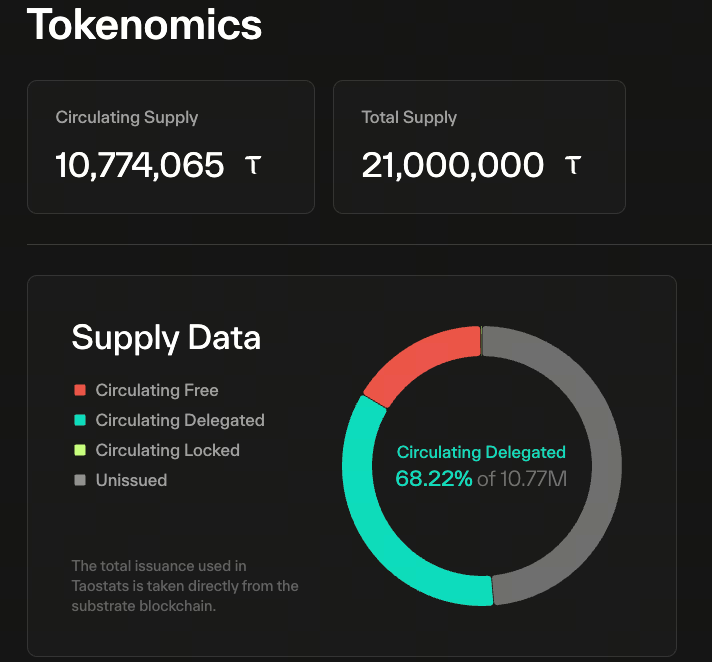
Under the current mechanism, daily TAO issuance is allocated as follows:
This structure balances incentives between model providers and evaluators, supports ongoing subnet ecosystem growth, and promotes efficient allocation of network resources.
TAO Inflation And Halving Mechanism
Bittensor controls inflation through a halving schedule similar to Bitcoin, while using dynamic issuance to support long term sustainability.
-
In the early stage, the issuance rate is relatively high to attract computing resources, AI models, and developers, helping the network achieve initial growth
-
As the network matures, halving events progressively reduce daily issuance, lowering inflation and reinforcing scarcity
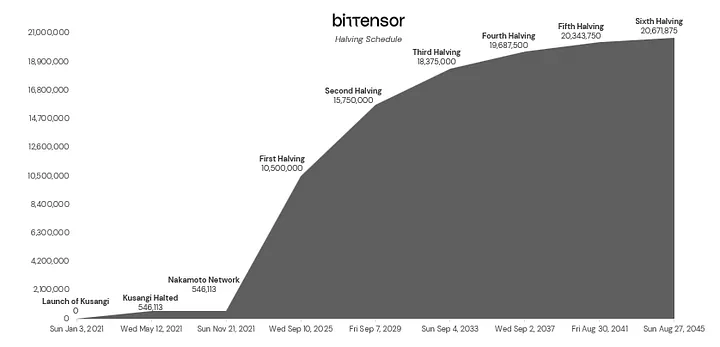
For example, the first halving expected by the end of 2025 reduces daily TAO issuance from around 7200 to 3600. This brings annual inflation down from approximately 26% to about 13%, strengthening a scarcity narrative similar to Bitcoin. This design provides strong incentives for early contributors while supporting long term stability and value retention as the network evolves.
TAO Incentive Mechanism And Reward Distribution
The TAO incentive mechanism acts as the economic engine of the Bittensor network. It distributes newly issued tokens based on the quantified performance of Miners and Validators.
The process operates as follows:
-
Miners provide AI model outputs across different subnets, such as text generation, embeddings, prediction, or detection tasks
-
Validators evaluate the quality of these outputs according to subnet specific criteria and assign weights, forming a consensus score
-
The protocol distributes TAO rewards based on these scores, with higher performing Miners and Validators receiving greater rewards
This performance-based feedback loop encourages continuous optimization of models, data, and inference strategies, ultimately improving the overall intelligence output of the network.
TAO Staking And Network Security
TAO holders can participate in network operations and security through staking, either by delegating to Validators or running Validator nodes directly.
The staking mechanism serves several key functions:
-
Increasing Validator weight More staked TAO increases a Validator’s weight within subnets, leading to a higher share of rewards and creating a performance based competitive environment
-
Aligning long term incentives Stakers earn rewards while also being exposed to network risks, encouraging decisions that support long term sustainability
-
Strengthening network security Validators with poor performance or malicious behavior can be economically penalized or excluded, helping prevent manipulation of the incentive system
By combining staking with incentives, TAO functions not only as a circulating asset but also as collateral that supports network reliability and security.
TAO Mining Model And AI Driven Competition
In Bittensor, mining shifts from pure computational competition to performance based competition centered on AI models.
-
Miners They earn rewards by submitting high quality model outputs such as text generation, prediction, or task specific responses, with rewards determined by performance ranking rather than hardware power
-
Validators They design queries, collect responses, and evaluate Miner outputs. Rewards depend on how closely their evaluations align with network consensus and task objectives
This model driven approach redirects competition from hardware accumulation toward optimization of algorithms, data, and task design, improving capital efficiency and accelerating innovation.
TAO In The Subnet Economy
The Bittensor network consists of multiple independent subnets, each operating around specific tasks and incentive structures, with TAO as the foundational economic unit.
At the subnet level, TAO is used to:
-
Act as a universal incentive asset for rewarding Miners and Validators, with some subnets introducing additional tokens layered on top of TAO
-
Power internal economic cycles including registration fees, staking requirements, reward distribution, and task design
-
Support specialized AI applications such as text generation, embeddings, prediction, risk analysis, and content moderation
This multi subnet structure allows TAO to capture value across different vertical AI markets while maintaining unified liquidity and coordination across the network.
TAO Value Capture Mechanism
The value of TAO is primarily driven by demand within the AI network and the growth of the broader ecosystem.
-
Demand for AI services: As more subnets provide AI services, demand for TAO increases
-
Incentive demand: Miners and Validators rely on TAO as the reward mechanism
-
Staking demand: As the network expands, greater security requirements increase staking demand
-
Ecosystem expansion: More subnets lead to more applications and stronger value capture potential
Advantages And Risks Of TAO Tokenomics
The TAO token model offers several advantages:
-
Precise incentives: Rewards are directly tied to model performance, directing resources toward the most valuable contributions
-
High openness: Developers with models or computing resources can participate without centralized permission, lowering barriers to entry
-
Strong scalability: The subnet structure allows tailored incentive models for different AI tasks, supporting diverse applications
-
Deep integration of AI and crypto: Programmable incentives bring AI production relationships on chain, supporting broader Web3 AI and DePIN narratives
At the same time, there are notable risks:
-
Inflation and price volatility: Higher issuance in early stages may lead to volatility and pressure on long term holders
-
Evaluation bias and strategic behavior: Validator scoring may involve subjectivity or coordination risks if incentive design is not robust
-
Cold start challenges: New subnets may struggle to attract sufficient participants without strong incentives
-
Uncertainty in model competition: AI tasks are dynamic and complex, making it challenging to ensure long term alignment between evaluation mechanisms and real world performance
Understanding both advantages and risks is essential for assessing TAO’s long term potential and cyclical behavior.
Conclusion
TAO, as the core token of the Bittensor network, builds a decentralized economic system centered on AI model competition through its supply model, halving mechanism, staking system, and subnet incentive design.
Its value is not only derived from scarcity but also from actual network usage and ecosystem expansion. As decentralized AI continues to develop, TAO may become an important bridge connecting artificial intelligence with the broader crypto economy.
FAQs
What is TAO?
TAO is the native token of the Bittensor decentralized AI network. It is used to reward Miners and Validators for model contributions and evaluations, and also serves as the base asset for settlement and staking within the network.
How is TAO issued? Does it have a halving mechanism?
TAO is issued through block rewards with a fixed daily emission in the early stage. It follows a scheduled halving model over time, reducing issuance by approximately 50 percent at each interval, similar to Bitcoin, to lower inflation and reinforce scarcity.
Is there a maximum supply of TAO?
Yes, TAO follows a scarcity based model with a total supply capped at around 21 million tokens. The supply is released gradually through a predictable and decreasing emission schedule.
How can TAO be obtained?
TAO can be earned by running a Miner to provide AI models or a Validator to evaluate models within the Bittensor network. Users can also participate through staking and sharing validator rewards, or acquire TAO through secondary market trading.
What drives the value of TAO?
The value of TAO is primarily driven by demand within the Bittensor AI network, including consumption of AI services across subnets, incentive demand from Miners and Validators, and increasing staking demand as the network grows.
What role does TAO play in the subnet economy?
TAO acts as the base token shared across all subnets. It is used to directly reward Miners and Validators, and can also be combined with subnet specific tokens to create layered incentive structures and economic models.







