OpenVPP: Building the Future of Global Energy Payments and Tokenization Network

Beginner
Quick Reads
Last Updated 2026-03-28 23:27:16
Reading Time: 1m
OpenVPP establishes a decentralized payment and tokenization infrastructure, delivering stablecoin micropayment capabilities, smart device connectivity, and virtual power plant solutions to serve the global $10 trillion electricity sector.

OpenVPP Overview


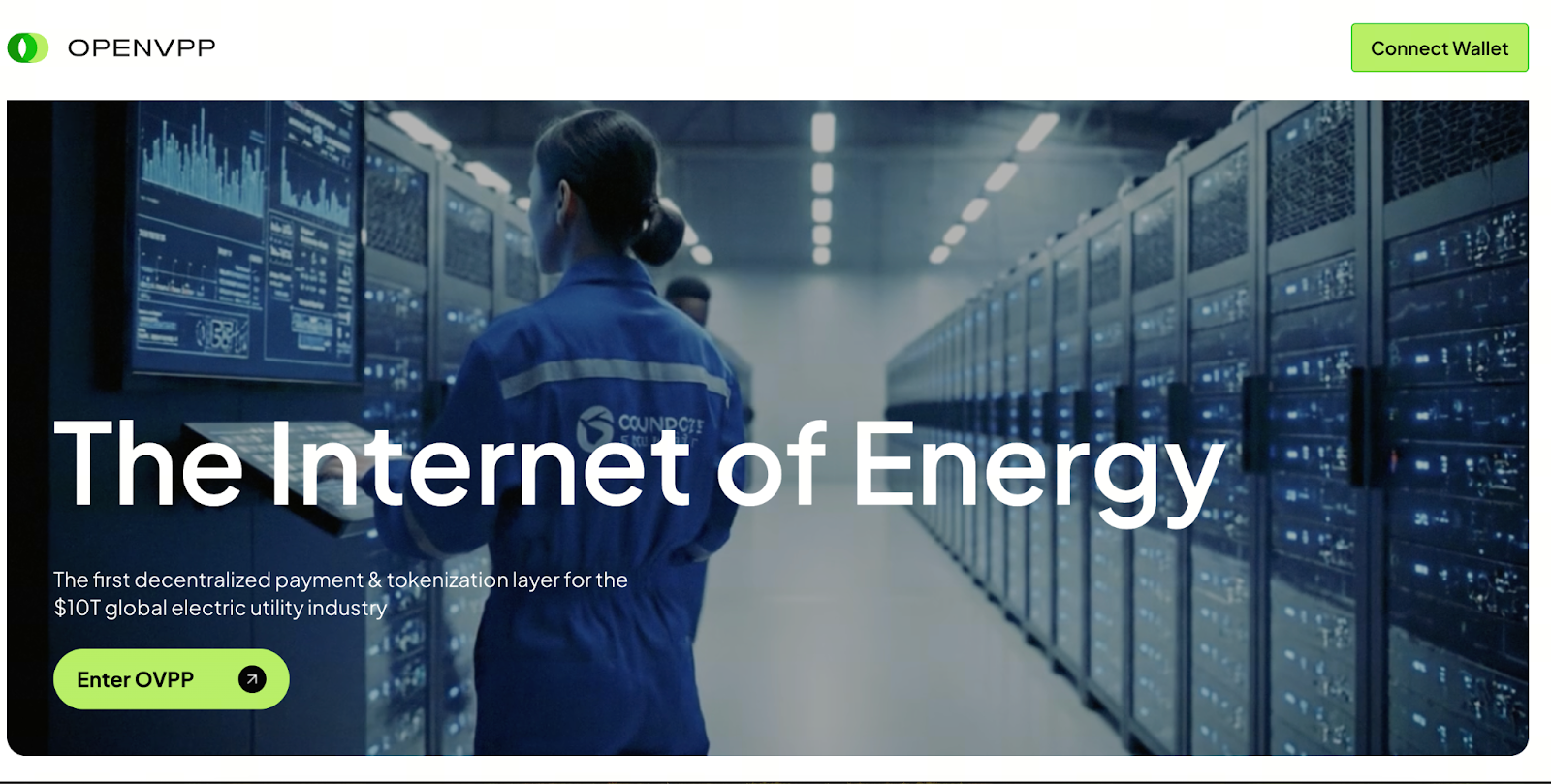
Image source: https://openvpp.energy/

OpenVPP is a decentralized payment and tokenization protocol designed for the global electricity industry, with the vision of becoming the “Energy Internet.” The platform modernizes energy payment infrastructure by delivering programmable stablecoin solutions tailored for smart devices and virtual power plants, enabling transactions that are fast, secure, and fully automated. By directly integrating distributed energy resources (DERs) and advanced metering systems, OpenVPP provides utilities and end users with efficient, compliant solutions for micropayments and asset management.

Challenges in Energy Payments

The electricity sector processes over $10 trillion in annual payments globally, making it one of the largest areas of daily financial activity. As advanced metering infrastructure (AMI) and distributed energy resources (DERs) become widespread, legacy offline payment systems are increasingly unable to meet the requirements for automated payments demanded by smart energy devices. These traditional systems suffer from slow settlements, centralized risk exposure, and security vulnerabilities, and they cannot reliably support microtransactions across diverse devices and scenarios.

Additionally, power metering is evolving from whole-building assessments toward asset-level sub-metering, which necessitates digital and decentralized upgrades for payment systems to effectively manage both consumption and production data.

Key Technical Innovations

  • Custom Stablecoin Payment Layer: OpenVPP enables utilities to automate payments using stablecoins or custom tokens, with dedicated oracles that adapt to various energy scenarios.
  • Decentralized Integration for DERs: The platform offers a peer-to-peer routing and integration layer—akin to “DNS for DERs”—allowing utilities and device providers to interact seamlessly without centralized intermediaries. This empowers configurable payment workflows and virtual power plant management.
  • Gas Abstraction for User Experience: OpenVPP lets electricity customers manage bills and initiate payments from mobile wallets, using gas abstraction so users need not hold native tokens for on-chain transactions. Secure, convenient payments are achieved through OAuth authorization, gas sponsor relays, and specialized settlement mechanisms.

$OVPP Token Functions

  • Payment Currency: Used to register devices and access APIs. Stablecoins or fiat currencies convert automatically to $OVPP on the backend, sustaining token demand.
  • Governance: $OVPP holders participate directly in protocol governance, advancing decentralized decision-making.
  • Incentives: Part of the token supply incentivizes stakers, device aggregators, and utilities to join the ecosystem.

Market Potential & Ecosystem Outlook

OpenVPP is positioned to bring the multi-trillion-dollar global energy payments economy on-chain, establishing itself as the backbone network for smart energy and DER payments. By partnering with leading stablecoin issuers and major energy infrastructure providers, OpenVPP is building an end-to-end decentralized payment infrastructure, driving digital transformation and intelligence across the energy sector.

OVPP is now available on Gate’s Spot Market. Click to trade: https://www.gate.com/trade/OVPP_USDT

Author: Max
Disclaimer
* The information is not intended to be and does not constitute financial advice or any other recommendation of any sort offered or endorsed by Gate.
* This article may not be reproduced, transmitted or copied without referencing Gate. Contravention is an infringement of Copyright Act and may be subject to legal action.

Related Articles

AI-Native Settlement Layers: How United Stables Is Building the Next Financial Rail
Beginner

AI-Native Settlement Layers: How United Stables Is Building the Next Financial Rail

Stablecoins were originally designed as dollar substitutes within exchanges, primarily used for asset pricing and trade settlement. As on-chain financial ecosystems have matured, their role has expanded beyond simple payments to include collateral assets, cross-chain liquidity mediums, and unified settlement units. In particular, as AI systems and automated agents begin to participate directly in economic activity, demand has risen sharply for programmable value units capable of instant settlement. This shift is pushing stablecoins toward the role of foundational financial infrastructure.
2026-03-25 03:16:17
DePIN Identity Network and Real World Applications: How Humanity Protocol Brings on-chain Identity Into the Physical World
Beginner

DePIN Identity Network and Real World Applications: How Humanity Protocol Brings on-chain Identity Into the Physical World

Most Web3 identity systems remain confined to on-chain environments and struggle to achieve meaningful adoption in real world settings. Through a DePIN architecture and physical verification hardware, Humanity Protocol aims to bring decentralized identity into access control systems, hospitality, public services, and offline events, allowing on-chain identity to function not just as a digital credential, but as foundational infrastructure for real world access.
2026-03-25 07:40:53
The ve(3,3) Flywheel Explained: How AERO Tokenomics Powers Aerodrome’s DeFi Economy
Beginner

The ve(3,3) Flywheel Explained: How AERO Tokenomics Powers Aerodrome’s DeFi Economy

In the competition for DeFi liquidity, high-inflation mining alone is no longer enough to build lasting advantages. Aerodrome applies the ve(3,3) economic model to redesign token emissions, voting mechanisms, and revenue distribution, creating a liquidity flywheel centered on governance and cash flow. This article examines AERO tokenomics, the veAERO locking mechanism, and protocol revenue models to explain how Aerodrome builds a sustainable DeFi economic system.
2026-03-25 06:41:58
Aerodrome Tokenomics: How ve(3,3) Powers Base's Most Profitable DEX
Beginner

Aerodrome Tokenomics: How ve(3,3) Powers Base's Most Profitable DEX

AERO is the native token of Aerodrome Finance, a core decentralized exchange and liquidity protocol in the Base ecosystem. It is primarily used for liquidity incentives and ecosystem operations. veAERO is a governance NFT that users receive by locking AERO, representing both voting power and the right to share protocol revenue. Through a dual track structure of AERO as a utility token and veAERO as a governance credential, Aerodrome separates liquidity usage value from long term governance power, allowing participants to act as liquidity providers, governance decision makers, and revenue sharers within the same system.
2026-03-25 06:40:31
Aster vs Hyperliquid: Which Perp DEX Will Prevail?
Beginner

Aster vs Hyperliquid: Which Perp DEX Will Prevail?

Aster and Hyperliquid are the two representative protocols of the "purpose-built L1 path" within the current decentralized perpetual exchange (Perp DEX) sector. As a pioneer in the field, Hyperliquid has built a deep liquidity moat through its highly mature order book architecture and strong community consensus. Conversely, Aster, as a rising challenger, seeks to leapfrog the competition in high-performance trading through more aggressive multi-chain aggregation logic, private transaction modules, and an underlying execution environment optimized for 2026 market demands.
2026-03-24 11:58:33
Gold Price Forecast for the Next Five Years: 2026–2030 Trend Outlook and Investment Implications, Could It Reach $6,000?
Beginner

Gold Price Forecast for the Next Five Years: 2026–2030 Trend Outlook and Investment Implications, Could It Reach $6,000?

Analyze current gold price trends alongside authoritative five-year forecasts, integrating an evaluation of market risks and opportunities. This gives investors insight into the potential trajectory of gold prices and the main drivers expected to shape the market over the next five years.
2026-03-25 18:13:30





