Over the past decade, the crypto industry has largely centered around the concept of “assets.” From Bitcoin to DeFi to stablecoins, blockchain has built a permissionless global financial system. However, as capital flows more freely, a deeper issue has come into focus: identity remains fragmented and siloed.
Users are still required to repeatedly register and verify their identity across different platforms. This inefficient experience raises barriers to entry and has become a key obstacle to Web3’s integration with mainstream finance. Against this backdrop, the “identity layer” is increasingly seen as essential infrastructure for the next phase of development, and idOS is emerging as a major player in this space.
What is idOS?
As an identity operating system designed for Web3, idOS (IDOS) aims to let users carry, manage, and authorize their identity data across applications. Unlike Web2 platforms, where user data is centrally controlled, idOS emphasizes data sovereignty, giving users full control over their own identity information.
In this model, identity is no longer tied to a single platform. Instead, it becomes a portable resource. Users can reuse their identity across multiple applications while precisely controlling how their data is accessed through permission mechanisms. This enables efficient verification without compromising privacy.
The Core Problem in Web3: Why is idOS Needed?
One of the fundamental issues in today’s Web3 ecosystem is the imbalance between financial and identity infrastructure. While financial systems have matured rapidly, identity systems lag behind. Users often need to complete KYC processes repeatedly across platforms, increasing time costs and leading to significant user drop-off during onboarding.
At the same time, user data is typically locked within individual platforms and lacks portability, which contradicts Web3’s core principles of openness and interoperability. At its core, Web3 lacks a unified identity layer to connect users, applications, and compliance frameworks. This is precisely the gap idOS aims to fill.
The idOS Solution: Making Identity as Fluid as Assets
The core idea behind idOS is to transform identity into a resource that can move freely across platforms. Users only need to complete identity verification once, after which their KYC data can be reused across multiple applications, significantly reducing redundancy.
All identity data is encrypted and controlled directly by the user. Applications can only access this data with explicit permission, and users can choose to disclose only what is necessary. For example, they can prove they have completed KYC without revealing full personal details. This approach balances privacy protection with regulatory compliance.
Technical Architecture: How Does idOS Work?
At the technical level, idOS uses a layered architecture to manage identity and enable data flow. At the base is an encrypted data storage network that securely holds user identity information. On top of that sits an economic network that governs data access and incentive mechanisms.
This separation of storage and usage enhances security while enabling efficient data exchange through economic incentives. In addition, idOS supports multi-chain environments, allowing identities to move seamlessly across blockchains and enabling true cross-ecosystem interoperability.
idOS and the Stablecoin Economy
Stablecoins solve the problem of value transfer, while the identity layer addresses trust and compliance. In traditional finance, capital movement is inherently tied to identity verification, making identity and finance inseparable.
In a Web3 environment, without identity layer support, stablecoins may circulate globally but struggle to integrate into regulated systems or support large-scale financial applications. This is where idOS becomes critical. By linking user identity with on-chain activity, it enables stablecoins to expand within compliant frameworks.
Real-World Value and Use Cases of idOS
In practice, idOS can significantly enhance multiple key use cases. In payments, it enables identity-verified stablecoin transactions that meet cross-border compliance requirements. In the convergence of DeFi and CeFi, it provides institutions with the identity infrastructure needed to safely enter on-chain financial systems.
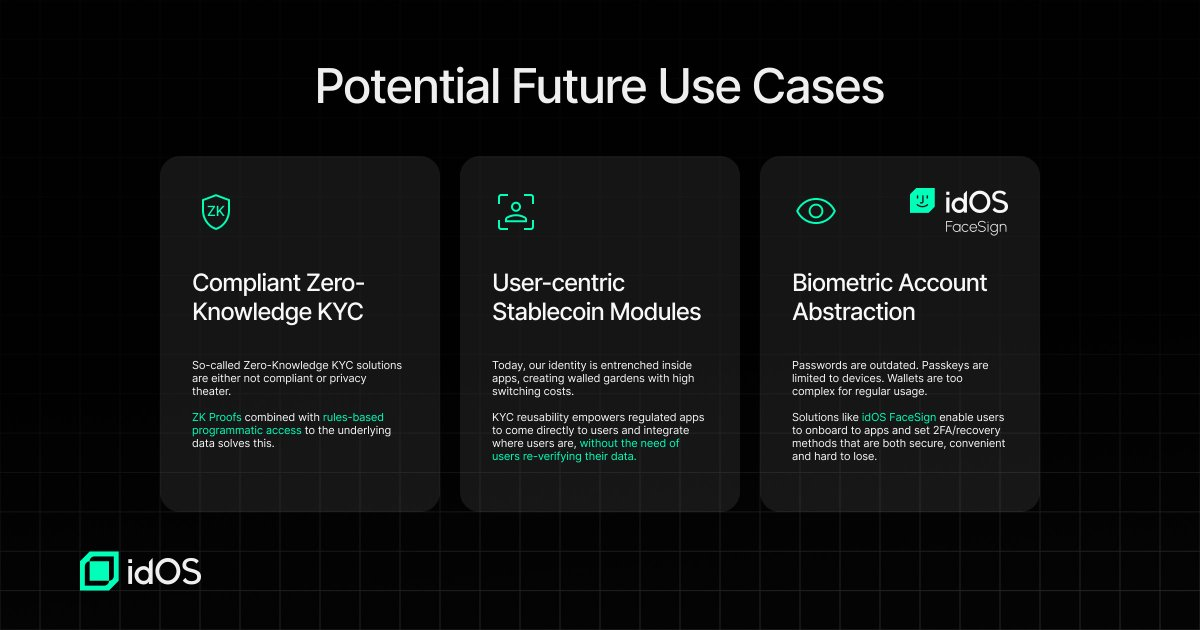
Additionally, identity verification is essential in areas such as Web3 banking and real-world assets (RWA). By reducing verification costs and improving data usability, idOS makes these applications more viable and supports Web3’s expansion into the real economy.
idOS Ecosystem and Adoption
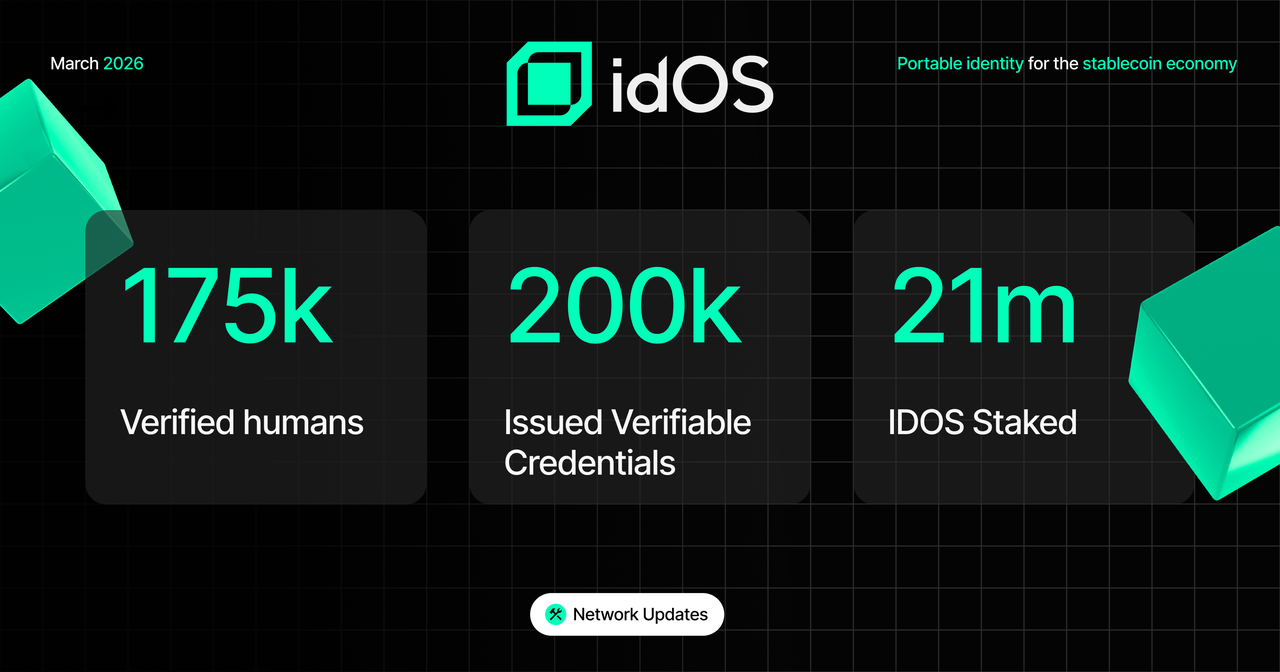
From a development perspective, idOS has already achieved meaningful traction. Its network has verified over 150,000 users and supports more than 40 blockchains. Several applications serving large user bases are adopting or integrating idOS as their identity system. This indicates that idOS is moving beyond theory and becoming part of real-world infrastructure.
The Role of the IDOS Token
Within the idOS network, the IDOS token connects the data and economic layers. It is used to pay for data access and serves as part of the incentive mechanism that encourages participants to provide and maintain services. The token also plays a role in governance, allowing the community to take part in key decisions.
Conclusion
From a broader perspective, idOS represents a shift in Web3’s direction. The industry is moving from an asset-centric model toward one centered on users and identity. Identity is no longer a secondary feature but a core layer that connects finance, applications, and compliance.
At the same time, the concept of data sovereignty is becoming a reality. Users are beginning to truly own and control their data, using it securely across different contexts. This shift could reshape not only Web3, but the structure of the internet as a whole.
FAQs
What is the difference between idOS and DID?
idOS builds upon decentralized identity (DID) by extending beyond identification. It integrates KYC, data storage, and incentive mechanisms, making it closer to a practical infrastructure solution.
Does idOS affect user privacy?
Privacy protection is central to idOS’s design. User data is encrypted, access is controlled through permissions, and selective disclosure is supported to prevent unnecessary data exposure.
Does idOS support cross-chain usage?
Yes, idOS supports multiple blockchain networks and is designed to enable identity to move freely across chains.
Why do stablecoins need an identity layer?
Because regulatory requirements tie financial activity to identity. Without an identity layer, stablecoins struggle to integrate into mainstream financial systems or scale effectively.
Who are the target users of idOS?
idOS serves both end users and developers. For users, it simplifies identity verification. For developers, it provides a ready-to-integrate identity infrastructure.