ZeroBase Token (ZBT) Airdrop Explained: How to Participate

Beginner
Quick Reads
Last Updated 2026-03-28 10:41:10
Reading Time: 1m
The ZeroBase (ZBT) airdrop is now complete. The project team covered all gas fees, and tokens have been automatically sent to the wallets of eligible users. Information on participation methods is available for those interested.

What is ZeroBase (ZBT)?

ZeroBase is a decentralized zero-knowledge proof infrastructure platform dedicated to Web3 privacy and scalability solutions. It delivers real-time zero-knowledge proof generation for financial auditing and privacy-focused blockchain applications.

ZBT Airdrop Overview
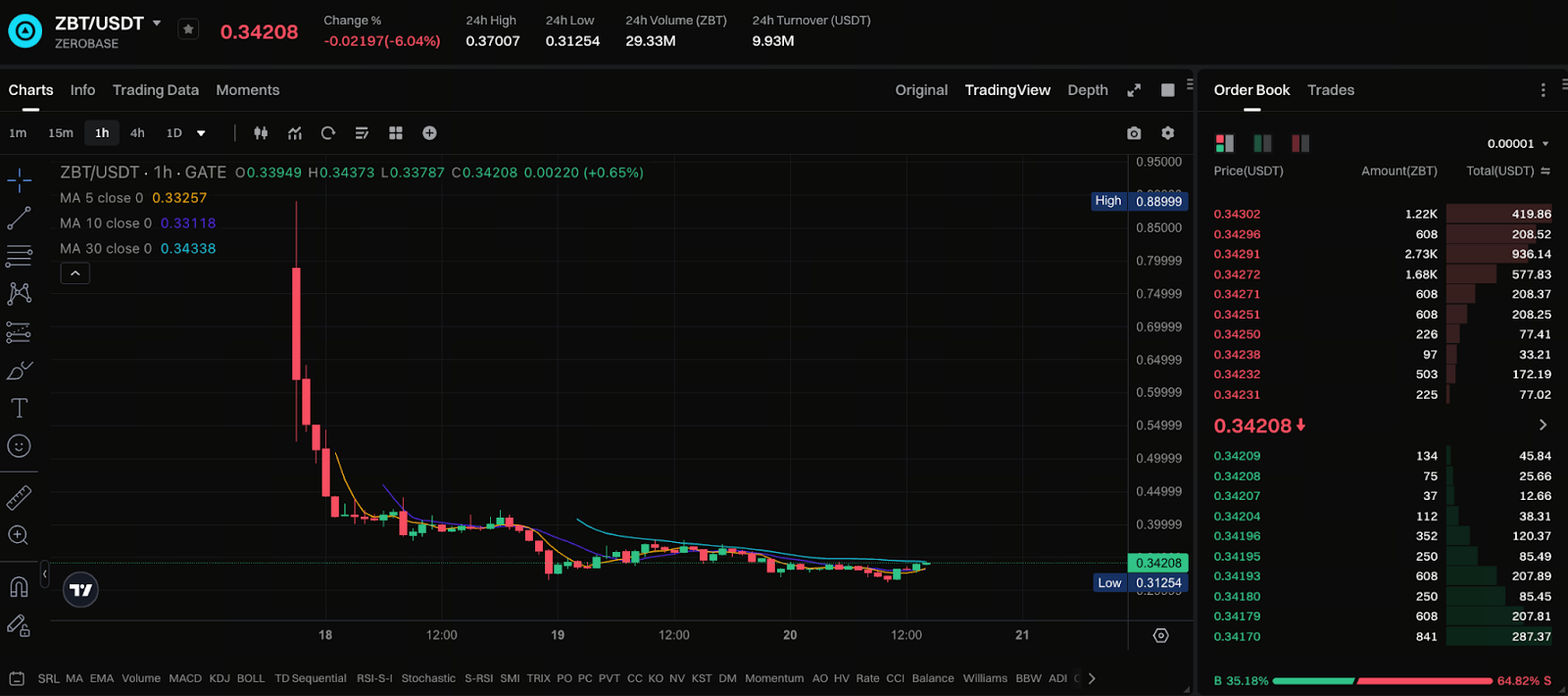

Figure: https://www.gate.com/trade/ZBT_USDT

ZeroBase completed its ZBT token airdrop on October 17, 2025 (UTC). The project team utilized a frictionless distribution mechanism, automatically delivering tokens to users without requiring them to pay gas fees. This approach lowered participation barriers and minimized the risk of failed transactions caused by network congestion.

How to Participate in the ZBT Airdrop?

No manual claiming or gas payments were needed for this airdrop. The project team covered all gas expenses and directly distributed tokens to eligible wallet addresses across two networks. Specific allocations were as follows:

  • Ethereum Network: 17,043 addresses received a total of 19,540,974.3 ZBT
  • BNB Smart Chain: 133,538 addresses received a total of 459,025.6988 ZBT

ZeroBase delivered tokens to users holding 10 ZBT or more via Ethereum. Those with fewer than 10 ZBT received them via BSC. This approach maximized gas efficiency.

ZBT Market Performance

On October 17 (UTC), ZBT debuted on both Binance Alpha Spot and ZBT/USDT perpetual contracts, which offered up to 50x leverage. The dual-market launch boosted liquidity, attracting market makers, arbitrage traders, and high-frequency trading firms. As a result, trading volume surged on the first day, and price volatility exceeded that of most new listings.

Summary

The ZeroBase ZBT airdrop allowed users to receive tokens effortlessly. ZBT is now available on several trading platforms, which has increased market liquidity and allows investors to monitor its performance.

Author: Max
Disclaimer
* The information is not intended to be and does not constitute financial advice or any other recommendation of any sort offered or endorsed by Gate.
* This article may not be reproduced, transmitted or copied without referencing Gate. Contravention is an infringement of Copyright Act and may be subject to legal action.

Related Articles

What is Fartcoin? All You Need to Know About FARTCOIN
Intermediate

What is Fartcoin? All You Need to Know About FARTCOIN

Fartcoin (FARTCOIN) is a representative meme coin within the Solana ecosystem based on an AI-driven narrative. Its core concept originated from an experiment aimed at exploring the "boundaries between AI Agents and humor." More than just a digital asset with social attributes, the project deeply couples absurd humor culture with on-chain financial logic by integrating autonomous AI interaction models.
2026-04-04 22:01:19
Gold Price Forecast for the Next Five Years: 2026–2030 Trend Outlook and Investment Implications, Could It Reach $6,000?
Beginner

Gold Price Forecast for the Next Five Years: 2026–2030 Trend Outlook and Investment Implications, Could It Reach $6,000?

Analyze current gold price trends alongside authoritative five-year forecasts, integrating an evaluation of market risks and opportunities. This gives investors insight into the potential trajectory of gold prices and the main drivers expected to shape the market over the next five years.
2026-03-25 18:13:30
AI-Native Settlement Layers: How United Stables Is Building the Next Financial Rail
Beginner

AI-Native Settlement Layers: How United Stables Is Building the Next Financial Rail

Stablecoins were originally designed as dollar substitutes within exchanges, primarily used for asset pricing and trade settlement. As on-chain financial ecosystems have matured, their role has expanded beyond simple payments to include collateral assets, cross-chain liquidity mediums, and unified settlement units. In particular, as AI systems and automated agents begin to participate directly in economic activity, demand has risen sharply for programmable value units capable of instant settlement. This shift is pushing stablecoins toward the role of foundational financial infrastructure.
2026-03-25 03:16:17
Aster vs Hyperliquid: Which Perp DEX Will Prevail?
Beginner

Aster vs Hyperliquid: Which Perp DEX Will Prevail?

Aster and Hyperliquid are the two representative protocols of the "purpose-built L1 path" within the current decentralized perpetual exchange (Perp DEX) sector. As a pioneer in the field, Hyperliquid has built a deep liquidity moat through its highly mature order book architecture and strong community consensus. Conversely, Aster, as a rising challenger, seeks to leapfrog the competition in high-performance trading through more aggressive multi-chain aggregation logic, private transaction modules, and an underlying execution environment optimized for 2026 market demands.
2026-03-24 11:58:33
How Does Kite Work? An In-Depth Look at Kite's Identity and Programmable Permission Architecture
Beginner

How Does Kite Work? An In-Depth Look at Kite's Identity and Programmable Permission Architecture

Kite is an EVM compatible Layer 1 blockchain network that runs on proof of stake. It is designed to give AI agents verifiable identity, programmable permissions, and real time settlement in an on-chain execution environment. In Kite's design, AI is no longer only a tool that follows instructions. It becomes an economic participant with independent on-chain identity and direct control over assets. Within secure and auditable infrastructure, an AI agent can complete payments, call services, and coordinate tasks autonomously, making Kite a foundational layer for the emerging agent economy.
2026-03-25 06:02:34
DePIN Identity Network and Real World Applications: How Humanity Protocol Brings on-chain Identity Into the Physical World
Beginner

DePIN Identity Network and Real World Applications: How Humanity Protocol Brings on-chain Identity Into the Physical World

Most Web3 identity systems remain confined to on-chain environments and struggle to achieve meaningful adoption in real world settings. Through a DePIN architecture and physical verification hardware, Humanity Protocol aims to bring decentralized identity into access control systems, hospitality, public services, and offline events, allowing on-chain identity to function not just as a digital credential, but as foundational infrastructure for real world access.
2026-03-25 07:40:53