What Is Hedera?
Hedera is a public distributed ledger network leveraging the “hashgraph consensus” mechanism, designed to process high volumes of transactions with low fees and deliver fast, irreversible finality. Its native token, HBAR, is used for transaction fees, incentivizing network nodes, and facilitating micropayments for small and high-frequency transactions.
Hashgraph is an accounting structure based on a Directed Acyclic Graph (DAG), differing from the traditional “chained block” structure of conventional blockchains. Hedera’s consensus protocol features asynchronous Byzantine Fault Tolerance (aBFT), meaning the network remains secure and consistent even in the face of malicious actors or latency issues. Transactions receive fair timestamps, which helps ensure orderly processing and reduces front-running.
What Are the Current Price, Market Cap, and Circulating Supply of Hedera (HBAR)?
As of 2026-01-16 (source: platform data), HBAR’s latest price is $0.117510. The circulating supply is 42,793,137,594.180763 HBAR, with both total and maximum supply capped at 50,000,000,000 HBAR.
Additional data for this date:
- Circulating market capitalization is approximately $5,875,500,000.
- Fully Diluted Valuation (FDV) is also around $5,875,500,000.
- Market cap dominance stands at about 0.17%.
- Short-term price movements: 1 hour -0.16%, 24 hours -2.69%, 7 days -1.43%, 30 days +3.67%.
- 24-hour trading volume is roughly $2,690,197.
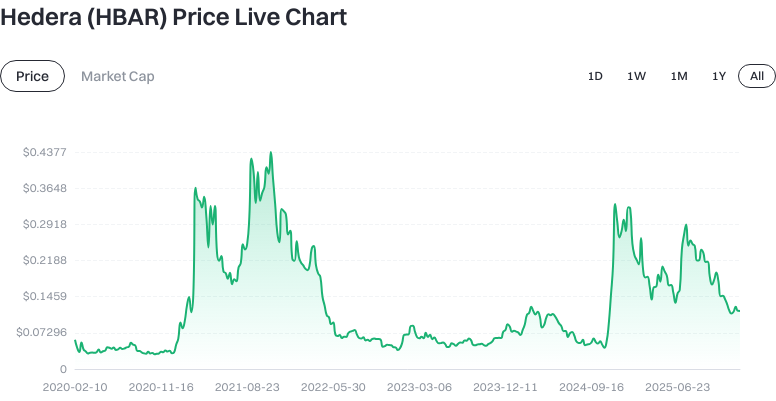
Click to view HBAR live price chart
Terminology:
- Circulating supply: Number of tokens currently available for trading in the market.
- Total supply: Number of tokens that have been issued.
- Maximum supply: The hard cap defined at the protocol level.
- Market cap: Price multiplied by circulating supply.
- Fully Diluted Valuation (FDV): Estimated project valuation based on maximum or total supply.
Who Created Hedera (HBAR) and When?
The Hedera public network launched on 2020-02-13 with HBAR as its native asset. According to public records (as of 2024-10), Hedera’s underlying technology was proposed by Leemon Baird and commercialized in partnership with Mance Harmon. Governance is managed by the Hedera Governing Council, which consists of multiple cross-industry enterprises responsible for overseeing policy evolution and node permissions.
Initially, Hedera adopted a relatively strict governance and node permission model. Over time, it has gradually expanded participation and advanced toward a more open operational framework to balance performance, regulatory compliance, and decentralization.
How Does Hedera (HBAR) Work?
At its core, Hedera uses the hashgraph consensus:
- Nodes quickly share transactions and metadata through “gossip” communication.
- The “gossip-about-gossip” process records how messages propagate across the network.
- “Virtual voting” enables consensus without large-scale vote broadcasting.
- The aBFT property ensures secure and final consensus even if some nodes fail or act maliciously.
Finality means that once a transaction is confirmed, there’s no need to wait for additional blocks before considering it irreversible—ideal for applications requiring settlement certainty. TPS (transactions per second) measures network throughput; Hedera is engineered for high TPS and low costs.
Key network services include:
- Hedera Token Service (HTS): Native token issuance and management with customizable permissions and fee structures.
- Hedera Consensus Service (HCS): Verifiable timestamping and ordered event recording for applications.
- Smart Contract Service: An EVM-compatible execution environment supporting mainstream contract languages and tools.
- Mirror Nodes: Read-only infrastructure for querying and analyzing on-chain events.
HBAR powers all these services by covering fees and incentivizing participation, ensuring secure and continuous network operation.
What Can You Do with Hedera (HBAR)?
Key use cases for HBAR and the Hedera network include:
- Micropayments & content monetization: Fast settlements for small payments based on views or usage duration.
- Timestamping & audit trails: Recording critical business events on-chain for compliance and forensic purposes.
- Supply chain & asset tracking: Immutable documentation and querying of goods movement.
- Gaming & loyalty points: Enabling high-frequency, low-value transactions with minimal fees.
- Enterprise data sharing: Unified event sequencing and verification in multi-party collaboration scenarios.
All these scenarios leverage rapid finality and low transaction costs, with HBAR serving as both the settlement medium and fee token.
What Are the Main Risks and Regulatory Considerations for Hedera (HBAR)?
Key risks include:
- Price volatility: Crypto assets are subject to significant fluctuations driven by market sentiment and macroeconomic factors.
- Governance & decentralization: The concentration of decision-making within the Governing Council and the pace at which permissioning evolves impact ecosystem participation and network resilience.
- Technical compatibility: EVM compatibility, tooling support, and developer resources affect migration costs for applications.
- Regulatory compliance: Requirements vary by jurisdiction—pay attention to KYC (Know Your Customer) obligations and tax reporting duties.
- Account & private key security: Enable two-factor authentication on exchange accounts; securely back up mnemonic phrases/private keys for self-custody wallets; remain vigilant against phishing attacks.
- Network & address selection: Always choose the correct network and address format when depositing or withdrawing HBAR—using an incorrect network can result in lost assets. If prompted to include a memo/tag, follow instructions carefully.
What Is the Long-Term Value Proposition for Hedera (HBAR)?
Long-term value depends on the balance between performance, cost-efficiency, and adoption. Hedera’s strengths lie in high throughput, rapid finality, and low transaction fees—attributes well-suited to micropayments and enterprise collaboration. Its council-based governance model emphasizes stability and regulatory compatibility, potentially attracting enterprise adoption; however, further progress toward openness and decentralization will be important. With a maximum supply capped at 50 billion tokens (as of 2026-01-16), the release schedule and incentive programs will shape medium- to long-term supply-demand dynamics. Growth in developer tools, ecosystem activity, and real-world applications will support HBAR’s utility and network effects; conversely, stagnant adoption may limit its valuation and usage.
How Can I Buy and Safely Store Hedera (HBAR) on Gate?
Step 1: Register and log in to your Gate account. Complete identity verification (KYC) as prompted to unlock higher limits and withdrawal capabilities.
Step 2: Fund your account by depositing fiat or transferring USDT to Gate. Exchange USDT for HBAR in the spot market.
Step 3: Search for HBAR trading pairs on the “Spot Trading” page and select your preferred market.
Step 4: Place your order—choose a market order (instant execution at current price) or a limit order (set your desired price). Review quantities and fees before confirming.
Step 5 (optional): Withdraw HBAR to a self-custody wallet. In “Assets – Withdraw,” select the HBAR network and correct address format; always test with a small withdrawal first before transferring larger amounts. If a memo/tag is required, ensure you include it as instructed.
Step 6: Store securely. For long-term holding, use cold storage solutions and offline backup of your mnemonic/private keys. On Gate, enable two-factor authentication, anti-phishing codes, and login alerts to reduce account theft risk.
Step 7: Ongoing management. Set up price alerts and take-profit/stop-loss strategies; regularly review your portfolio exposure; stay updated on project developments and ecosystem changes.
How Does Hedera (HBAR) Compare to Solana?
- Consensus & finality: Hedera uses hashgraph plus aBFT for rapid finality; Solana combines Proof of History with Proof of Stake (PoS), leveraging parallelization for high throughput. Both target high performance but via distinct technical paths.
- Development & ecosystem: Hedera offers HTS, HCS, and an EVM-compatible contract environment; Solana’s ecosystem primarily utilizes Rust/Move-based tools. Developer experience varies based on team expertise.
- Fees & application focus: Both networks offer low transaction fees suited for high-frequency use cases. Hedera prioritizes enterprise collaboration and timestamped records; Solana leads in DeFi, NFTs, and mass-market applications.
- Governance structure: Hedera is governed by a council prioritizing stability and compliance; Solana’s governance is community-driven through its foundation with more open node participation. Governance reflects differences in target audiences and adoption strategies.
- Tokenomics: Each has distinct issuance schedules and incentive mechanisms; supply unlocking impacts pricing dynamics and participant behavior.
Summary of Hedera (HBAR)
Hedera delivers high throughput, low transaction costs, and rapid finality through hashgraph consensus. HBAR is essential as both a fee token and incentive mechanism—particularly suitable for micropayments, audit trails, and enterprise use cases. As of 2026-01-16, its scale and activity remain stable; long-term performance depends on broader adoption by enterprises/developers, increased openness in governance, and growth in ecosystem tools. For individuals, HBAR can be purchased via Gate following clear security practices—spread allocations sensibly, maintain disciplined take-profit/stop-loss plans, monitor project evolution, and adapt to regulatory changes to participate responsibly in the network’s potential growth.
FAQ
Is HBAR the Same as Hedera?
HBAR is the native token of the Hedera network; Hedera refers to the entire distributed ledger technology platform. In short, Hedera is the platform while HBAR is its digital currency. HBAR pays transaction fees, participates in governance, incentivizes validators, and serves as essential fuel across the ecosystem.
Is HBAR Suitable for Beginners?
As a mainstream public blockchain token, HBAR holds investment potential—but all crypto assets carry risks. Beginners should understand both its technical fundamentals and market volatility before investing only what they can afford to lose. If you choose to participate, buy through reputable platforms like Gate and safeguard your private keys or use hardware wallets.
Is HBAR's Total Supply Fixed?
HBAR has a maximum supply cap of 50 billion tokens established at network launch—this fixed limit helps prevent unlimited inflation. The current circulating supply is less than the total supply; remaining tokens are released into the ecosystem gradually according to schedule.
Does HBAR Have Good Liquidity on Exchanges?
As a major public blockchain token, HBAR enjoys strong liquidity across leading global exchanges—including Gate—with competitive trading pairs. You can easily swap HBAR with major cryptocurrencies at tight spreads. Trading on Gate typically offers stable execution prices and deep order books.
Can You Earn Rewards from Mining or Staking HBAR?
HBAR does not use traditional mining but relies on permissioned validator nodes to secure the network. Individual users cannot mine directly but may participate through staking programs offered by certain wallets or platforms to earn annualized rewards. Yields vary by provider and market conditions—be sure to understand staking mechanics and associated risks before participating.
- Hashgraph: The distributed ledger technology behind Hedera utilizing a Directed Acyclic Graph (DAG) structure for greater efficiency than traditional blockchains.
- Consensus mechanism: Hedera employs an asynchronous Byzantine Fault Tolerance (aBFT) algorithm to guarantee security and transaction finality.
- Gas fees: Costs paid in HBAR for executing transactions or smart contracts on the Hedera network.
- Smart contracts: Self-executing programs supported by Hedera that power decentralized applications (DApps).
- Node validation: Authorized nodes participate in verifying transactions and maintaining ledger security within the Hedera network.
- Token staking: Mechanism where users lock up HBAR tokens to participate in validation or earn rewards.
Further Reading & References on Hedera Hashgraph (HBAR)