 A new survey from Northwestern Mutual reveals that 73 percent of Americans using or considering speculative assets such as cryptocurrency, prediction markets, and sports betting say they do so because they feel financially behind.
The 2026 Planning & Progress study, conducted in January among 4,375 U.S. adults, highlights a growing sense of “financial nihilism” among younger generations, with 80 percent of Gen Z and Millennials who feel behind believing high-risk investments offer a faster path to their goals than traditional methods.
Economic Backdrop and Cost-of-Living Squeeze
Persistent Financial Pressures
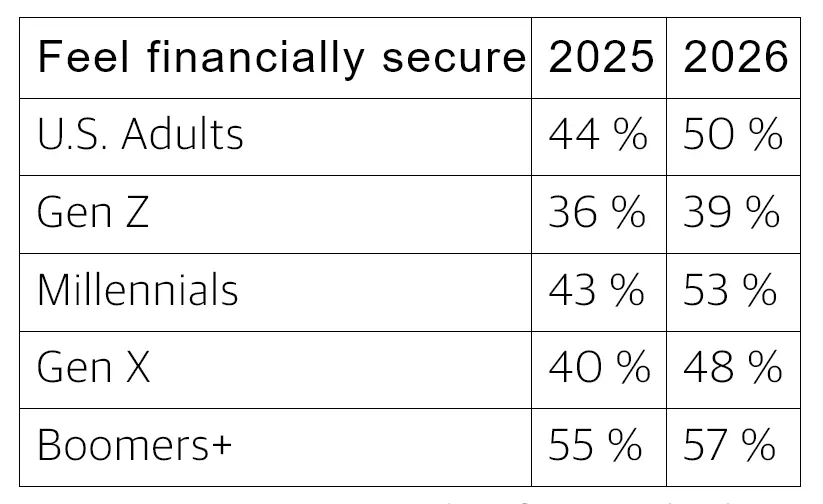 (Source: Northwestern Mutual)
While headline inflation has cooled to 2.4 percent in January 2026 and real average hourly earnings rose 1.2 percent over the year, households continue to face acute financial strain from everyday expenses. A February survey found 87 percent of Americans believe the U.S. is in a cost-of-living crisis, with more than half struggling to pay bills such as rent on time and 50 percent unable to afford necessities like groceries.
(Source: Northwestern Mutual)
While headline inflation has cooled to 2.4 percent in January 2026 and real average hourly earnings rose 1.2 percent over the year, households continue to face acute financial strain from everyday expenses. A February survey found 87 percent of Americans believe the U.S. is in a cost-of-living crisis, with more than half struggling to pay bills such as rent on time and 50 percent unable to afford necessities like groceries.
Housing Affordability Crisis
Housing remains a critical pressure point. The typical U.S. rent in February stood at $1,895, a nearly 2 percent yearly increase, and two in three renters do not believe they can buy a home they want in the foreseeable future. Data shows nearly 70 percent of renters were forced to move in the last two years due to rising housing costs, and 75 percent say housing costs played a role in accumulating the debt that led them to seek help.
Rising Debt Burdens
Consumer debt continues to mount. Federal Reserve data shows credit card balances hit $1.28 trillion at the end of 2025, up $44 billion in a single quarter, with interest rates remaining above 20 percent. The average U.S. family carries more than $268,060 in mortgage debt and approximately $6,523 in credit card debt, with essential costs rising 20 to 25 percent over four years while incomes have not kept pace.
Financial Anxiety and Generational Divide
Retirement Confidence Gap
Americans believe they will need $1.26 million to retire comfortably, yet 70 percent hold personal debt averaging $21,500, with credit cards as the primary source. Nearly half of Americans admit they do not understand how taxes could impact their retirement and have not factored taxes into their financial planning.
Gen Z’s Big Risk Appetite
The Northwestern Mutual study found that among Gen Z respondents who feel financially behind, nearly one-third are currently invested in or considering prediction markets or sports betting. The percentage of adults who believe owning a home is financially affordable rose to 54 percent for Gen Z in 2026, up from 42 percent in 2025, partly driven by parents planning to help: nearly three-quarters of parents with children at home have thought about or started financial planning to help their children purchase a home.
Industry Expert Perspectives
“Financial Nihilism” as Rational Response
John Roberts, Northwestern Mutual’s chief field officer, described the phenomenon: “Among a segment of those feeling financially insecure, a sense of financial nihilism is setting in. They’re effectively saying they haven’t saved enough and aren’t earning the returns they want in a long-term focused portfolio, so may as well swing for the fences.”
CoinFund managing partner David Pakman, speaking at Consensus Hong Kong, reframed this behavior as “economic nihilism”—a calculated response to structural barriers in wealth building. He noted that housing costs have shifted dramatically: for Gen X and Boomers, the average home cost about 4.5 times annual salary; for Gen Z, it is closer to 7.5 times, effectively shutting younger people out of the housing market.
“It’s becoming actually rational to think that if the typical ways that long-term wealth creation is closed off to you, a small chance at a large return beats near certainty of slow decline,” Pakman said.
Concerns About Information Asymmetry
Roberts also highlighted risks in prediction markets: “There is asymmetry in the prediction markets for sure, you can’t prove it, but it’s there, and that for me is a big distinction between regulated securities and betting.” The study found women were half as likely as men to use speculative assets.
Advisor Skepticism
Schwab CEO Rick Wurster voiced concerns about the overlap between gambling and investing: “I hope as an industry, we’re able to tell the story to clients about the difference between gambling and investing.” He noted that sports betting constitutes 95 percent of prediction markets volume and should remain with gambling platforms, though true prediction markets based on economic indicators could eventually make sense within investment portfolios.
FAQ: Americans Turning to Crypto and Speculative Assets
Q: What percentage of Americans feel financially behind and turn to speculative assets?
A: According to the Northwestern Mutual study, 73 percent of Americans using or considering speculative assets such as crypto, prediction markets, and sports betting say they do so because they feel financially behind. Among Gen Z and Millennials in that group, 80 percent believe high-risk investments offer a faster path to their goals than traditional methods.
Q: What economic factors are driving this trend?
A: Persistent cost-of-living pressures include housing costs forcing nearly 70 percent of renters to move, credit card debt reaching $1.28 trillion with interest rates above 20 percent, and essential costs rising 20 to 25 percent over four years while incomes stagnate. Two in three renters do not believe they can afford to buy a home.
Q: What is “financial nihilism” and how does it relate to crypto?
A: Financial nihilism refers to the belief that traditional wealth-building methods no longer work fast enough for ordinary people. Industry experts describe it as a rational response to structural barriers—when conventional paths like homeownership are closed off, younger generations turn to high-risk assets like crypto as a “catch-up trade” rather than reckless gambling.
Q: How do industry leaders view prediction markets compared to traditional investing?
A: Executives express caution. Schwab’s CEO distinguishes between gambling—which constitutes 95 percent of prediction markets volume—and true prediction markets for economic indicators. Northwestern Mutual warns of information asymmetry, noting women are half as likely as men to participate, suggesting differences in risk perception.
Disclaimer: The information on this page may come from third parties and does not represent the views or opinions of Gate. The content displayed on this page is for reference only and does not constitute any financial, investment, or legal advice. Gate does not guarantee the accuracy or completeness of the information and shall not be liable for any losses arising from the use of this information. Virtual asset investments carry high risks and are subject to significant price volatility. You may lose all of your invested principal. Please fully understand the relevant risks and make prudent decisions based on your own financial situation and risk tolerance. For details, please refer to
Disclaimer.


