OpenClaw has sparked a nationwide “Lobster Farming” craze in China. China United Securities pointed out that domestic giants are rushing to enter the market to compete for the traffic entrance of the Agent era. Ultra-low-cost APIs are triggering massive computational power consumption, coupled with government subsidies. China is reshaping the AI market with a “cost + traffic + policy” triple advantage.
(Background: China crazy about installing OpenClaw, official warnings of potential “industrial production line out of control”)
(Additional context: After OpenClaw’s explosion: How a single open-source lobster is influencing U.S. stocks?)
The open-source AI intelligence software OpenClaw has ignited a nationwide “Lobster Farming” fever in China. Nearly a thousand people queued outside Tencent’s headquarters in Shenzhen to install it, from programmers to retired engineers, housewives, and even elderly people actively participating.
The speed and enthusiasm with which Chinese people embrace AI have amazed foreigners.
“Quite amazing!” wrote Philip Sun, Asia Sales at Goldman Sachs, in a memo. “The young Chinese investors I’ve interacted with already have several ‘lobsters’… One responsible for summarizing market news every morning, another analyzing whether investment decisions are too emotional, and even a ‘supervisor lobster’ watching over the others.”

( Tencent employees set up a booth outside Shenzhen headquarters, offering free OpenClaw installation for passersby)
This wave of “AI Lobster” fever not only shocked Wall Street but also triggered a deep reassessment of the “Western Lobster, Eastern Farming” industry logic. On March 11, China United Securities released a research report titled “Western Lobster, Eastern Farming — A Comparison of OpenClaw Development in China and the U.S.,” analyzing the underlying business logic of this trend.
“Western Lobster, Eastern Farming”: The Chinese Logic of Industry Implementation
Although OpenClaw originated abroad, after February, the Chinese market quickly adopted and scaled its application, showing a unique “Western Lobster, Eastern Farming” characteristic.
The report believes that this wave of “Eastern Lobster” is mainly driven by domestic giants’ “FOMO” anxiety over OpenClaw’s market trend. In reality, it reflects an ecological mismatch between domestic and overseas AI application deployment in the Agent era. Compared to overseas, China has cost, traffic, and policy advantages in this “lobster wave.”
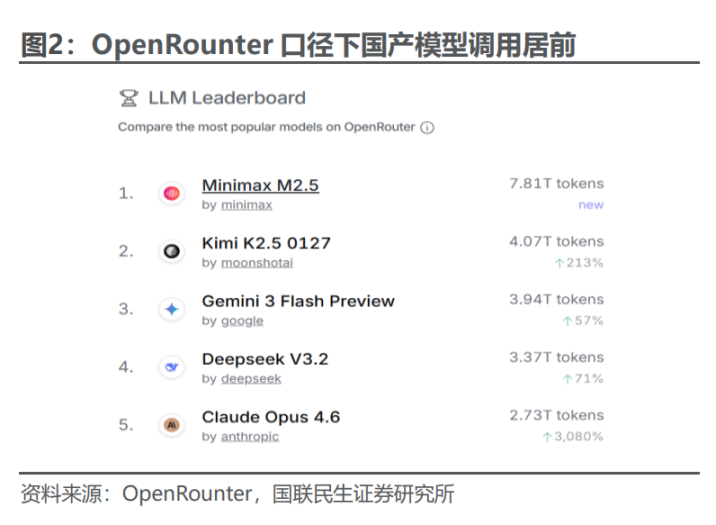
From a cost perspective, China’s large model ecosystem has formed a unique “low-cost API” barrier. The report notes: “The API call price for domestic models is about one-sixth of similar overseas products.” This advantage stems from cheaper electricity powering domestic computing, more flexible hardware configurations, and fierce competition among model vendors.
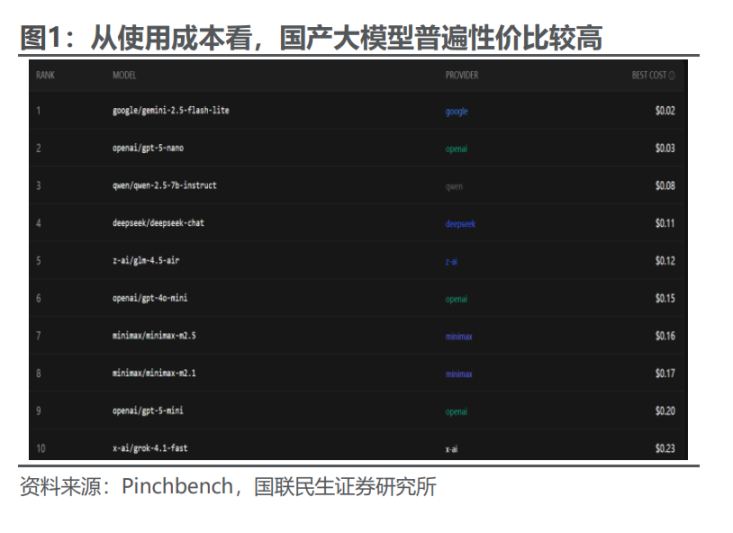
Moreover, driven by OpenClaw, the consumption of tokens in domestic models has accelerated. Data from OpenRouter shows recent peaks in large model usage, with steep growth rates, and China’s models rank high in token consumption. The rapid increase in token usage also proves the cost advantage.

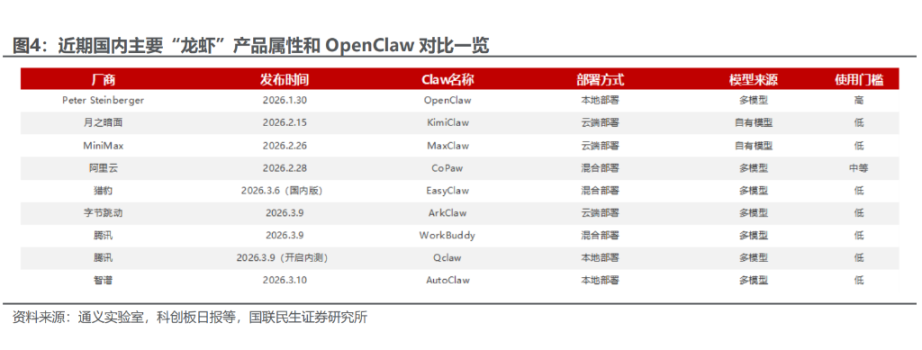
From a traffic perspective, active participation by major companies is key to the “Lobster Fever” explosion. With Zhipu launching “AutoClaw” on March 10, domestic “lobster products” have extended deployment methods to local, cloud, and hybrid setups.
For internet giants, deploying OpenClaw may not only boost revenue from Agent services but also involve competing for the potential “new distribution rights” in the Agent era. Looking ahead, as Agent deployment continues, interactions between humans and the digital world may undergo a new restructuring — as operational control shifts from humans to Agents, new traffic entrances could also migrate.
For major companies, although OpenClaw may still face technical immaturity, its shift of AI from “Chat” to “Work” could trigger market concerns over changes in new platform entry points, leading to widespread FOMO and active deployment. Additionally, giants like Tencent, leveraging their social viral effects, could further boost traffic attention, spreading societal focus on the “Lobster Wave.”
From a policy perspective, cities like Shenzhen and Wuxi have taken the lead with special policies. The report mentions that Wuxi High-tech Zone issued 12 “Lobster Farming” policies, with individual support up to 5 million yuan, covering talent recruitment, industry landing, and safety compliance.
-
On March 8, Shenzhen announced that the Longgang District AI (Robotics) Bureau is soliciting opinions on the “Measures Supporting OpenClaw & OPC Development” draft, encouraging market-oriented, professional platform carriers to launch “Lobster Service Zones,” offering free deployment services for OpenClaw and subsidies for qualified entities.
-
On March 9, Wuxi High-tech Zone released “Measures for Supporting the Integration of OpenClaw and Other Open Source Community Projects with the OPC Community.” The 12 “Lobster Farming” policies support everything from basic support to industry landing, talent recruitment, and safety compliance, with individual support up to 5 million yuan.
In terms of deployment, local cloud platforms offering free deployment and development kits will receive full subsidies of up to 1 million yuan.
“Localization” of Deployment Models and Model Selection
The latest development in this wave is the direct involvement of leading large model vendors.
China United Securities pointed out in their report: “On March 10, Zhipu officially launched AutoClaw (Chinese name: AoLong) — a one-click installable local version of OpenClaw with full capabilities.”
According to Zhipu’s description: “AutoClaw AoLong comes preloaded with over 50 mainstream skills, ready to use out of the box, covering high-frequency scenarios such as content creation, office work, coding, marketing, and financial research, supporting one-click integration with tools like Feishu.”
Not only Zhipu, but domestic giants are actively participating in localization. Since February, companies like Zhipu, MiniMax, and major cloud providers have released related Claw products.
China United Securities observed that domestic products now show distinct features in deployment methods and model sources.
In deployment, they clearly state: “The participation of various entities in this ‘Lobster Wave’ shows a ‘flowering’ scene.” Unlike overseas OpenClaw, which emphasizes local deployment, domestic “Lobster products” feature local, cloud, and hybrid deployment options, offering greater flexibility. The report suggests this is mainly because domestic “Lobster products” focus more on deployment convenience and security.
Regarding model integration, the report emphasizes: “Currently, most domestic entities use multi-model matching, but some choose to rely solely on their own models.” Compared to the broad support in overseas versions, domestic “Lobster products” mainly support invocation of mainstream domestic large models, with some only supporting their own models.
Overall, the report believes that under the “Lobster Fever” driven by this wave of OpenClaw, China’s AI application deployment, demand acceleration, and industry chain prosperity remain the main trends.