Welcome to Latam Insights, a compilation of the most relevant crypto news from Latin America over the past week. In this edition, Paraguay strengthens its crypto reporting requirements, Argentina blocks operations for a peso stablecoin, and new revelations surge in the case against Libra in Argentina.
Paraguay Strengthens Mandatory Reporting Requirements for VASPs and Individuals
The government of Paraguay is ramping up the scrutiny of the cryptocurrency market.
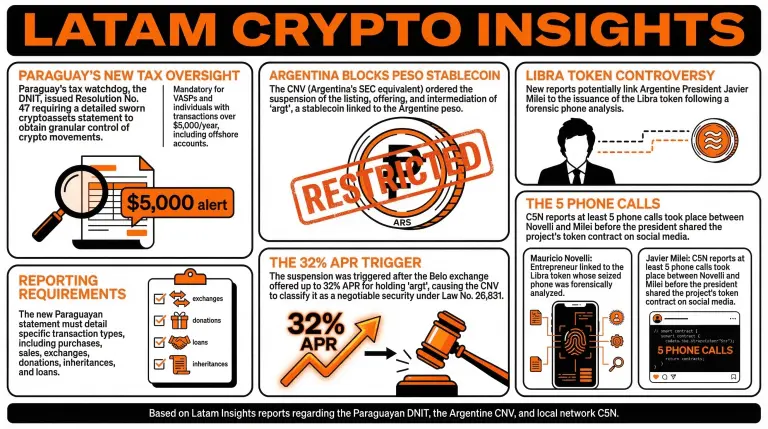
The National Directorate of Tax Revenue (DNIT), Paraguay’s tax watchdog, has issued a resolution creating a new figure, a sworn cryptoassets statement, to obtain a more granular control and oversight of the crypto movements in the country.
Resolution No. 47 establishes that both operators of virtual asset service providers (VASPs) and individuals making crypto transactions with volumes going over $5,000 per year, even if transacting using offshore accounts or outside exchange platforms, must issue this detailed statement.
The document must identify, at the very minimum, the class of transaction completed -purchases and sales, holding or possession, exchanges between different crypto assets, donations, inheritances, temporary assignments, rentals, or loans, among others.
Read more.
Argentine Securities Regulator Blocks Peso Stablecoin Operations
The Argentine equivalent of the SEC, the CNV, executed the first measure against a stablecoin linked to the national fiat currency, the Argentine peso.
On March 12, the institution issued a resolution ordering the suspension of the listing, offering, and intermediation of argt, stating that the token was classified as a security offered to investors without complying with the rules established for these assets.
The action comes after Belo, an exchange that listed the stablecoin, offered up to 32% in APR, introducing a return promise linked to holding the virtual asset. As a consequence, the CNV assessed that this would make it “fall under the figure of an investment contract included in the definition of negotiable security provided for in article 2 of Law No. 26,831 of the Capital Market, which results in its classification as a negotiable security subject to the public offering regime.”
Read more.
Libra Case: Milei Had Continuous Communication With Associates Before Token Launch
The Libra case might take a new turn after reports potentially linking President Javier Milei to the token issuance.
According to local reports, a forensic analysis of the seized phone of Mauricio Novelli, one of the entrepreneurs linked to the issuance of Libra, shows several phone calls and communications directed to President Javier Milei’s phone at the time of the token issuance.
C5N, one of the largest news networks in Argentina, stressed that there were at least 5 phone calls between Novelli and Milei before the president shared the project’s token contract with his followers on social media channels.
Read more.
FAQ
- What new crypto regulations were introduced in Paraguay?
Paraguay is implementing stricter reporting requirements for VASPs and individuals executing crypto transactions over $5,000 annually.
- What action did Argentina’s CNV take regarding peso stablecoin operations?
The CNV suspended the listing and trading of the argt stablecoin for failing to comply with securities regulations.
- What recent developments have emerged in the Libra case in Argentina?
Reports suggest President Javier Milei was in contact with associates linked to the Libra token before its launch, indicating potential involvement.
Disclaimer: The information on this page may come from third parties and does not represent the views or opinions of Gate. The content displayed on this page is for reference only and does not constitute any financial, investment, or legal advice. Gate does not guarantee the accuracy or completeness of the information and shall not be liable for any losses arising from the use of this information. Virtual asset investments carry high risks and are subject to significant price volatility. You may lose all of your invested principal. Please fully understand the relevant risks and make prudent decisions based on your own financial situation and risk tolerance. For details, please refer to
Disclaimer.


