
Solana’s popular self-custody crypto wallet Phantom received a no-action letter from the U.S. Commodity Futures Trading Commission (CFTC) Market Participants Division on March 17, allowing it to connect users directly to CFTC-registered derivatives markets as a non-custodial interface without registering as an introducing broker.
Core Conditions and Scope of the CFTC No-Action Letter
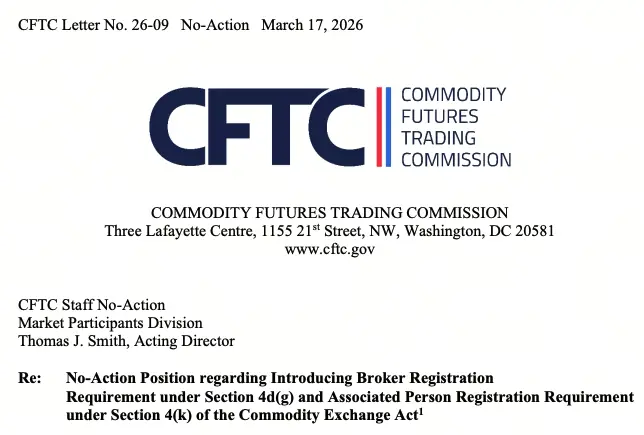 (Source: CFTC)
The CFTC Market Participants Division confirmed that as long as Phantom meets certain conditions, the regulator will not recommend enforcement action against it. The key elements of this permission framework include:
Pure Interface Position: Phantom functions as a non-custodial software layer interface, with users submitting orders directly to CFTC-registered entities (futures commission merchants and designated contract markets). Phantom does not facilitate trade matching.
No Customer Funds Held: Customer assets remain under the control of the users at all times; Phantom does not hold any customer funds.
Connected to Registered Compliance Entities: The connected trading platforms must be officially registered and compliant with CFTC regulations.
Scope of Regulated Products: The exemption applies to derivatives contracts and event contracts regulated by the CFTC.
Based on this framework, Phantom users can access regulated derivatives and event contracts directly within the app while maintaining the integrity of a non-custodial wallet.
Regulatory Breakthrough for Non-Custodial Interfaces: Bridging DeFi and TradFi Compliance
The core innovation of this CFTC no-action letter is that it explicitly clarifies the compliance boundaries for non-custodial interfaces within the existing regulatory framework. Crypto wallet providers have long faced the challenge of how to legally integrate regulated financial products without completing full financial institution registration.
Phantom’s case provides a practical industry pathway: through a clear non-custodial architecture, direct connection to CFTC-registered compliant entities, and no involvement in fund custody or order mediation, non-custodial wallet applications may under certain conditions be exempt from broker-dealer registration obligations. If widely adopted, this model could open a channel for crypto-native users to access regulated derivatives within a single app without switching to traditional brokerage accounts.
Proactive Compliance Strategy: Regulatory Communication Over Post-Event Remedies
Phantom CEO Brandon Milman emphasized in a blog post that the company deliberately adopted a “proactive communication with regulators before product development,” contrasting with the industry norm of “building systems first, seeking approval later.” He stated, “Ensuring the security and usability of cryptocurrencies hinges on building financial products under clear, rational regulatory constraints. Early communication with regulators when necessary can lead to better outcomes for users, the industry, and regulators themselves.”
Phantom noted that early discussions with the CFTC helped clarify how non-custodial interfaces operate under current rules, establishing a regulatory consensus before formal application.
Frequently Asked Questions
Q: What specifically does the CFTC no-action letter granted to Phantom permit?
A: The CFTC confirmed that Phantom, as a non-custodial interface connecting users directly to CFTC-registered derivatives markets, can operate without holding customer funds, without mediating trades, and by connecting directly to registered compliant entities. This exempts it from the requirement to register as an introducing broker, enabling legal integration of regulated derivatives and event contracts within the app.
Q: Why is this case described as “the first” or “unprecedented”?
A: Previously, regulators had never explicitly clarified the compliance pathway for non-custodial wallet interfaces in derivatives markets. Phantom’s no-action letter is the first case to receive formal CFTC stance under this architecture, providing a regulatory precedent and operational template for other crypto wallets seeking regulated derivatives access.
Q: What does this ruling mean for other Solana wallets and crypto wallet providers?
A: If other non-custodial wallet providers adopt a similar architecture—no customer fund custody, no trade mediation, acting solely as an interface connecting to CFTC-registered entities—they can seek similar regulatory confirmation from the CFTC based on Phantom’s precedent, expanding compliant access to regulated financial products within their applications.
Disclaimer: The information on this page may come from third parties and does not represent the views or opinions of Gate. The content displayed on this page is for reference only and does not constitute any financial, investment, or legal advice. Gate does not guarantee the accuracy or completeness of the information and shall not be liable for any losses arising from the use of this information. Virtual asset investments carry high risks and are subject to significant price volatility. You may lose all of your invested principal. Please fully understand the relevant risks and make prudent decisions based on your own financial situation and risk tolerance. For details, please refer to
Disclaimer.


