A NFT creator with 220,000 followers shared their monthly OpenClaw AI Agent business bill, with fixed expenses of $705 and zero income.
(Background: OpenClaw update next week: support for Claude Code and OpenAI Codex)
(Additional context: After OpenClaw’s explosion in popularity: how a small open-source lobster shook up the US stock market?)
In the AI tools era, a fixed monthly cost of $205—Claude Max Plan $200 plus Brave Browser $5—is one of the lowest barriers to entry for starting a business. Plus a one-time hardware cost of $500 for a Mac Mini. BentoBoiNFT posted their bill on X, and the content is actually quite conservative.
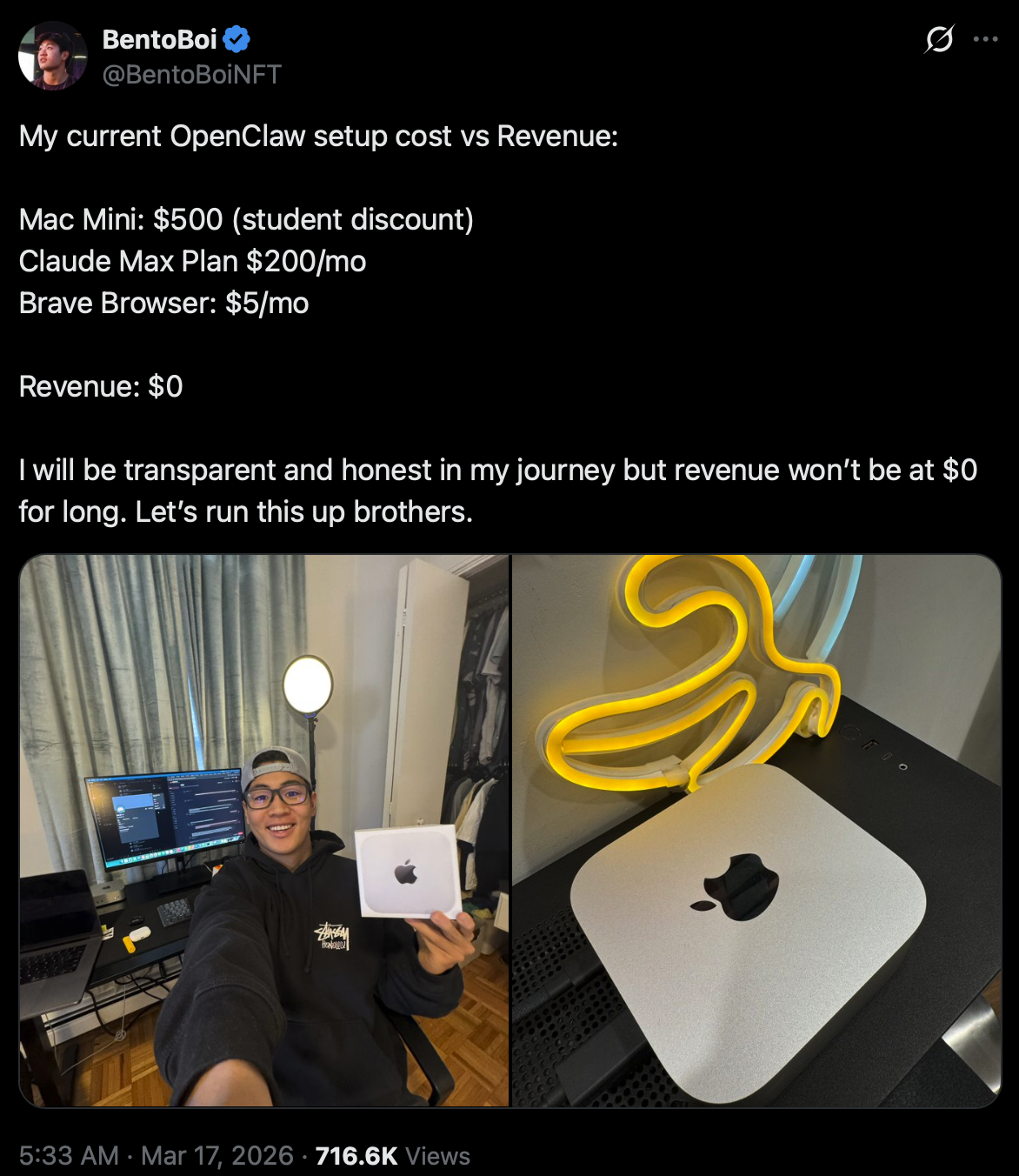
This screenshot on X received 7,102 likes and 3,962 saves, with an unusually high save rate, indicating many people in similar situations are quietly tracking their expenses.
What’s truly worth analyzing isn’t how outrageous the bill is, but how long the “zero” income column will last. An AI Agent business with zero income, like any other zero-income venture, is fundamentally no different. Many “AI entrepreneurs” seem to forget this.
The Overlooked 92.4% on Polymarket
The most circulated success story of an AI Agent is a Claude AI Agent turning $1,000 into $14,216 in 48 hours. The speed of this story’s spread far exceeds another figure on the same platform: on Polymarket, 92.4% of traders ultimately lose money.
The data tells us a different story. A 1,322% return isn’t proof of a strategic advantage in prediction markets; it’s more likely a one-off arbitrage or luck event in a market with limited liquidity. Using this case as a benchmark for AI Agent trading ability is like evaluating financial plans based on lottery jackpot winnings.
A 92.4% loss rate means that if an AI Agent trades on Polymarket, it’s very likely in that 92.4%. Unless you have strong reasons to believe your setup falls into the remaining 7.6%, “I used Claude” isn’t a valid reason.
The bill itself isn’t the problem; expectations are
Returning to BentoBoiNFT’s bill, what does $205 a month buy? Access to the high-limit Claude Max Plan, and an experimental environment to test AI Agent business models. From a startup trial-and-error perspective, this number is reasonable.
The real question is: how many people pay this fee without clearly defining what “success” means, or how long it takes to validate their hypotheses?
The market is always right—until it’s not. The 7,102 likes reflect that many people are in the same situation: paying the bill, with the income column empty, but uncertain whether they’re testing a hypothesis or have already failed.
I hope every AI entrepreneur understands that zero income isn’t necessarily the end, but you must set a deadline to break that zero. Otherwise, it’s time to fold.

Disclaimer: The information on this page may come from third parties and does not represent the views or opinions of Gate. The content displayed on this page is for reference only and does not constitute any financial, investment, or legal advice. Gate does not guarantee the accuracy or completeness of the information and shall not be liable for any losses arising from the use of this information. Virtual asset investments carry high risks and are subject to significant price volatility. You may lose all of your invested principal. Please fully understand the relevant risks and make prudent decisions based on your own financial situation and risk tolerance. For details, please refer to
Disclaimer.


