
Nvidia DLSS 5 Technology Demonstration Receives Negative Reviews, Players Criticize It for Ruining Game Art. Jensen Huang Responds by Saying Developers Have Full Control, but Foreign Media Report That Capcom Employees Were Unaware of the Preview in Advance; Industry Opinions on AI Neural Rendering Are Divided.
Nvidia DLSS 5 Tech Demo Faces Overwhelming Negative Feedback
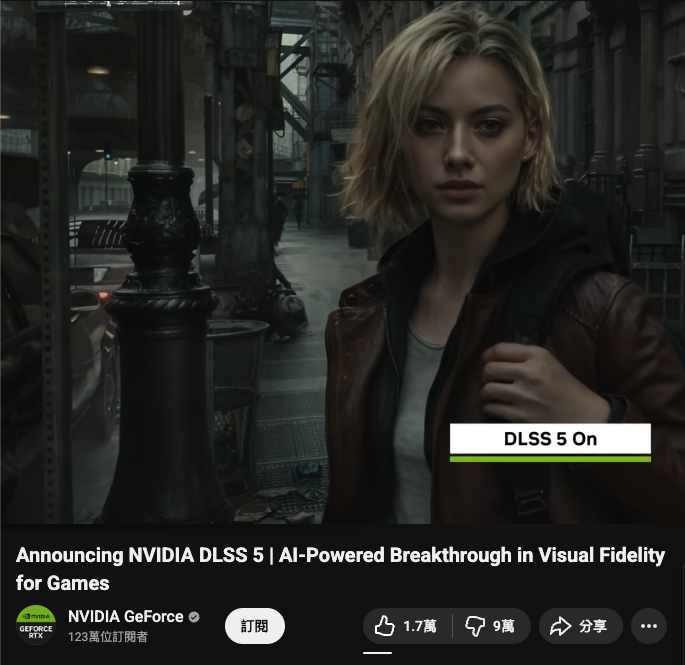
Recently, graphics card giant Nvidia released a demo video of DLSS 5, showcasing games like “Resident Evil 9: Village of Shadows” and “Assassin’s Creed: Shadows,” but it sparked a wave of negative reviews from players. The most viewed video on Nvidia’s official YouTube channel has only 1 like and 90,000 dislikes.
Based on Steam game reviews, this kind of feedback can be considered overwhelmingly negative.
Many players and streamers focused on the appearance changes of protagonist Grace Ashcroft, believing that the processed visuals are overly smooth and lack realism, masking the carefully crafted art style originally designed by the development team.
Jensen Huang Claims DLSS 5 Critics Are Completely Wrong
In response to external criticism, Nvidia CEO Jensen Huang stated during a Q&A at GTC 2026 that these players’ opinions about the technology are entirely wrong. DLSS 5 combines the control of game geometry and textures with generative AI technology, belonging to a level of geometric generation control, which Nvidia calls “Neural Rendering.”
Huang emphasized that game developers can still fine-tune how the generative AI operates, including adjusting game visuals to cartoon styles or glass-like effects. All content control remains entirely in the hands of the developers.
- Related report: Grace becomes AI face? Nvidia DLSS 5 uses Resident Evil 9 for demonstration, massive player criticism, tech community defends
Foreign Media Reports Capcom and Ubisoft Employees Were Unaware in Advance
Meanwhile, gaming media outlet Insider Gaming reached out to developers who adopted DLSS 5 for their opinions.
Capcom and Ubisoft developers revealed that they learned about the demo content simultaneously with the public, without prior notice. One Ubisoft employee said, “We found out about it together with everyone else.”
Capcom developers noted that their company was relatively conservative regarding AI technology during previous projects. Some internal staff worry that this presentation indicates a shift in the publisher’s attitude toward generative AI and its application in games.
Capcom’s technical director, Ichiki Abe, disclosed last year that they are currently using generative AI to increase pre-production efficiency. One of the most time-consuming and labor-intensive parts of game development is coming up with thousands of unique ideas, which requires multiple options, each including illustrations and text to communicate concepts to art directors and artists.
Therefore, they built a system that allows generative AI to read various game design documents and generate ideas, improving development speed and efficiency, while also providing feedback during the process to further refine the results.

Image Source: Capcom Resident Evil 9 Village of Shadows Main Visual Promotional Art
Epic Games Producer Supports DLSS 5 Despite Backlash
Although DLSS 5 faces a lot of negative reviews, Epic Games’ chief producer Jean Pierre Kellams publicly supports it.
He believes DLSS 5’s improvements in lighting and shadows are remarkable, capable of achieving physically accurate effects with very low resource consumption. If this technology showcases next-generation hardware rather than AI, players would be as amazed as they were when seeing Ubisoft’s Watch Dogs visuals.
Former Intel senior executive and current president of data center and IT infrastructure marketing firm Signal65, Ryan Shrout, also commented that the visual enhancements of DLSS 5 are very obvious, and the focus on character faces is overemphasized; the technology improves entire scenes comprehensively.
For example, in the indoor scenes of “Starfield,” the once dull coffee machine now appears natural and three-dimensional after enabling DLSS 5, with clearer spatial relationships between objects and the environment.
Former R star Animator Warns DLSS 5 Replaces Original Creations
However, Mike York, a former Rockstar animator involved in “Red Dead Redemption 2,” criticized that, based on the “Resident Evil 9” demo, DLSS 5’s changes are not limited to lighting but also alter background textures like columns.
DLSS 5 essentially allows AI to re-render each frame from scratch, which cannot perfectly reproduce the original image, leading to visuals that diverge from the game’s initial design.
He worries that if DLSS 5 becomes a widespread quick fix for high-quality visuals, future players will experience AI-generated versions, replacing the original artistic intent of developers.
Senior editor Simon Cardy from IGN believes that if generative AI like DLSS 5 is allowed to develop unchecked in game visuals, it could implicitly permit developers to neglect art direction, doing only basic work and letting AI fill in the gaps.
As a player, she wants to see human-created art, to know whether a scene’s lighting was carefully designed or if character facial details were meticulously crafted.
Further Reading:
Project Genie creates interactive worlds causing gaming stocks to plummet; GTA parent company: Public has misconceptions about creation
Disclaimer: The information on this page may come from third parties and does not represent the views or opinions of Gate. The content displayed on this page is for reference only and does not constitute any financial, investment, or legal advice. Gate does not guarantee the accuracy or completeness of the information and shall not be liable for any losses arising from the use of this information. Virtual asset investments carry high risks and are subject to significant price volatility. You may lose all of your invested principal. Please fully understand the relevant risks and make prudent decisions based on your own financial situation and risk tolerance. For details, please refer to
Disclaimer.


