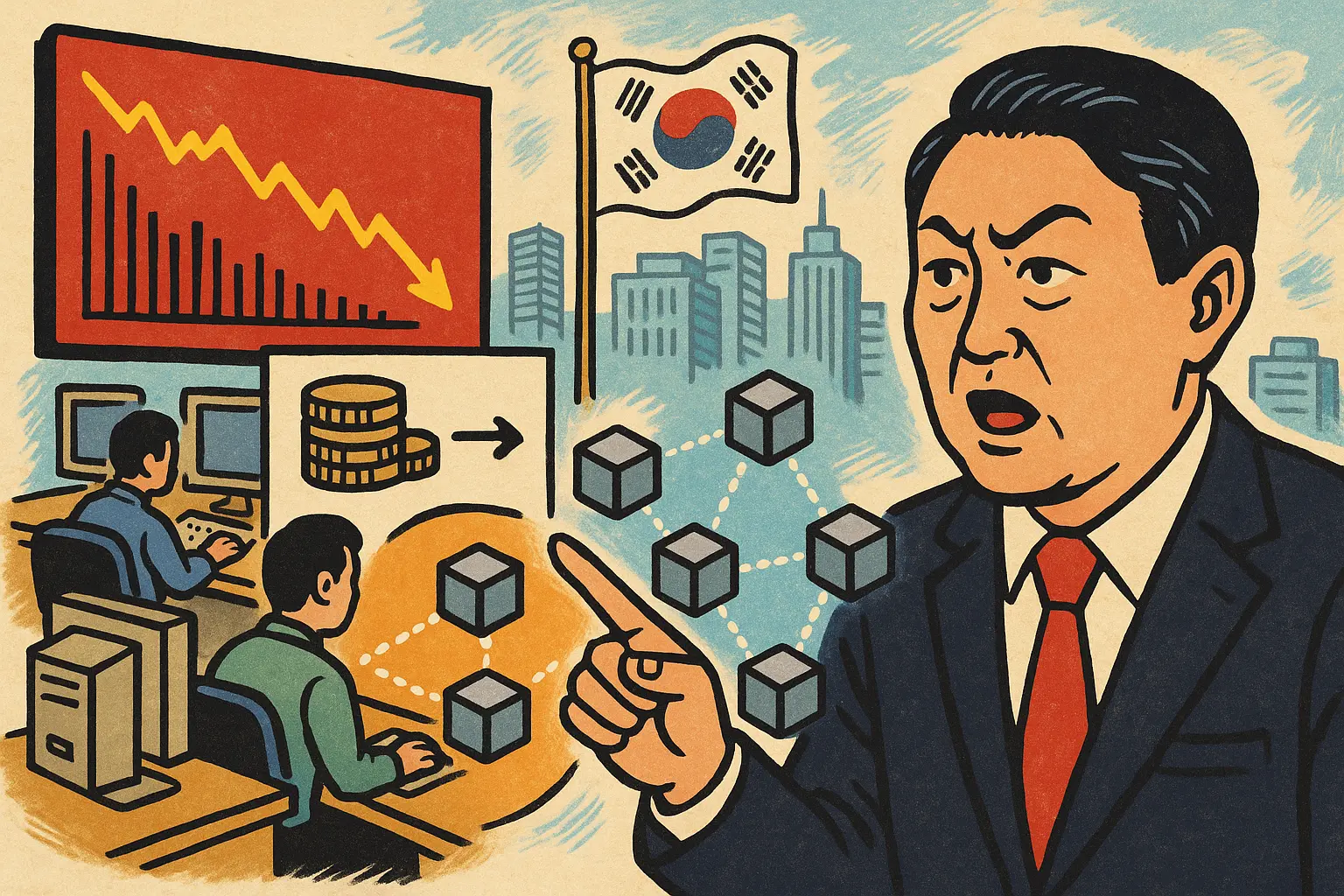
South Korean President Lee Jae-myung recently questioned the current stock settlement system directly: “Why do I have to wait until the day after tomorrow to receive the money after selling stocks today?” This question has triggered a series of reactions at the official level. The chairman of the Korea Exchange, Jeong Eon-woo, immediately stated that he would promote shortening the settlement cycle and for the first time mentioned the potential role of blockchain technology in an official setting, indicating that if blockchain trading is introduced, “the clearing and settlement processes could disappear, shifting instead to an instant payment model.”
The Operating Logic and Efficiency Bottlenecks of the T+2 System
Currently, South Korea’s stock market adopts a “T+2” settlement system, meaning that funds and securities are officially transferred two business days after the transaction is completed. This mechanism is built on the complex processes of counterparty risk management and fund allocation by clearing institutions. While it has been reasonable historically, in the era of high-speed digital trading, it is increasingly viewed as an efficiency bottleneck.
The issues with T+2 are not just about “waiting two days”—during weekends or long holidays, the settlement period can extend to T+3 or even T+4. After the 2021 GameStop incident, US-based Robinhood strongly lobbied regulators to reform the clearing system using similar logic, ultimately pushing the US stock market to shorten the settlement cycle from T+2 to T+1. However, even then, Robinhood CEO Vlad Tenev openly stated, “It’s still too slow, and risks still exist.”
The Significance of Korea Exchange’s First Mention of Blockchain: Policy Signal
Chairman Jeong Eon-woo’s statement carries important policy implications. In the past, discussions about shortening the settlement cycle mostly remained within the framework of “streamlining existing processes.” This time, the official explicitly mentioned blockchain technology for the first time, indicating that the reform approach has shifted from optimizing the current system to considering replacing the underlying infrastructure.
Recently, South Korea’s stock market has performed strongly. After February 27, due to geopolitical events, trading was halted for two days, but it quickly recovered, and by the time of this writing, it was less than 10% below its all-time high. Against the backdrop of a market revival, the political will and market environment to promote modernization of the settlement system are aligned. South Korea may become a leading case in Asia for exploring on-chain settlement.
Stock Tokenization: The Underlying Technology Path for T+0 Real-Time Settlement
To truly achieve T+0 instant settlement, the most convincing technological approach is stock tokenization. Converting stocks into tokens on the blockchain will fundamentally change the clearing architecture:
- Real-time Settlement: Delivery occurs immediately after the transaction, eliminating counterparty risk during the settlement period.
- 24/7 Trading: No longer limited by traditional market hours, increasing market liquidity.
- Fractionalization: Lowering the entry barrier for retail investors to high-priced stocks.
- Lower Clearing and Capital Costs: Clearing houses and brokerages do not need to bear significant uncertainties during settlement.
Last year, the US completed the transition from T+2 to T+1, and Europe plans to follow suit. Major global markets are racing to modernize their settlement systems. If South Korea successfully adopts blockchain infrastructure, it will gain a significant institutional advantage in the competitive Asian capital markets.
Frequently Asked Questions
Q: What is the T+2 settlement system, and why does South Korea want to reform it?
A: T+2 means that funds and securities are officially transferred two business days after the stock transaction is completed. South Korea currently uses this system, but in the high-speed digital trading environment, it is inefficient. During weekends or long holidays, the settlement can extend to T+3 or T+4. President Lee Jae-myung’s public questioning has prompted official discussions on reform.
Q: What does the blockchain settlement mentioned by the Korea Exchange mean?
A: The Korea Exchange chairman indicated that introducing blockchain technology could replace traditional clearing and settlement processes, enabling transactions to settle instantly. Essentially, this involves tokenizing stocks so that each transaction is completed directly on the blockchain without relying on multi-day processes by clearing institutions.
Q: How does stock tokenization differ from current stock trading?
A: Current stock trading relies on clearing institutions as an intermediary to manage counterparty risk, requiring several days to settle. With stock tokenization, transaction records are directly recorded on the blockchain, theoretically enabling instant delivery, 24-hour trading, and lower friction costs, while significantly reducing systemic risk.
Disclaimer: The information on this page may come from third parties and does not represent the views or opinions of Gate. The content displayed on this page is for reference only and does not constitute any financial, investment, or legal advice. Gate does not guarantee the accuracy or completeness of the information and shall not be liable for any losses arising from the use of this information. Virtual asset investments carry high risks and are subject to significant price volatility. You may lose all of your invested principal. Please fully understand the relevant risks and make prudent decisions based on your own financial situation and risk tolerance. For details, please refer to
Disclaimer.


