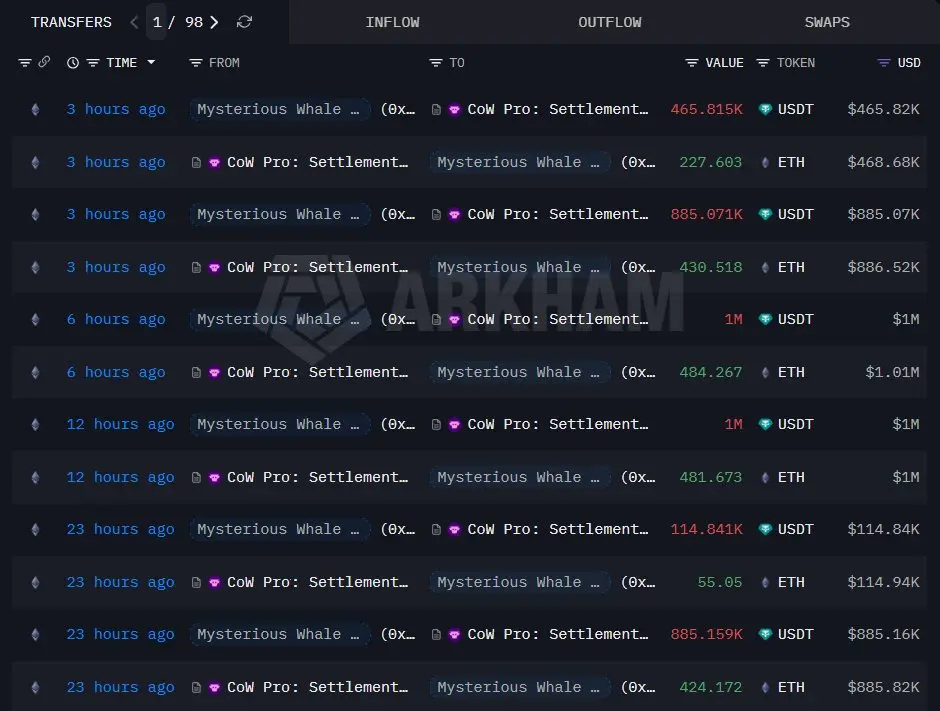
OnchainLens disclosed on March 23 that a mysterious whale address associated with the ShapeShift era withdrew USDT worth 4.35 million USD from the Aave platform and fully exchanged it for 2,103 ETH. After the transaction, the whale’s ETH holdings increased to 122,392 ETH, with a current market value of approximately $251.3 million.
Pattern of Two Transactions: The Accumulation Logic of the ShapeShift Era Whale
(Source: Arkham)
According to on-chain data from Arkham Intelligence, this whale address has been active since the ShapeShift era. ShapeShift was a pivotal period of transformation in the cryptocurrency exchange landscape, during which early users held tokens at very low costs.
Comparison of the two operations:
First operation: Withdraw $4.29 million USDT from Aave and purchase 2,012 ETH
Second operation: Withdraw $4.35 million USDT from Aave and purchase 2,103 ETH
Cumulative result: Over these two transactions, the whale increased its ETH holdings by more than 4,100 ETH, reaching a total of 122,392 ETH with a market value of about $251.3 million.
This pattern of executing nearly fixed-scale trades repeatedly within a short period indicates that the whale is employing a rhythmic, phased accumulation strategy rather than making a large one-time purchase. This approach helps to reduce market impact and avoid drawing attention.
DeFi Strategy Utilizing Aave Liquidity
The whale’s choice to withdraw USDT from Aave instead of directly selling ETH reflects a typical DeFi leverage accumulation strategy. By collateralizing assets on Aave to borrow USDT, then using the borrowed stablecoins to buy ETH at market lows, the whale maintains its original asset exposure while expanding its ETH position.
This operational structure allows the whale to continuously grow its holdings without triggering large-scale fund transfer alerts, while leveraging Aave’s instant liquidity to seize market opportunities. Currently, Aave is one of the largest decentralized lending protocols in the crypto space, providing a stable infrastructure for institutional-grade whale fund management.
Market Signal from 120,000 ETH Holdings
The systematic and large-scale accumulation of ETH by the whale sends multiple on-chain signals worth monitoring. Historically, when whales accumulate over 4,000 ETH through consecutive operations in a short period, it often leads to increased 24-hour trading volume for the ETH/USDT pair and attracts retail followings.
The inflow of institutional funds into DeFi platforms like Aave also indicates that large holders remain optimistic about Ethereum’s long-term value. Analysts are currently focusing on key technical levels, including support around $2,000 and resistance at $2,500, both of which have historically shown significant price reactions following similar whale accumulation events.
Frequently Asked Questions
Q: Why does this whale choose to withdraw USDT from Aave instead of directly buying ETH?
A: Withdrawing USDT from Aave instead of directly purchasing ETH with cash is a typical DeFi leverage strategy: borrowing stablecoins against existing collateral to buy target assets, thereby expanding holdings without selling the original assets. This approach preserves the potential for asset appreciation while increasing ETH holdings at market lows.
Q: What does holding over 120,000 ETH signify for the market?
A: Owning more than 120,000 ETH (roughly $2.5 billion market value) by a single address is a significant institutional-level position. Its systematic accumulation behavior is often interpreted as a bullish signal for ETH’s medium- to long-term trend, especially when employing the same strategy twice, indicating active positioning within specific price ranges.
Q: How can retail investors track whale on-chain activity?
A: Tools like OnchainLens, Arkham Intelligence, and Nansen can be used to monitor large addresses’ ETH transfers, Aave lending operations, and exchange inflows. Continuous ETH accumulation or USDT withdrawals by major addresses are typically important short-term market signals.
Disclaimer: The information on this page may come from third parties and does not represent the views or opinions of Gate. The content displayed on this page is for reference only and does not constitute any financial, investment, or legal advice. Gate does not guarantee the accuracy or completeness of the information and shall not be liable for any losses arising from the use of this information. Virtual asset investments carry high risks and are subject to significant price volatility. You may lose all of your invested principal. Please fully understand the relevant risks and make prudent decisions based on your own financial situation and risk tolerance. For details, please refer to
Disclaimer.


