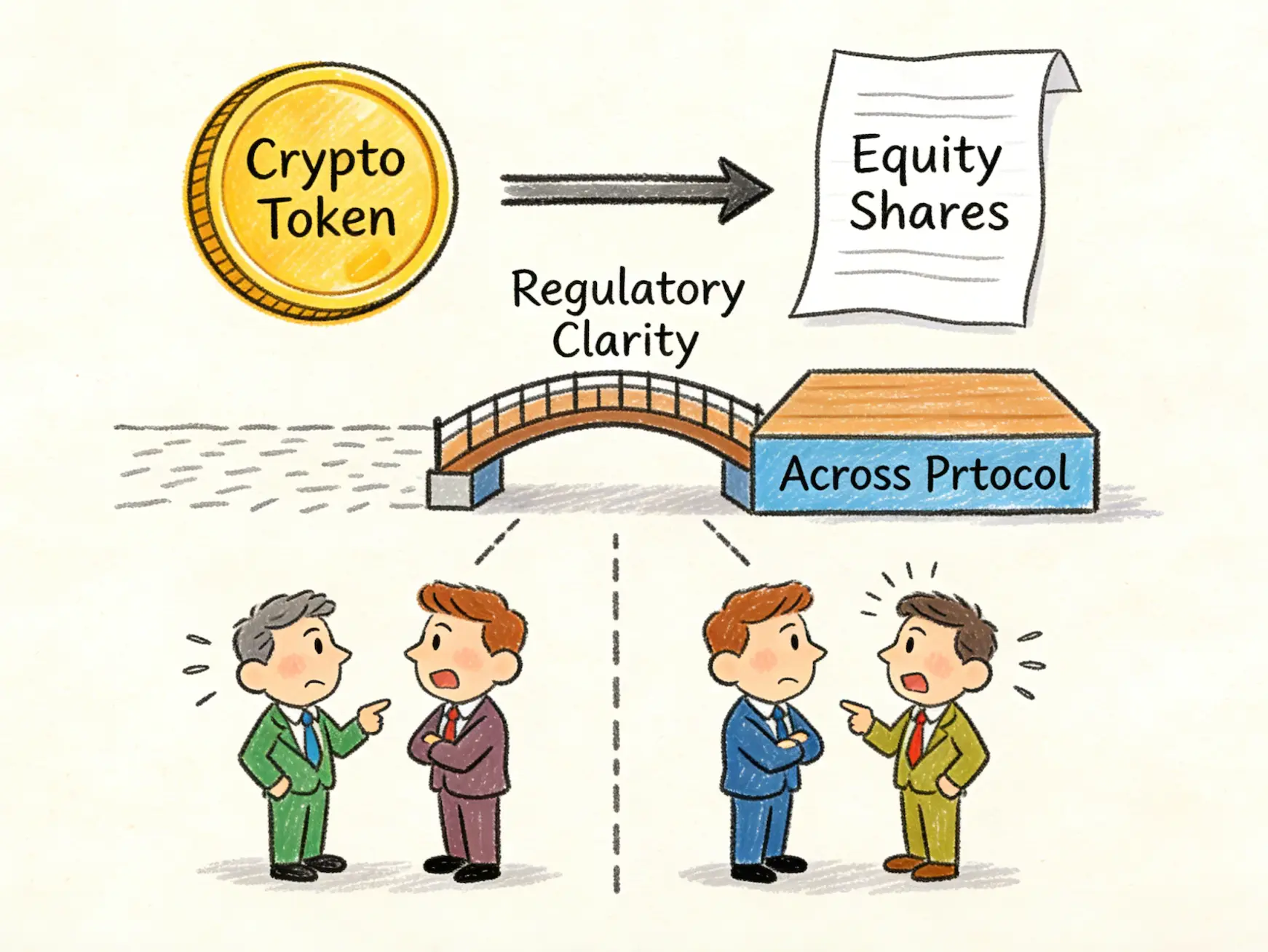
 Across Protocol, a Paradigm-backed bridge protocol, has initiated a temperature check proposal to transition from its token and DAO structure to equity and a corporate setup, citing challenges in forming partnerships and scaling under the current model.
The proposal has ignited broader industry discussion about whether more crypto projects may follow suit as regulatory clarity improves and institutional adoption grows. Investors and analysts suggest that while tokens will remain important for true protocols like Bitcoin and Ethereum, many application-layer projects are reconsidering decentralized governance structures that were initially adopted partly as a regulatory defense mechanism.
The Across proposal comes at a time when many protocol tokens have lagged despite significant usage and revenue generation, highlighting structural issues in value accrual mechanisms that may be addressed through alternative corporate structures.
Rationale Behind the Shift: DAO Structures Under Scrutiny
Governance Efficiency Concerns
Industry observers argue that DAO structures, while innovative, often introduce operational friction that hinders business development. Rob Hadick, General Partner at Dragonfly, stated: “It’s been clear for a while now that the DAO model is antithetical to how the best businesses are built. DAO governance, if done appropriately, often results in businesses moving more slowly, taking less risk, and being beholden to decision makers that are likely less informed or talented than the founding team.”
Even when founding teams retain significant control, the structure can still slow execution, complicate partnerships with centralized entities, and create inefficiencies in delivering value to stakeholders. For projects serving institutional or enterprise clients, these friction points are particularly problematic.
Regulatory Origins of DAO Structures
The prevalence of DAO structures was significantly shaped by the previous regulatory environment. Raye Hadi, Research Associate of Digital Assets at ARK Invest, noted: “During the prior administration, regulatory hostility […] pushed many teams toward DAO structures as a way to distance themselves from potential enforcement risk.”
Thomas Klocanas, Managing Partner at Strobe Ventures, characterized much of this as “decentralization theater”—adopting DAO structures as a regulatory strategy rather than a genuine governance choice. Many teams launched tokens before their protocols were ready for distributed decision-making, creating the appearance of decentralization without the underlying substance.
Changing Regulatory Landscape
With clearer regulatory frameworks emerging and institutional interest growing, teams are reassessing these structures. Richard Galvin, Executive Chairman and CIO at Digital Asset Capital Management, noted that “we are aware of others considering similar moves” to the Across proposal. Michael Bucella, Co-founder at Neoclassic Capital, added that many leadership teams are having these conversations “behind closed doors.”
Bucella suggested that teams restructuring now could appear “visionary” in 18 months, while those holding onto broken token models may be compared to those who continued defending ICOs in 2019.
Token Value Accrual: Structural Challenges
Revenue vs. Token Performance Disconnect
Data compiled by The Block reveals a significant divergence between protocol revenue and token performance. Top crypto protocols generate substantial revenue, but that growth is not consistently translating into token value:
Hyperliquid: Generated over $923 million in revenue across perps and spot over the past year, with its HYPE token outperforming
Sky (formerly MakerDAO) : Has held up relatively well on both revenue and token performance
TRON and Ethereum: Native tokens have remained comparatively resilient
DeFi application tokens: PUMP (despite over $500 million in revenue from PumpFun and PumpSwap), JUP, AAVE, AERO, CAKE, and LDO have underperformed
Root Causes of Disconnect
Several investors identified a fundamental issue: most tokens do not give holders a clear claim on protocol revenue or cash flows. Amir Hajian, Researcher at Keyrock, emphasized that “protocols need explicit, recurring value accrual mechanisms that connect revenue to the token, whether through buybacks, burns, or direct revenue share.”
Regulatory uncertainty around securities laws has historically made teams cautious about linking tokens directly to revenue. Hadick noted that “it will be easier for tokens to reflect the true value of a protocol when and if Congress and the regulators can agree on a framework to allow tokens to have some form of exposure, ownership, and value from the efforts of the protocol.”
Without that clarity, value often accumulates outside the token. This has led to structures where a labs company generates revenue while the token sits with a foundation, creating a disconnect between value creation and value accrual.
Future Token Design: ‘Network Equity’
Klocanas argued that token design needs to evolve toward what he calls “network equity”—tokens where holders have a credible claim on the protocol’s economic output. “The broader signal is that with regulatory clarity now available, teams no longer have to maintain the pretense of decentralization as legal camouflage,” he stated.
Which Projects Are Most Likely to Consider Equity Structures?
Infrastructure and B2B Protocols
Projects that already operate like businesses, with a core team driving execution and revenue, are the most likely candidates for equity structures. Hajian identified cross-chain bridges and interoperability protocols as the “most obvious category” because they serve as B2B infrastructure products where enterprise integrations require enforceable contracts, service level agreements, and clear counterparty liability.
Other candidates include:
Protocol vs. Project Distinction
Lex Sokolin, Co-founder and Managing Partner at Generative Ventures, offered a framework: “You wouldn’t expect Bitcoin or Ethereum to have equity, because they are protocols.” These systems rely on tokens and decentralized participation to function. In contrast, many crypto applications with governance tokens are not true protocols, and their tokens often behave more like synthetic equity exposure.
Token-to-Equity Limitations
While equity may become more accessible onchain as infrastructure improves, regulatory constraints remain significant. Hadi noted that accredited investor rules, jurisdictional limits, and other requirements could restrict who can participate, potentially complicating transitions for existing tokenholders.
Market Implications: Shrinking Token Universe
Impact on Liquid Funds
If more protocols move from tokens to equity, the token market is likely to shrink. Hadick stated: “It does, absolutely, shrink the investable universe. A lot of the protocols considering these take-private transactions are those with fundamental success and growth.” He noted that this is one reason many crypto liquid funds are now trading more macro assets or equities.
Quality Over Quantity
Some investors view this as a market clean-up rather than a loss. Mathijs van Esch, General Partner at Maven 11, commented: “I think to a large extent we have too many tokens in the current crypto market.” The likely outcome is fewer tokens but higher quality projects with better-aligned incentives and clearer value accrual mechanisms.
Boris Revsin, General Partner at Tribe Capital, acknowledged that the token market may contract due to weaker prices but expressed optimism that with improved structures, regulatory clarity, and the next market cycle, a “record-breaking comeback” could occur—though “not anytime soon.”
Investment Focus Shifting
Several investors noted a recent shift toward equity investments. Hadick observed: “Over the last year, the founder quality in traditional equity businesses across verticals like stablecoins, prediction markets, fintech, and tokenization has been higher quality than their more crypto native counterparts and has resulted in us doing more equity investing in the last year than years prior.”
Others remain flexible but acknowledge that the bar for token investments is now significantly higher. Anirudh Pai, Partner at Robot Ventures, stated: “Tokens are still interesting when the structure is tight, and value actually flows back. But the bar is a lot higher now.”
Frequently Asked Questions
Why is Across Protocol considering moving from a token to equity structure?
Across Protocol’s proposal cites challenges in forming partnerships and scaling under its current DAO structure. The project believes a corporate setup would better enable it to work with institutional and enterprise partners, which often require enforceable contracts, clear counterparty liability, and streamlined governance—elements that are more complex under decentralized governance models.
Are more crypto projects likely to follow Across Protocol’s lead?
Yes, several investors and analysts expect more projects to explore shifts toward equity and corporate structures. Michael Bucella of Neoclassic Capital noted that many leadership teams are having these conversations “behind closed doors.” The most likely candidates are infrastructure and middleware protocols that serve institutional or enterprise clients, where business development requires clear accountability and contractual relationships.
How does the value disconnect between protocol revenue and token performance affect this shift?
Data shows many DeFi protocols generate substantial revenue without corresponding token appreciation. This disconnect stems partly from regulatory uncertainty that has historically made teams cautious about linking tokens directly to revenue. As regulatory clarity improves, projects may seek alternative structures—such as equity—that allow for clearer value accrual mechanisms and better alignment with traditional business models.


