
American Bitcoin Corp. (ABTC), a mining company led by Eric Trump—son of U.S. President Donald Trump—as Chief Strategy Officer, announced Sunday that its bitcoin reserves have surpassed 7,000 BTC. Based on the current bitcoin price of about $67,500, its holdings are valued at approximately $473 million to $475 million, ranking 16th among publicly traded companies worldwide that hold bitcoin.
ABTC’s rapid growth trajectory in bitcoin reserves
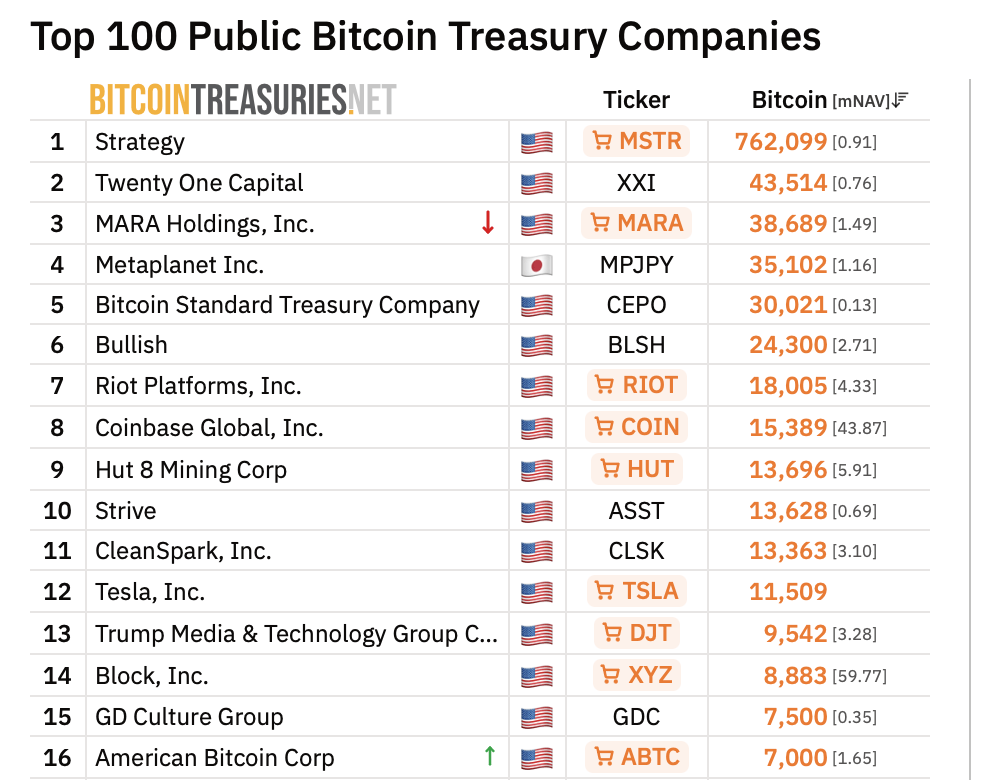 (Source: Bitcoin Treasuries)
Since listing on Nasdaq in September 2025, ABTC’s amount of bitcoin reserves has grown by nearly three times. About one-third of its holdings come from its own mining business, while the other two-thirds come from strategic purchases in the public market. On the mining operations front, after the company added 11,298 new ASIC mining rigs in early March, its total number of operating mining rigs reached about 89,000 units, with total computing power of roughly 28.1 EH/s.
Key milestone timeline of ABTC’s bitcoin holdings
Late 2025: Holdings of about 5,401 BTC
Mid-February 2026: Surpassed 6,000 BTC
Early March 2026: Reached about 6,500 BTC
Mid-March 2026: Rose to about 6,899 BTC
End of March 2026: Surpassed 7,000 BTC, ranking 16th globally among publicly traded companies
Eric Trump has consistently advocated holding all mined and purchased bitcoins rather than selling them, and said the company is building the backbone of U.S. bitcoin infrastructure. The company said that, since its listing, the Satoshi per share metric has more than doubled.
Stock price plunges 90%: The double pressure of dilution effects and book losses
Despite the continued growth in its bitcoin reserves, ABTC’s stock performance has disappointed shareholders. The share price fell from nearly $9 at the time of listing to between $0.85 and $0.90, a decline of 80% to 90%.
One of the core pressures is massive share dilution. ABTC raised substantial capital by issuing shares at market price, causing the number of shares outstanding to exceed 900 million. Critics noted that even though bitcoin reserves are increasing, a severe dilution effect is eroding the actual amount of bitcoin per share.
On the financial side, ABTC reported a net loss of $59 million in the fourth quarter of 2025, mainly driven by a $227 million non-cash book loss generated under the new fair value accounting rules issued by FASB. In the fourth quarter, the bitcoin price fell about 23% from its historical high of $126,000. Although the company sold no holdings, the book loss still materialized. Revenue in the same period was $78 million, with mining gross profit margins of nearly 53%.
In addition, when the lock-up period expired at the end of 2025, large-volume trading triggered a one-day drop of 35% to 39%. ABTC’s beta is about 3.8, making it significantly more sensitive than typical stocks to bitcoin price volatility and crypto market sentiment. Analysts’ consensus rating is broadly “Hold,” with a target price near $4. Some analysts downgrade to “Sell” due to what they consider overvaluation.
Frequently Asked Questions
What role does Eric Trump play in ABTC?
Eric Trump is a co-founder and Chief Strategy Officer (CSO) of American Bitcoin Corp., actively advocating a bitcoin reserve strategy of “hold rather than sell.” The parent company is Hut 8 Corp. ABTC completed its Nasdaq listing in September 2025 after merging with Gryphon Digital Mining.
How did ABTC accumulate its 7,000 BTC?
One-third of the holdings come from its own mining, while two-thirds come from strategic purchases in the public market. Purchase funding comes in part from credit facilities provided by the parent company Hut 8 and Two Prime. Currently, the company has computing power of 28.1 EH/s and operates about 89,000 ASIC mining rigs.
Why do ABTC’s bitcoin reserves grow but its stock price still falls sharply?
The main reason is that large-scale share dilution (shares outstanding exceed 900 million) erodes bitcoin per share; meanwhile, the expiration of the lock-up period triggers concentrated selling, and a high beta (about 3.8) amplifies the impact of bitcoin price volatility. Combined with the $227 million non-cash book loss generated by the new FASB rules, these factors jointly suppress stock performance.
Disclaimer: The information on this page may come from third parties and does not represent the views or opinions of Gate. The content displayed on this page is for reference only and does not constitute any financial, investment, or legal advice. Gate does not guarantee the accuracy or completeness of the information and shall not be liable for any losses arising from the use of this information. Virtual asset investments carry high risks and are subject to significant price volatility. You may lose all of your invested principal. Please fully understand the relevant risks and make prudent decisions based on your own financial situation and risk tolerance. For details, please refer to
Disclaimer.


