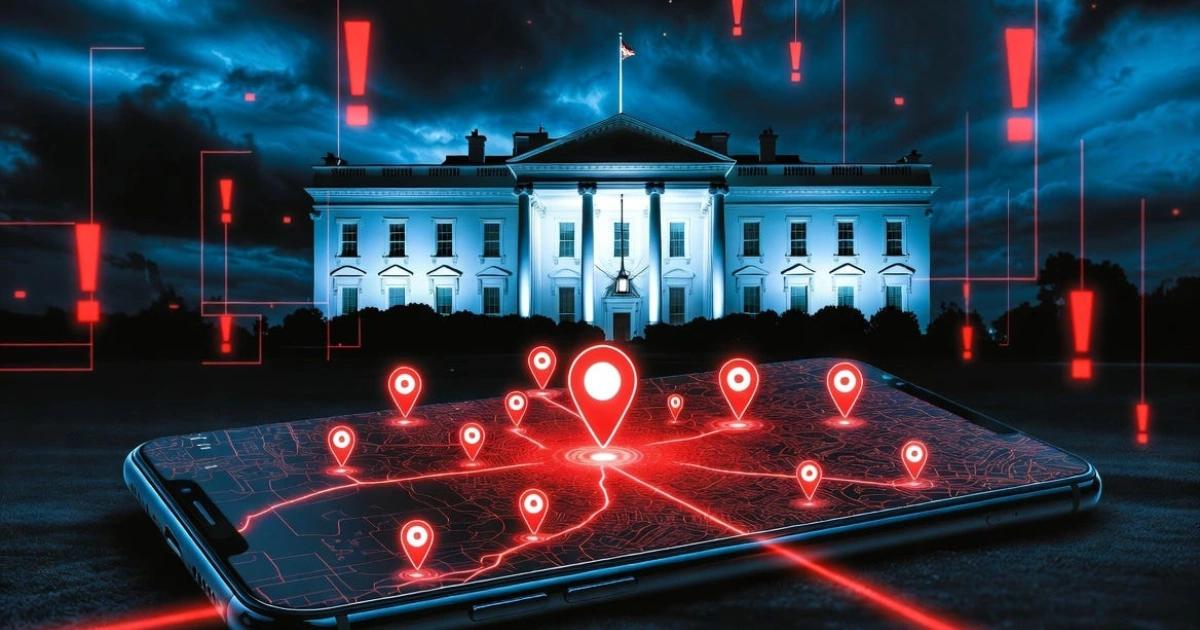
The White House has rolled out an official app to provide real-time policy information, but suspected access to GPS and personal data has sparked privacy concerns, highlighting the challenges of digital governance and trust.
The White House app officially goes live, with a focus on “unfiltered information delivered straight to you”
The White House recently launched an official smartphone application, aiming to let users directly receive government policy updates, major announcements, and real-time video content. The application integrates news push notifications, live broadcasts, social content, and policy information pages, and also provides features for user feedback and contacting the White House. Officially, it is positioned as an “information hub directly connected to the White House.”
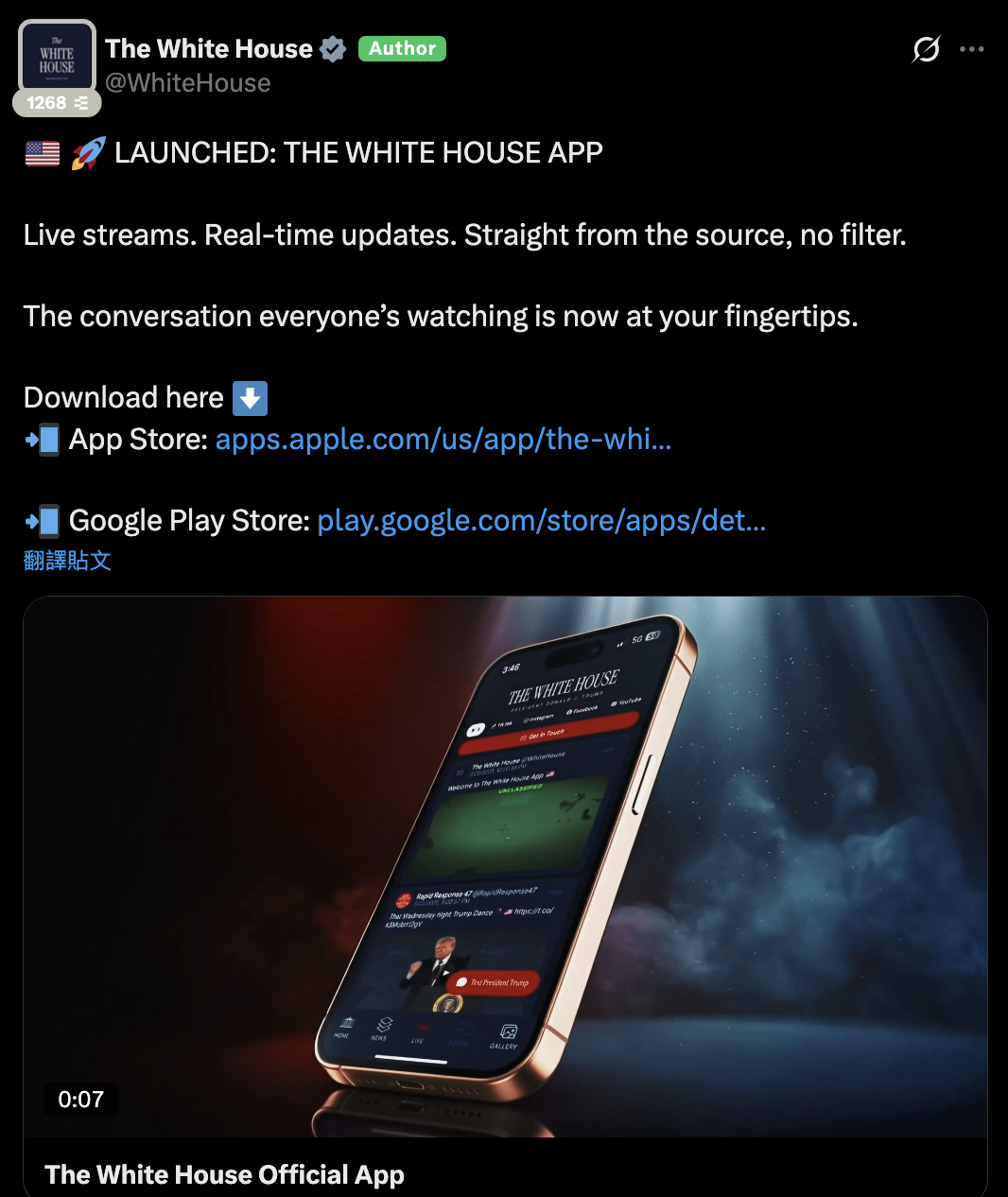
Image source: X/@WhiteHouse The White House launches an official smartphone application, aiming to let users directly receive government policy updates, major announcements, and real-time video content.
The White House said that the app will provide an “instant, unfiltered” source of official information, enabling users to keep track of government policy progress and administrative developments. The content covers policy achievements, media materials, and information from the White House’s existing website. Some pages also compile filtered news reports and economic data, in an effort to build an information dissemination channel led by the government.
However, some media observations have noted that certain features may not be fully implemented in the initial rollout phase—for example, the real-time livestream feature was not able to synchronize live coverage in some public events, indicating that the product is still in the process of gradual refinement.
Concerns over permissions and data collection focus attention on GPS
With the app’s release, users and cybersecurity researchers have begun paying attention to its data access permissions and privacy policy. Some developers’ analyses suggest that the app may have the capability to access device GPS location, network activity, and device storage space, raising concerns about the extent of user data collection.
Although the app store page currently does not clearly indicate all related permissions, code analysis shows that the app may include location-tracking functionality, and even has a technical architecture that updates locations periodically when running in the foreground and background. One developer noted that in theory, the relevant mechanism can perform location updates every 4.5 minutes in the foreground and every 9.5 minutes in the background.
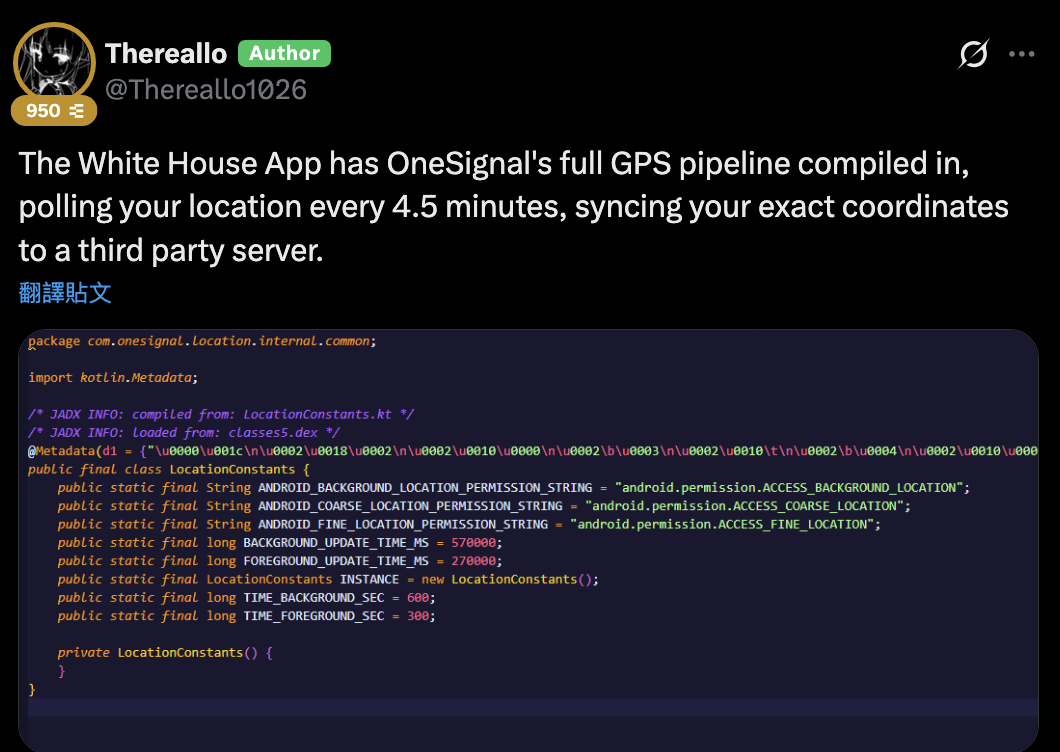
Image source: X/@thereallo1026 A developer said that, in theory, the relevant mechanism can perform location updates every 4.5 minutes in the foreground and every 9.5 minutes in the background.
In addition, the app may also collect data such as users’ notification interactions, click behavior, phone numbers, and email addresses. The White House’s official privacy policy states that the system will automatically record basic information such as users’ IP addresses, and store personal data when users subscribe to services.
- Further reading: AI writes code and goes wrong! The convenience store’s short-dated product app “Leftover Food Hunter” explodes with cybersecurity issues—GPS in the home is fully exposed
Cybersecurity experts question the necessity; app features and permissions are mismatched
Regarding the location feature, cybersecurity experts said that, as of now, the application does not provide maps, local services, or any location-related functions, so the necessity of granting GPS permission is being questioned. One engineer said bluntly that the app has no core feature that requires real-time location, yet still contains the relevant technical architecture, suggesting an imbalance in the design.
At the same time, some researchers pointed out that the application may carry risks in terms of data transmission and security protections. For example, in public Wi-Fi environments, third parties with technical capability could intercept API transmission data, and even modify application behavior.
These analyses are based on publicly downloadable apps and basic testing. They do not involve system intrusion or advanced cracking methods, showing that the concerns are not built on a high technical threshold, but on potential issues that can be observed by ordinary developers.
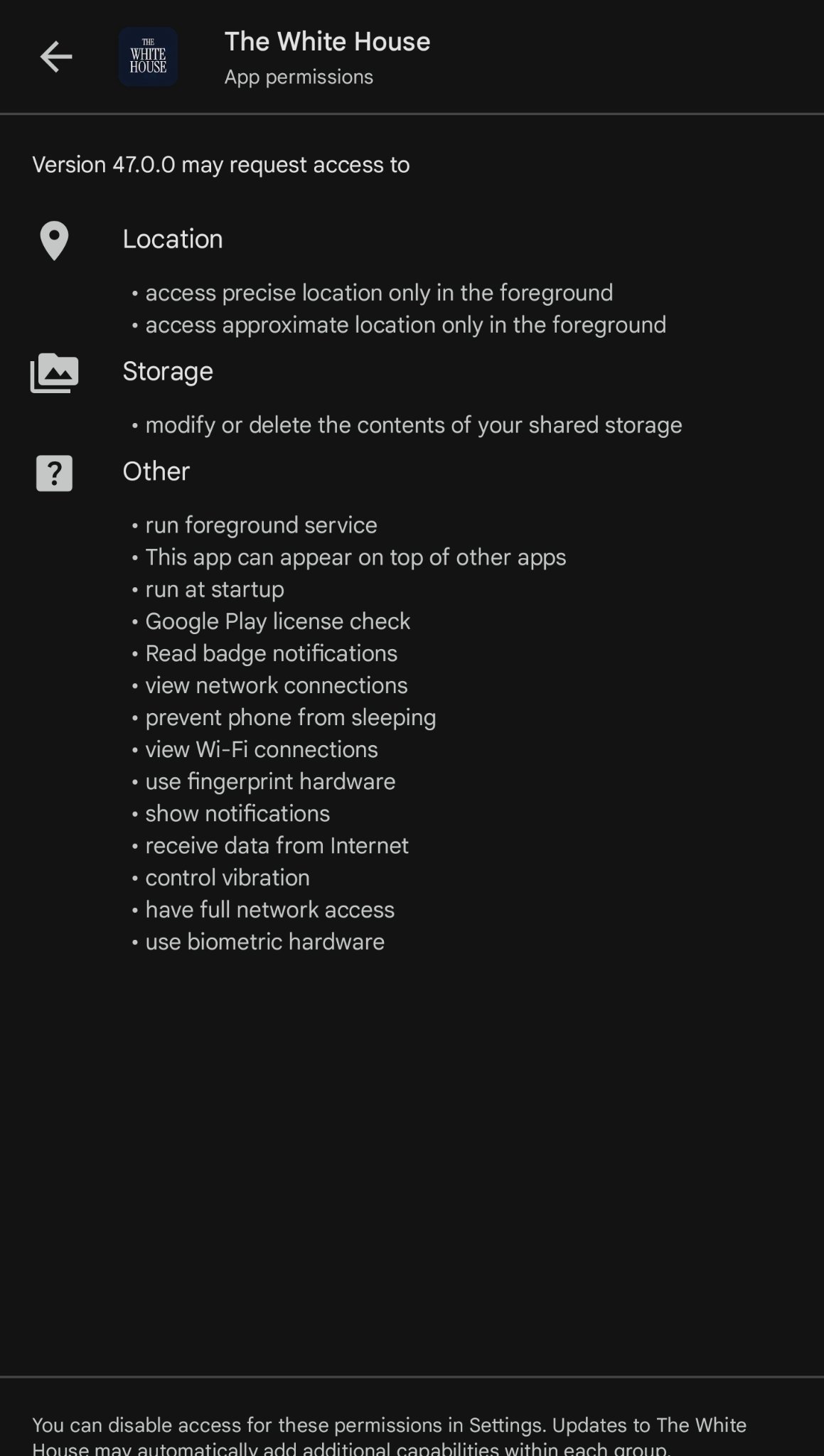
Image source: X/@Emmett31539642 Some researchers said that the app may have risks in data transmission and security protection.
Government app sparks privacy controversy, and digital governance and trust issues come to the fore
Although most commercial apps also require similar permissions, experts believe that when data collection comes from a government entity, it will bring users a higher level of sensitivity and trust pressure. Especially when it involves location and behavior tracking, the public is more concerned about whether its purpose is clear and whether it has adequate regulatory mechanisms.
There is currently no evidence showing that the app has actually enabled continuous location tracking or conducted large-scale data collection, but the existence of the relevant technical architecture is enough to trigger discussion. This incident also reflects that, as the government actively promotes digital services and information transparency, how to strike a balance between convenience and privacy protection will become an important issue for digital governance in the future.
This article is generated by the encrypted Agent compiling information from multiple parties, with 《Encrypted Cities》 conducting review and editing. It is still in the training stage, and may contain logical deviations or information errors. The content is for reference only—please do not treat it as investment advice.
Disclaimer: The information on this page may come from third parties and does not represent the views or opinions of Gate. The content displayed on this page is for reference only and does not constitute any financial, investment, or legal advice. Gate does not guarantee the accuracy or completeness of the information and shall not be liable for any losses arising from the use of this information. Virtual asset investments carry high risks and are subject to significant price volatility. You may lose all of your invested principal. Please fully understand the relevant risks and make prudent decisions based on your own financial situation and risk tolerance. For details, please refer to
Disclaimer.


