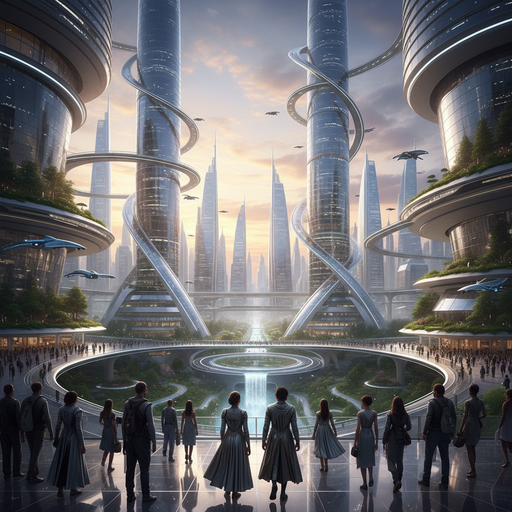
Solarpunk isn't just an aesthetic—it's a blueprint for how communities could actually operate. Picture a world running on renewable energy: solar panels, wind turbines, geothermal systems replacing fossil fuels entirely. Buildings breathe with the landscape instead of suffocating it—vertical gardens, living walls, rooftop farms integrated into urban design. Architecture becomes ecology.
Then comes the living part. Homes designed for true self-sufficiency—think permaculture gardens, rainwater harvesting, zero-waste systems built into daily life. People stop being isolated consumers and start becoming producers. You grow your food, generate your power, manage resources collectively. It's radically decentralized in practice.
The social model flips too. Instead of sprawling individualism, communities organize around shared resources and mutual aid. Neighborhoods become networks of makers, gardeners, and creators. Abundance flows through cooperation rather than extraction.
Solarpunk merges cutting-edge technology with indigenous wisdom and local knowledge. It's not rejecting innovation—it's redirecting it toward regeneration. The future doesn't have to look dystopian. It could look alive.
This page may contain third-party content, which is provided for information purposes only (not representations/warranties) and should not be considered as an endorsement of its views by Gate, nor as financial or professional advice. See Disclaimer for details.
22 Likes
Reward
22
6
Repost
Share
Comment
0/400
FOMOmonster
· 01-07 04:06
Honestly, the solarpunk theory sounds beautiful, but when it comes to implementation... I'm a bit skeptical. Self-sufficiency sounds great, but how many people can actually stick to it in reality?
---
I'm interested in rooftop farms, but who will bear the infrastructure costs?
---
The internet hasn't truly decentralized humanity, so why would a distributed community work...
---
The part about indigenous wisdom is well written, but don't package high technology as a savior.
---
I just want to know how this system fights against capitalism. That's the key.
---
Community-driven sounds good, but what if neighbors don't cooperate? Haha
---
Zero-waste systems sound like utopia. Has anyone tried it?
---
It's basically what the Bitcoin community has been saying—decentralization, sovereignty, local production. Just a different skin.
---
Green building is already being done now, but the key is the difficulty in promotion...
---
I have to say, this vision is quite radical, a bit naive, but I like this attitude.
View OriginalReply0
ForeverBuyingDips
· 01-05 22:02
Solarpunk sounds idealistic, but can it really be scaled up? It still seems to rely on policy support.
---
Basically, it's about reinventing the village and community system, just with a tech overlay.
---
Generating your own electricity, growing your own vegetables... brother, isn't this a return to small-scale farming economy?
---
Hmm, there's something there. I agree with the indigenous wisdom part, but reaching consensus is really difficult.
---
Wait, isn't this the tokenomics and distributed governance that the Web3 community has been touting? Same old, different packaging.
---
Buildings can breathe, but capitalism will never stop breathing...
---
Permaculture + decentralization = the core of Solarpunk? This logic seems easier to implement on-chain.
---
I just want to know how many people a rooftop farm can support. Can we keep it realistic?
View OriginalReply0
bridge_anxiety
· 01-05 21:54
Solarpunk sounds idealistic, but how does it work in practice? We can't even manage waste sorting in our communities properly, so what are we talking about decentralization and self-sufficiency...
View OriginalReply0
NFTArchaeologis
· 01-05 21:45
Isn't this just a utopian fantasy wrapped in a technological shell... The problem is, how do we break the production relations? Having self-sufficient houses alone, without changing the social structure, will ultimately be absorbed by capital and become just another wave of consumer trends.
View OriginalReply0
OnChainSleuth
· 01-05 21:45
Solarpunk sounds quite idealistic, but when it comes to implementation, will it be hijacked by capital again?
View OriginalReply0
GateUser-9f682d4c
· 01-05 21:39
Solarpunk sounds good, but how can ordinary people really get involved? Feels still like idealism.
---
Not gonna lie, how much vested interest would need to change for this system to be implemented... The difficulty is off the charts.
---
I like this idea: decentralization + regeneration, but who will bear the infrastructure investment?
---
Vertical farms, rooftop farms—I've heard these too many times. The key is who can maintain them...
---
Indigenous wisdom is interesting, but does the Web3 community really understand this, or is it just a slogan?
---
Self-sufficiency sounds great, but would I give up convenience? Hard pass, bro.
---
Regeneration rather than extraction—if only all companies thought this way, lol.
---
Cooperation > plunder, sounds like an indirect critique of the current system.
Solarpunk isn't just an aesthetic—it's a blueprint for how communities could actually operate. Picture a world running on renewable energy: solar panels, wind turbines, geothermal systems replacing fossil fuels entirely. Buildings breathe with the landscape instead of suffocating it—vertical gardens, living walls, rooftop farms integrated into urban design. Architecture becomes ecology.
Then comes the living part. Homes designed for true self-sufficiency—think permaculture gardens, rainwater harvesting, zero-waste systems built into daily life. People stop being isolated consumers and start becoming producers. You grow your food, generate your power, manage resources collectively. It's radically decentralized in practice.
The social model flips too. Instead of sprawling individualism, communities organize around shared resources and mutual aid. Neighborhoods become networks of makers, gardeners, and creators. Abundance flows through cooperation rather than extraction.
Solarpunk merges cutting-edge technology with indigenous wisdom and local knowledge. It's not rejecting innovation—it's redirecting it toward regeneration. The future doesn't have to look dystopian. It could look alive.