 Bitcoin options traders have positioned for significant downside protection, with the put-to-call open interest ratio averaging 0.77 over the past month—the highest level since June 2021 and within the 91st percentile of all readings since mid-2019, according to VanEck’s March 2026 Bitcoin ChainCheck report.
Total options open interest now exceeds $33 billion, while premiums paid for put options relative to spot volume reached an all-time high of 4 basis points, roughly three times the levels seen following the Terra/Luna collapse in mid-2022. The defensive positioning comes as Bitcoin consolidates near $69,000 following a 19% decline in the 30-day average price, with realized volatility dropping from 80 to 50 and futures funding rates cooling from 4.1% to 2.7%.
The extreme skew in options markets presents two competing interpretations: historically, such peak fear levels have marked bottoms—as in June 2021 when similar readings preceded a rally from $29,000 to $60,000—but the willingness to pay record premiums for puts may also signal institutional expectations of further macro-driven downside.
Options Market Indicators Signal Unprecedented Defensiveness
Put/Call Ratio Hits Multi-Year High
 (Source: Artemis XYZ, Glassnode)
The put/call open interest ratio, which compares the volume of bearish put options to bullish call options, peaked at 0.84 during the past month and averaged 0.77—the highest level since June 2021, when China banned Bitcoin mining. At current levels, the ratio sits in the 91st percentile of all observations since mid-2019, indicating that institutional investors are allocating unusually strong capital toward downside hedging relative to bullish positioning.
Put Premiums Reach All-Time Highs
Total premiums paid for put options declined 24% month-over-month to $685 million over the past 30 days, but remain above 77% of monthly observations since the start of 2025. More significantly, put premiums relative to Bitcoin spot volume reached an all-time high of approximately 4 basis points—roughly three times the levels seen following the Terra/Luna stablecoin collapse and the Ethereum staking liquidity crisis in mid-2022.
By contrast, premiums paid for call options fell 12% to approximately $562 million, extending recent weakness and highlighting a decisive shift toward defensive positioning across the options market.
Options Skew at Extreme Levels
For the 30-day period ending March 3, 2026, the put/call premiums paid ratio reached 2.0, the highest level since summer 2022. Implied volatility on puts averaged approximately 66, about 16 points above realized volatility of 50 and roughly 17 points above implied call volatility. This differential ranks in the 89th percentile since August 2019, indicating that puts are substantially more expensive than calls as investors aggressively hedge downside risk.
Historical Context: Extreme Fear Has Preceded Recoveries
When options markets reach this level of implied volatility skew, historical patterns suggest potential upside ahead. Over the past six years, skew readings in the current decile (the second-highest bucket, D9) have corresponded to:
Average Bitcoin returns of +13% over the following 90 days—the strongest performance across all deciles
Average returns of +133% over the subsequent 360 days, ranking third among all deciles
This compares to overall average Bitcoin returns of -4.6% over 90 days and +102% over 360 days across all market periods. The data suggests that extreme put demand at current levels has historically preceded meaningful price recoveries rather than further declines.
Futures Markets and Volatility Cool
Leverage Declines
While options traders maintain defensive positions, other segments of the derivatives market show signs of cooling. Bitcoin futures funding rates—the cost of borrowing capital to maintain long positions—averaged 2.7%, down from 4.1% the prior month. Average Bitcoin futures open interest declined 1% month-over-month, suggesting leverage is being reduced as market conditions stabilize.
Realized Volatility Drops
Realized volatility, which measures actual observed price swings, fell sharply from approximately 80 to just above 50 over the past month. This decline in volatility, combined with falling leverage, is consistent with a post-stress positioning reset as traders de-risk and funding premiums normalize.
Onchain Activity Remains Subdued
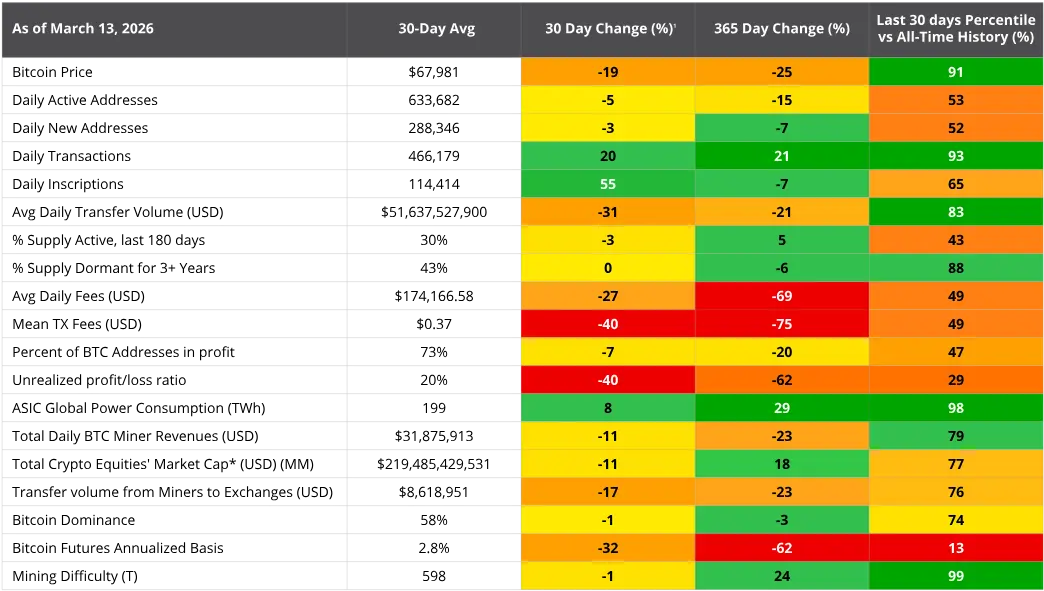
Network activity declined broadly across most major indicators over the past 30 days:
-
Transfer volume fell 31%
-
Total daily fees declined 27%
-
Daily active addresses dropped 5%
-
Mean transaction fees fell 40%
Total transaction count was the sole bright spot, rising modestly during the period. The muted onchain activity suggests limited speculative participation directly on the Bitcoin blockchain, though this dynamic may reflect the increasing role of offchain trading venues, derivatives markets, and exchange-traded products. As Bitcoin becomes more financialized, a growing share of trading activity occurs without generating onchain settlement transactions, meaning traditional network metrics capture a shrinking portion of total market activity compared with earlier cycles.
Long-Term Holder Distribution Slows
Long-term holder selling appears to be moderating, a potentially constructive signal. Transfer volume declined month-over-month across every age cohort, indicating that older coins—which tend to represent long-term investors and early holders—are being spent less frequently. Declining transfer activity among these cohorts typically signals reduced distribution pressure from experienced market participants.
This reduction in long-term holder spending coincided with a decline in active long-term Bitcoin supply from 31% to 30%, suggesting that a slightly smaller share of circulating BTC has transacted recently.
Miner Economics Tighten but Selling Remains Measured
Economic pressure on Bitcoin miners intensified during the past month:
-
Total miner revenues declined 11%
-
Bitcoin mining equities fell approximately 7%, reflecting weaker sector profitability
Despite this deterioration, miners did not meaningfully increase selling pressure. Miner outflows to exchanges rose only 1% in BTC terms, suggesting most operators are attempting to preserve remaining reserves rather than aggressively liquidating holdings. Industry developments highlight growing strategic shifts within the mining sector, with some firms pivoting toward AI infrastructure businesses amid tightening economics for pure-play Bitcoin mining.
Total miner balances (excluding wallets attributed to Satoshi Nakamoto) currently sit at approximately 684,000 BTC, down only about 0.5% year-over-year. Over the same period, roughly 164,000 new BTC were mined, suggesting miners effectively sold the entire newly issued supply. Aggregate miner balances have been gradually declining since late 2023, indicating steady distribution to fund operations and capital expenditures.
Market Structure Conclusions
VanEck’s analysis suggests several key dynamics currently shaping Bitcoin markets:
-
Cooling speculative leverage in futures markets
-
Elevated demand for downside hedging in options markets
-
Subdued onchain activity as trading shifts toward ETPs and derivatives
-
Declining distribution from long-term holders
-
Moderate but manageable miner supply pressure
While Bitcoin prices have stabilized in recent weeks, investor positioning across derivatives and onchain activity remains cautious, suggesting markets may still be consolidating following earlier volatility.
Frequently Asked Questions
What does the Bitcoin put/call ratio indicate about market sentiment?
The put/call open interest ratio measures relative demand for downside protection (puts) versus bullish bets (calls). At 0.77, the current ratio sits in the 91st percentile of all observations since mid-2019, indicating that investors are unusually defensive. Historically, extreme readings in this metric have preceded meaningful price recoveries, with average 90-day returns of +13% when the ratio reaches this decile.
Why are put premiums at all-time highs relative to spot volume?
Put premiums relative to Bitcoin spot volume reached 4 basis points—roughly three times the levels seen after the Terra/Luna collapse in mid-2022. This suggests that despite falling volatility, investors continue allocating significant capital toward hedging downside risk. The put/call premiums paid ratio of 2.0 is the highest since summer 2022, indicating puts are substantially more expensive than calls.
Are Bitcoin miners selling their holdings?
Bitcoin miners have been gradually reducing holdings since late 2023, with aggregate balances currently at approximately 684,000 BTC. While miners have effectively sold all newly issued supply over the past year (roughly 164,000 BTC), outflows to exchanges rose only 1% month-over-month, suggesting most operators are managing reserves conservatively rather than aggressively liquidating.


