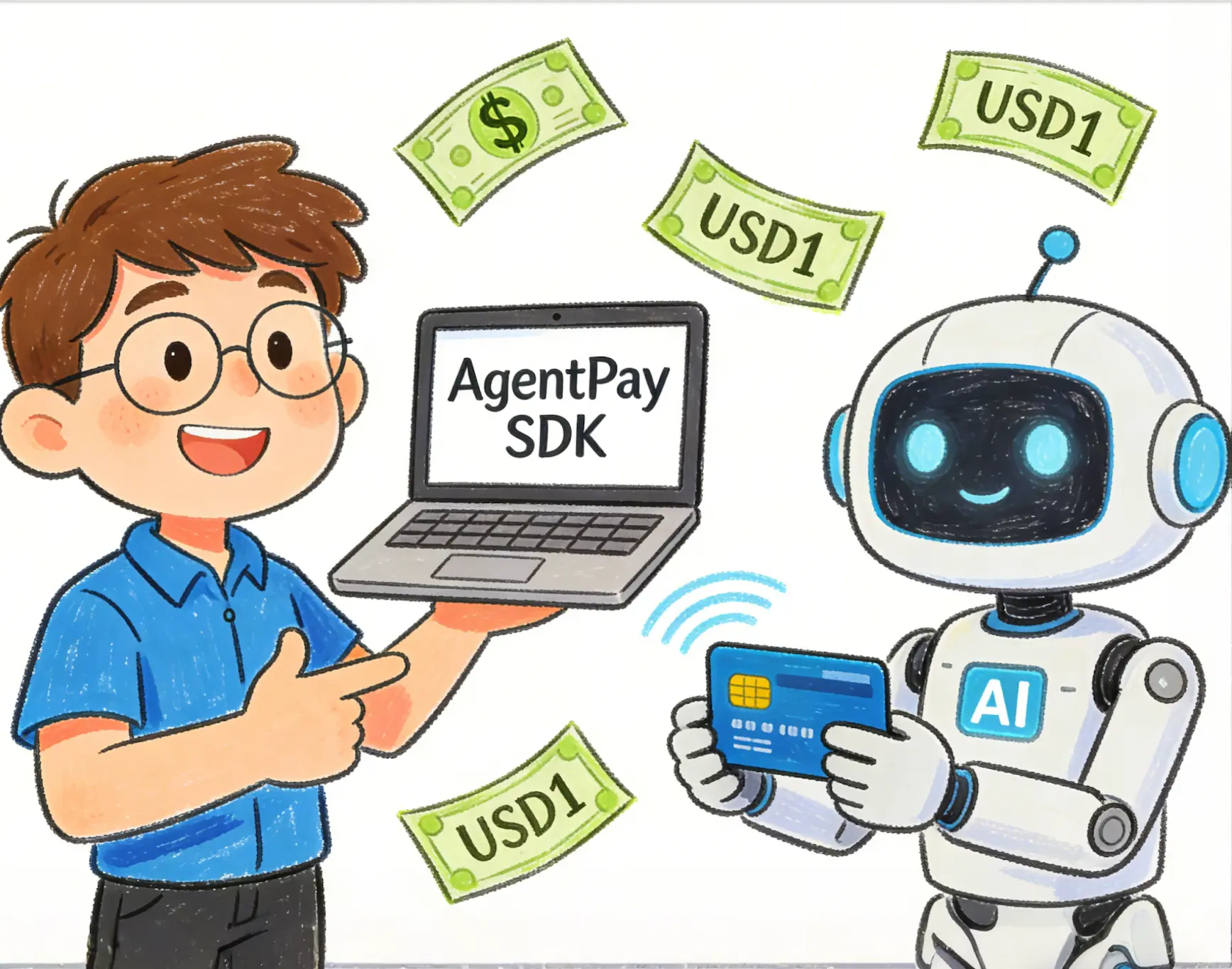
 World Liberty Financial (WLFI) introduced the AgentPay SDK on March 19, 2026, an open-source toolkit enabling AI agents to hold, send, and transact with USD1 stablecoins across EVM-compatible blockchains under programmable policy constraints.
The launch positions WLFI’s USD1—currently the fifth-largest stablecoin with a $4.5 billion market cap—as a settlement layer for the emerging “agentic economy,” where autonomous AI systems execute tasks involving money. The SDK integrates with developer tools including Claude Code, Cursor, and OpenClaw, allowing AI agents to perform transactions with local signing, policy enforcement, and optional human approval for higher-value transfers.
The release reflects a broader industry convergence of AI and crypto infrastructure, as firms increasingly explore blockchain rails for autonomous systems that require embedded compliance, secure key management without human intervention, and seamless developer integration.
AgentPay SDK Architecture and Capabilities
Core Components
The AgentPay SDK operates through four integrated layers:
CLI interface (agentpay) : Command-line tool for wallet management, token transfers, and policy configuration
Local signing daemon: Unix domain socket-based system enabling private key signing without network exposure
Policy engine: Evaluates transactions against configurable per-transaction and daily spending limits
Skill pack: Auto-detects and installs into AI development environments including Claude Code, Codex, Cursor, Windsurf, Cline, Goose, and OpenClaw
Transaction Flow
When an AI agent initiates a payment, the SDK executes a structured pipeline:
Intent parsing: The skill pack identifies payment parameters (amount, recipient, token)
Balance verification: Checks wallet balances for both USD1 and native gas tokens (e.g., BNB on BSC)
Policy evaluation: Compares transaction against preset limits and daily caps
Local signing: Vault-daemon signs transaction via Unix domain sockets without exposing private keys to external services
Broadcast: CLI submits transaction to the specified blockchain
Approval Workflow
For transactions exceeding configured thresholds, the SDK generates an approval request:
-
Agent receives pause notification with transaction details
-
Human operator reviews via CLI admin commands
-
Upon approval, transaction signs and broadcasts
-
Failed transactions are prevented when balances are insufficient, with agents instructed to request specific top-ups
USD1 as AI-Native Stablecoin
Market Position
USD1 has risen to become the fifth-largest stablecoin by market capitalization, currently at approximately $4.5 billion. WLFI positions the token not as a conventional stablecoin focused on liquidity or regulatory narratives, but as a dollar-denominated asset tailored for non-human transactors operating within AI-driven environments.
Technical Specifications
USD1 is pre-configured in the AgentPay SDK on:
Ethereum: Contract address 0x8d0D000Ee44948FC98c9B98A4FA4921476f08B0d
BNB Chain: Selected for low gas fees and fast finality
Embedded Features
The SDK includes built-in Bitrefill integration, enabling agents to purchase gift cards, eSIMs, and prepaid products across 12 EVM payment methods directly from the terminal.
Strategic Context and Industry Convergence
Agentic Economy Thesis
WLFI’s launch addresses a structural gap identified by the company: AI systems are increasingly capable of reasoning but lack infrastructure to operate with money autonomously. The AgentPay SDK enables workflows where agents can submit payment requests, operate within spend limits, route higher-risk actions for approval, and connect settlement to task completion.
Competitive Landscape
The launch positions WLFI alongside other crypto infrastructure providers targeting AI integration:
-
Tether’s QVAC division has released frameworks for AI model training on consumer devices
-
Multiple exchanges and protocols are developing agent-compatible payment rails
-
The convergence reflects growing recognition that blockchain infrastructure may serve as the native settlement layer for autonomous systems
Distinction from Existing Stablecoins
WLFI frames USD1’s differentiation from established stablecoins:
Regulatory-focused narratives: Represented by competitors emphasizing compliance
Liquidity-focused narratives: Represented by market leaders emphasizing availability
Capital efficiency narratives: Represented by DeFi-focused stablecoins
USD1 thesis: Built specifically for agentic systems requiring programmable policy controls and autonomous transaction capabilities
Roadmap and Future Development
Planned Features
WLFI indicated upcoming enhancements including:
EIP-3009 implementation: Gasless meta-transactions enabling agents to transact without native gas tokens
Standards track: EIP proposal for policy-aware agent interfaces, accompanied by a white paper on AI agent payment security
Plugin ecosystem: Third-party extensions without core SDK modifications
Cross-border expansion: Broader chain support including FX, remittance, institutional settlement, and DeFi protocol integrations
Developer Adoption
The SDK is designed for self-custodial operation with zero data sent to WLFI servers, emphasizing local execution and privacy. Installation is available via curl commands for macOS, with options for full runtime or skills-only deployment.
Frequently Asked Questions
What is the AgentPay SDK and how does it work?
The AgentPay SDK is an open-source toolkit enabling AI agents to transact with USD1 stablecoins across EVM chains. It combines local signing, policy enforcement, and optional human approval workflows. Agents initiate payments through integrated development environments, with transactions evaluated against preset limits before local signing and broadcast. Private keys never leave the user’s machine.
How does USD1 differ from other stablecoins?
USD1 is positioned specifically for autonomous AI systems rather than human users. It emphasizes programmable policy controls, local signing, and integration with AI development tools. With a $4.5 billion market cap ranking fifth among stablecoins, WLFI frames USD1 as infrastructure for the “agentic economy” where AI agents independently execute financial transactions within defined constraints.
What integrations are currently available?
The SDK auto-detects and installs into Claude Code, Codex, Cursor, Windsurf, Cline, Goose, and OpenClaw. Built-in Bitrefill integration enables gift card and eSIM purchases. USD1 is pre-configured on Ethereum and Binance Smart Chain, with planned expansion to additional networks.


