


Is Qtum (QTUM) a good investment?: A Comprehensive Analysis of Features, Risks, and Market Potential

Introduction: Qtum (QTUM) Investment Position and Market Prospects
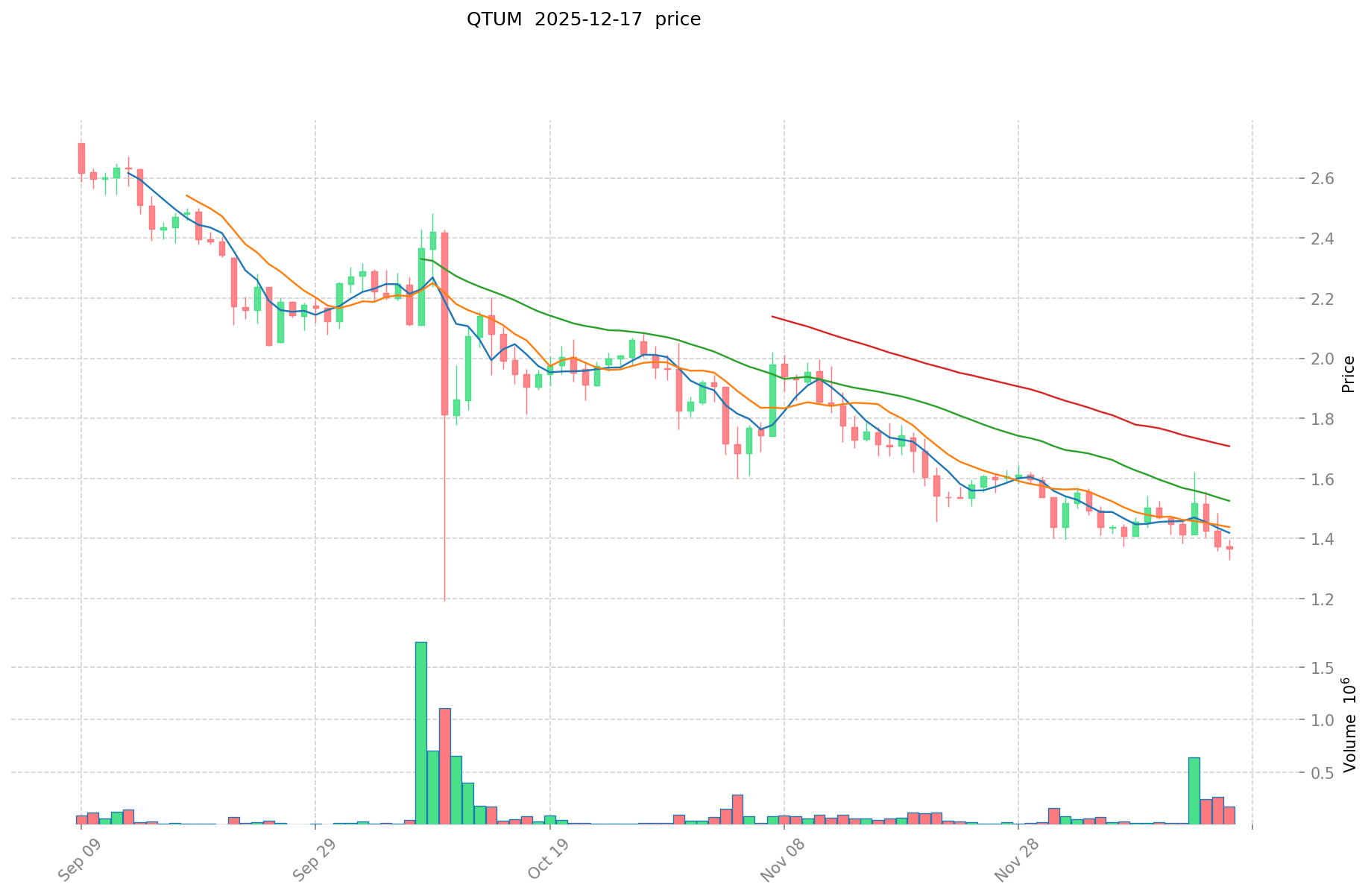
Qtum is an important asset in the cryptocurrency field. Since its launch in March 2017, it has achieved significant accomplishments in building a third blockchain ecosystem beyond Bitcoin and Ethereum. As of December 2025, Qtum's market cap stands at approximately $146.85 million, with a circulating supply of about 105.92 million QTUM tokens, and the current price is maintained around $1.362. Positioned as a hybrid blockchain platform combining Bitcoin's robust infrastructure with Ethereum-compatible smart contract capabilities, Qtum has gradually become a focal point when investors discuss whether Qtum (QTUM) represents a sound investment opportunity. This comprehensive analysis will examine Qtum's investment value, historical price movements, future price forecasts, and associated investment risks to provide investors with relevant reference information.
Qtum (QTUM) Comprehensive Market Analysis Report
I. QTUM Price History Review and Current Investment Value Status
QTUM Historical Price Performance and Investment Returns
- 2016: Qtum Foundation established and blockchain network launched → Early-stage project with minimal market recognition
- March 2017: Initial Coin Offering (ICO) completed with $15 million in funding → Project gained market attention
- January 2018: All-time high price reached at $100.22 (as of January 6, 2018) → Peak investor returns during the 2017-2018 bull market cycle
- March 2020: All-time low price recorded at $0.783142 (as of March 13, 2020) → Significant drawdown reflecting market volatility and the COVID-19 market shock
Current QTUM Investment Market Status (December 17, 2025)
| Metric | Value |
|---|---|
| Current Price | $1.362 USD |
| 24-Hour Price Change | -1.83% |
| 7-Day Price Change | -9.41% |
| 30-Day Price Change | -20.36% |
| 1-Year Price Change | -64.81% |
| 24-Hour Trading Volume | $225,149.73 USD |
| Total Market Capitalization | $146,854,116.97 USD |
| Circulating Supply | 105,923,897 QTUM |
| Maximum Supply | 107,822,406 QTUM |
| Circulating Supply Ratio | 98.24% |
| Market Ranking | #280 |
| Market Dominance | 0.0046% |
| Total Holders | 2,998,409 |
Market Emotion Indicator: Neutral (Score: 1)
Current QTUM real-time pricing available at Gate QTUM Market
II. Project Overview and Technical Architecture
Core Project Definition
Qtum Blockchain is a third-generation blockchain ecosystem developed independently of Bitcoin and Ethereum. The project aims to realize peer-to-peer value transfer through its proprietary Value Transfer Protocol and establish a decentralized application development platform (DApp Platform) supporting multiple industries including finance, Internet of Things (IoT), supply chain, social networking, and gaming.
Technical Architecture Characteristics
Qtum achieves a hybrid technical approach by combining:
- Bitcoin Core Infrastructure: Incorporates an improved version of Bitcoin's proven blockchain security framework
- Ethereum Virtual Machine (EVM) Compatibility: Integrates a compatible implementation of Ethereum's smart contract execution environment
This architectural design enables Qtum to leverage Bitcoin's network security robustness while simultaneously providing smart contract capabilities similar to Ethereum.
Consensus Mechanism
Qtum implements a Proof of Stake (PoS) consensus model, distinguishing it from Bitcoin's energy-intensive Proof of Work (PoW) and pre-merge Ethereum's PoW systems. Under this model:
- Network validators participate in transaction verification and network operations through staking
- Reward distribution is based on the total value staked by each participant
- Validators with greater stake amounts have higher probability of participating in the consensus process
III. Project Founding and Governance
Founding Team and Timeline
| Item | Details |
|---|---|
| Founders | Patrick Dai, Jordan Earls, Neil Mahi |
| Foundation Year | 2016 |
| ICO Launch Date | March 2017 |
| ICO Funding Amount | $15 million USD |
| Foundation Headquarters | Singapore |
Token Utility and Ecosystem Functions
QTUM token serves multiple functions within the Qtum ecosystem:
- DApp access and utilization
- Token-based voting mechanisms for governance
- Community autonomy and decision-making participation
- Application function consumption and transaction fee payments
- Staking for network validation rewards
IV. Recent Ecosystem Developments
Strategic Partnership: Qtum and Tenet Collaboration (May 2023)
Qtum entered into a cooperative agreement with Tenet, a Layer-1 ecosystem focused on creating yield and utility for Liquid Staking Derivatives (LSD) and Conflux. The partnership objectives include:
- Regional Market Expansion: Enhancing LSD (Liquid Staking Derivatives) market awareness specifically within the Chinese market
- Product Diversification: Qtum provides LSD solutions to Tenet users, expanding their staking product offerings
- Market Access: The collaboration facilitates Tenet's entry into China's substantial cryptocurrency market while establishing Qtum's presence in the broader LSD ecosystem
V. Market Position and Exchange Presence
| Category | Information |
|---|---|
| Trading Pairs | Listed on 31 major cryptocurrency exchanges |
| Official Website | https://qtum.org/ |
| Block Explorer | https://qtum.info/ |
| Source Code Repository | Multiple GitHub repositories including qtumproject/qtum and related development tools |
| Whitepaper | Qtum New Whitepaper (English) |
| Social Media Presence | Twitter (@qtum), Reddit (/r/Qtum), Facebook (QtumOfficial) |
Disclaimer
This report presents factual information derived from available market data as of December 17, 2025. The analysis does not constitute investment advice, financial recommendations, or endorsements. Cryptocurrency markets remain highly volatile and speculative. Past performance does not guarantee future results. Individuals should conduct independent research and consult qualified financial advisors before making investment decisions.
Qtum (QTUM) Investment Analysis Report
Report Date: December 17, 2025
I. Executive Summary
Qtum blockchain is a decentralized application development platform that combines Bitcoin's core infrastructure with an Ethereum-compatible virtual machine. As of December 17, 2025, QTUM is trading at $1.362, ranking 280th by market capitalization with a total market cap of $146.85 million. The token has experienced significant price decline over the past year, with a 1-year performance of -64.81%. Investment outlooks remain mixed, with both bullish and bearish technical indicators present.
II. Core Factors Influencing Whether Qtum (QTUM) is a Good Investment
Supply Mechanism and Scarcity
- Current Supply Structure: Total supply is fixed at 107,822,406 QTUM, with 105,923,897 coins currently in circulation (98.24% circulated)
- Scarcity Characteristics: The capped supply creates predictable inflation mechanics. The high circulation ratio indicates limited new supply entering the market
- Investment Significance: Fixed maximum supply supports long-term scarcity positioning, though the near-complete circulation eliminates future supply-driven scarcity premiums
Technology and Ecosystem Development
- Hybrid Architecture: Qtum combines Bitcoin's UTXO model with an Ethereum Virtual Machine (EVM)-compatible layer, enabling both security and smart contract functionality
- Multi-Industry Application Support: The platform is designed to support finance, Internet of Things, supply chain, social networks, and gaming applications
- Token Utility: QTUM serves multiple functions including DApp access, token voting, community governance, and application function consumption/payment
- Ecosystem Maturity: Active GitHub repositories (qtum, qtum-electrum, qtumjs, qtum-web-wallet, libqtum) indicate ongoing development
Market Position and Adoption
- Market Capitalization: $146.85 million places QTUM in a mid-tier position within cryptocurrency rankings
- Trading Activity: 24-hour volume of $225,149.73 across 31 exchanges demonstrates reasonable liquidity
- Active User Base: 2,998,409 token holders indicate distributed ownership and community participation
Price Performance and Market Sentiment
Recent Price Movements:
- 1-hour change: -0.16%
- 24-hour change: -1.83%
- 7-day change: -9.41%
- 30-day change: -20.36%
- 1-year change: -64.81%
Historical Price Levels:
- All-time high: $100.22 (January 6, 2018)
- All-time low: $0.783142 (March 13, 2020)
- Current price represents 98.64% decline from ATH and 73.78% above ATL
Market Sentiment Analysis
Technical analysis shows conflicting signals:
- 4-hour timeframe: Bearish indicators with 50-day and 200-day moving averages trending downward
- Daily and weekly timeframes: Bullish signals with upward-sloping 50-day moving averages, though these may act as resistance levels
- 30-day outlook: Modest growth projection of approximately 5%, potentially reaching $1.47
III. Market Outlook and Forecast Perspectives
Price Predictions
Multiple sources present varying forecasts:
- Long-term projection (2028): Expected value of $1.43 suggests minimal appreciation from current levels
- 2025 technical forecast: Gate.com target of $2.41 implies 77% upside potential
- Bearish scenario: CoinCodex technical analysis indicates 2025 bearish outlook based on quantitative indicators
- Mixed signals: Overall forecast consensus reflects uncertainty with both bullish and bearish technical indicators present
Investment Classification
Based on available data, investment outlooks remain divergent:
- Bullish forecasts emphasize potential recovery and long-term value
- Bearish assessments highlight technical weakness and extended downtrend
- Mixed signals suggest elevated volatility and uncertain near-term direction
IV. Risk Factors
- Significant Historical Decline: 64.81% loss over the past year indicates substantial volatility and downside risk
- Limited Market Share: 0.0046% market dominance reflects small position in broader cryptocurrency ecosystem
- Technical Weakness: Extended bearish trends on shorter timeframes suggest near-term pressure
- Regulatory Uncertainty: Cryptocurrency regulatory environment remains fluid and potentially restrictive
- Competition: Alternative smart contract platforms and layer-1 blockchains present competitive pressures
V. Official Resources
- Website: https://qtum.org/
- Block Explorer: https://qtum.info/
- GitHub Repositories: https://github.com/qtumproject/
- White Paper: https://qtumorg.s3.ap-northeast-2.amazonaws.com/Qtum_New_Whitepaper_en.pdf
- Social Channels: Twitter, Reddit, Facebook
VI. Conclusion
Qtum represents a technically sound blockchain platform combining proven infrastructure with smart contract functionality. However, the cryptocurrency demonstrates mixed investment characteristics: fixed supply and multi-industry application potential are offset by significant historical price decline, modest market position, and conflicting technical signals. Investment suitability depends on individual risk tolerance, time horizon, and portfolio objectives. The platform's long-term viability depends on ecosystem adoption acceleration and successful competition within the smart contract platform landscape.
Data Current As Of: December 17, 2025, 08:21:46 UTC
III. QTUM Future Investment Forecast and Price Outlook (Is Qtum(QTUM) worth investing in 2025-2030)
Short-term Investment Forecast (2025, short-term QTUM investment outlook)
- Conservative forecast: $1.075–$1.362
- Neutral forecast: $1.362–$1.470
- Optimistic forecast: $1.470–$4.960
Mid-term Investment Outlook (2026-2028, mid-term Qtum(QTUM) investment forecast)
- Market phase expectations: Consolidation with gradual accumulation phase, potential recovery from current downtrend with modest growth trajectory.
- Investment return projections:
- 2026: $1.076–$1.656
- 2027: $1.259–$2.104
- 2028: $1.529–$2.384
- Key catalysts: Network upgrades enhancing scalability, increased dApp ecosystem adoption, institutional recognition of hybrid blockchain architecture combining Bitcoin and Ethereum advantages.
Long-term Investment Outlook (Is QTUM a good long-term investment?)
- Base case scenario: $1.83–$2.31 USD (assuming steady ecosystem development and mainstream adoption of smart contract platform)
- Optimistic scenario: $2.27–$2.38 USD (corresponding to expanded institutional adoption and significant expansion of decentralized application ecosystem)
- Risk scenario: $1.49–$1.83 USD (extreme market downturn or reduced competitive positioning amid emerging blockchain solutions)
Click to view QTUM long-term investment and price forecast: Price Prediction
2025-12-31 to 2030-12-31 Long-term Outlook
- Base case scenario: $1.83–$2.31 USD (corresponding to steady platform development and incremental mainstream application expansion)
- Optimistic scenario: $2.27–$2.38 USD (corresponding to large-scale ecosystem adoption and favorable market environment)
- Transformative scenario: $2.38 USD and above (if ecosystem achieves breakthrough progress and mainstream adoption accelerates)
- 2030-12-31 predicted high: $2.31 USD (based on optimistic development assumptions)
Disclaimer: Price predictions are statistical models based on historical patterns and multiple forecasting sources. Actual market performance may diverge significantly from projections due to unforeseen market dynamics, regulatory changes, technological developments, and macroeconomic conditions. Past performance does not guarantee future results. Investors should conduct independent research and consult qualified financial advisors before making investment decisions. Cryptocurrency markets carry substantial volatility and risk of capital loss.
| 年份 | 预测最高价 | 预测平均价格 | 预测最低价 | 涨跌幅 |
|---|---|---|---|---|
| 2025 | 1.46988 | 1.361 | 1.07519 | 0 |
| 2026 | 1.6560648 | 1.41544 | 1.0757344 | 4 |
| 2027 | 2.103980788 | 1.5357524 | 1.259316968 | 12 |
| 2028 | 2.38402523814 | 1.819866594 | 1.52868793896 | 33 |
| 2029 | 2.312140507677 | 2.10194591607 | 1.4923816004097 | 54 |
| 2030 | 2.273254508229705 | 2.2070432118735 | 1.831845865855005 | 62 |
Qtum (QTUM) Investment Analysis Report
I. Project Overview
Basic Information
Qtum Blockchain is committed to developing a third blockchain ecosystem beyond Bitcoin and Ethereum. The project realizes point-to-point value transfer through a Value Transfer Protocol and builds a decentralized application development platform (DApp Platform) supporting multiple industries including finance, Internet of Things, supply chain, social networking, and gaming.
Technical Architecture
Qtum combines an improved version of Bitcoin core infrastructure with a compatible Ethereum Virtual Machine version, integrating Bitcoin's robust blockchain network with smart contract capabilities. The QTUM token serves multiple functions: accessing DApps, token voting, community governance, and application function consumption/payment.
Market Position
| Metric | Value |
|---|---|
| Current Price | $1.362 USD |
| Market Cap Ranking | #280 |
| Circulating Supply | 105,923,897 QTUM |
| Total Supply | 107,822,406 QTUM |
| Market Capitalization | $146,854,116.97 USD |
| Market Dominance | 0.0046% |
| Token Holders | 2,998,409 |
| Exchange Listings | 31 |
II. Price Performance & Market Analysis
Current Market Status (As of December 17, 2025)
| Time Period | Price Change |
|---|---|
| 1 Hour | -0.16% |
| 24 Hours | -1.83% |
| 7 Days | -9.41% |
| 30 Days | -20.36% |
| 1 Year | -64.81% |
Price Range
- All-Time High: $100.22 (January 6, 2018)
- All-Time Low: $0.783142 (March 13, 2020)
- 24-Hour Range: $1.3281 - $1.3865
Market Metrics
- 24-Hour Trading Volume: $225,149.73 USD
- Circulation Ratio: 98.24%
- Fully Diluted Valuation: $146,854,116.97 USD
- Market Emotion Index: Positive (1/10)
III. Investment Strategy & Risk Management
Investment Methodology
Long-term Holding (HODL QTUM)
- Suitable for conservative investors seeking exposure to smart contract platforms
- Strategy focuses on accumulation during market downturns
- Optimal for investors with 3+ year time horizons
Active Trading
- Dependent on technical analysis and swing trading opportunities
- Requires monitoring 24-hour and 7-day price movements
- Suitable for experienced traders with risk tolerance
Risk Management
Asset Allocation Recommendations
| Investor Profile | QTUM Allocation | Supporting Assets |
|---|---|---|
| Conservative | 1-3% of portfolio | Bitcoin (50%), Stablecoins (30%), Other Alts (17-19%) |
| Aggressive | 5-10% of portfolio | Large-cap alts (40%), Mid-cap alts (35%), Other positions (15-25%) |
| Professional | 3-8% of portfolio | Diversified multi-layer allocation |
Hedging Strategies
- Multi-asset portfolio diversification across different blockchain sectors
- Stablecoin reserves for volatility management
- Inverse position hedging for significant holdings
Secure Storage Solutions
- Cold Wallets: Ledger Nano S/X, Trezor for long-term holdings
- Hot Wallets: Official Qtum Web wallet for active trading/DApp interaction
- Exchange Holdings: Limited to active trading amounts only
Note: Official Qtum resources available at https://qtum.org/ and https://qtum.info/
IV. Investment Risks & Challenges
Market Risk
- High volatility: 64.81% decline over 1 year demonstrates significant price fluctuations
- Price manipulation: Limited liquidity relative to larger market cap projects (#280 ranking)
- Market sentiment dependency with narrow 24-hour trading volume of $225,149.73 USD
Regulatory Risk
- Cryptocurrency regulatory frameworks vary significantly across jurisdictions
- DApp platform regulations remain uncertain in many markets
- Smart contract legal status continues evolving globally
Technical Risk
- Network security vulnerabilities in blockchain operations
- Smart contract execution failures or bugs
- Compatibility challenges between Bitcoin and Ethereum VM integration
- Platform adoption and user growth dependencies
Competitive Risk
- Competition from established platforms (Ethereum, Solana, Polkadot)
- Developer ecosystem maturity relative to competitors
- DApp ecosystem adoption rates and network effects
V. Conclusion: Is Qtum a Good Investment?
Investment Value Summary
Qtum presents a hybrid blockchain model combining Bitcoin's security infrastructure with Ethereum's smart contract functionality. However, the 64.81% annual decline and #280 market cap ranking indicate significant challenges in market adoption and competitive positioning. The project offers medium-to-long-term potential for investors betting on alternative smart contract platforms, but faces substantial headwinds from larger, more established competitors.
Investor Recommendations
✅ Beginners: Dollar-cost averaging (DCA) strategy with secure cold wallet storage; limit allocation to 1-2% of portfolio
✅ Experienced Traders: Swing trading during support/resistance levels; utilize multi-position hedging; target 5-10% portfolio allocation with proven risk management
✅ Institutional Investors: Strategic long-term configuration (3-8% allocation) as part of diversified alternative blockchain exposure; monitor regulatory developments
Important Disclaimer
⚠️ Warning: Cryptocurrency investment carries substantial risk including potential total loss of invested capital. This report is provided solely for informational purposes and does not constitute investment advice, financial recommendation, or solicitation to purchase. Investors must conduct independent research and consult qualified financial advisors before making investment decisions. Past performance does not guarantee future results.
Report Generated: December 17, 2025
Qtum (QTUM) Comprehensive Investment Analysis Report - FAQ
VII. FAQ
Q1: What is Qtum and how does it differ from Bitcoin and Ethereum?
A: Qtum is a third-generation blockchain ecosystem that combines Bitcoin's robust infrastructure with an Ethereum-compatible Virtual Machine (EVM). Unlike Bitcoin, which focuses solely on peer-to-peer value transfer, Qtum enables smart contract functionality similar to Ethereum. The platform implements a Proof of Stake (PoS) consensus mechanism rather than Bitcoin's energy-intensive Proof of Work, making it more environmentally efficient. Qtum's hybrid architecture allows developers to build decentralized applications (DApps) across finance, Internet of Things, supply chain, social networking, and gaming industries while maintaining Bitcoin's proven security framework.
Q2: What is the current market position of QTUM token as of December 2025?
A: As of December 17, 2025, QTUM is trading at $1.362 USD with a market capitalization of approximately $146.85 million, ranking #280 among cryptocurrencies by market cap. The token has a circulating supply of 105,923,897 QTUM out of a maximum supply of 107,822,406 QTUM (98.24% circulation ratio). QTUM is listed on 31 major cryptocurrency exchanges with 24-hour trading volume of $225,149.73 USD. The token has experienced significant negative price performance over the past year, declining 64.81% annually while trading with a neutral market sentiment indicator.
Q3: Is QTUM a good investment opportunity in 2025-2030?
A: QTUM presents mixed investment characteristics requiring careful consideration. The platform's fixed maximum supply and multi-industry application potential provide long-term value propositions. However, the 64.81% annual price decline, modest 0.0046% market dominance, and conflicting technical signals indicate substantial near-term uncertainty. Price forecasts vary significantly: conservative projections suggest $1.075-$1.362 (2025), while optimistic scenarios project $2.27-$2.38 USD by 2030. Investment suitability depends on individual risk tolerance, time horizon, and portfolio objectives. The platform requires 3+ year holding periods to realize potential gains, making it suitable primarily for long-term, risk-tolerant investors rather than short-term traders.
Q4: What are the primary risk factors associated with QTUM investment?
A: Key risk factors include: (1) Market Risk - extreme volatility demonstrated by 64.81% annual decline and limited liquidity relative to larger projects; (2) Regulatory Risk - evolving and uncertain cryptocurrency regulations across jurisdictions affecting DApp platform operations; (3) Technical Risk - potential smart contract execution failures, blockchain security vulnerabilities, and compatibility challenges between integrated Bitcoin and Ethereum systems; (4) Competitive Risk - intense competition from established platforms like Ethereum, Solana, and Polkadot with larger developer ecosystems and user bases; (5) Adoption Risk - dependency on DApp ecosystem growth and network effects to justify current valuation; (6) Historical Performance - 98.64% decline from all-time high ($100.22) demonstrates significant previous investor losses.
Q5: What functions does the QTUM token serve within the ecosystem?
A: The QTUM token fulfills multiple critical functions: (1) DApp Access and Utilization - enabling users to interact with decentralized applications on the Qtum platform; (2) Governance - token holders participate in token-based voting mechanisms and community decision-making processes; (3) Transaction Fees - QTUM is consumed as payment for application functions and network transactions; (4) Staking Rewards - under the Proof of Stake consensus mechanism, validators stake QTUM to participate in network validation and earn proportional rewards; (5) Community Autonomy - token holders exercise collective governance over protocol upgrades and ecosystem development priorities. This multi-functional design creates utility beyond speculative value.
Q6: What are the recommended investment strategies for different investor profiles?
A: Investment strategies should align with risk tolerance and investment horizon: (1) Conservative Investors - implement dollar-cost averaging (DCA) strategy with 1-3% portfolio allocation; prioritize cold wallet storage (Ledger Nano, Trezor); maintain 3+ year holding period; supplement with 50% Bitcoin, 30% stablecoins; (2) Experienced Traders - employ swing trading strategies based on 24-hour and 7-day technical analysis; utilize 5-10% portfolio allocation; implement multi-position hedging; actively monitor support/resistance levels; (3) Professional Investors - implement 3-8% diversified allocation within multi-layer blockchain sector exposure; monitor regulatory developments closely; employ sophisticated hedging instruments. All investor profiles should maintain separate stablecoin reserves (20-30% of holdings) for volatility management and avoid storing significant amounts on cryptocurrency exchanges.
Q7: What historical price performance context should inform current investment decisions?
A: QTUM's price history provides important context: the token reached an all-time high of $100.22 on January 6, 2018, representing the peak of the 2017-2018 bull market cycle. The all-time low of $0.783142 occurred on March 13, 2020, during the COVID-19 market shock. The current price of $1.362 represents a 98.64% decline from the all-time high and a 73.78% recovery from the all-time low. Recent performance shows 7-day decline of -9.41% and 30-day decline of -20.36%, indicating downward momentum. This history demonstrates extreme volatility and significant investor losses during previous bull-bear cycles. Past performance does not guarantee future results, and investors should not rely on historical price movements to predict future performance.
Q8: What are the official resources and where can investors access reliable information about Qtum?
A: Official Qtum resources include: (1) Website - https://qtum.org/ (primary information source); (2) Block Explorer - https://qtum.info/ (blockchain transaction verification and network statistics); (3) Whitepaper - https://qtumorg.s3.ap-northeast-2.amazonaws.com/Qtum_New_Whitepaper_en.pdf (comprehensive technical documentation); (4) GitHub Repositories - https://github.com/qtumproject/ (source code and development tracking); (5) Social Media - Twitter (@qtum), Reddit (/r/Qtum), Facebook (QtumOfficial) for community updates; (6) Trading Data - Gate QTUM Market and 30 other major exchanges for real-time pricing. Investors should verify information through multiple official channels and avoid relying on unverified third-party sources or social media speculation for investment decisions.
Disclaimer: This FAQ provides factual information current as of December 17, 2025, and does not constitute investment advice, financial recommendations, or solicitation to purchase. Cryptocurrency markets remain highly volatile and speculative. Investors must conduct independent research and consult qualified financial advisors before making investment decisions. Past performance does not guarantee future results.
Share
How to Buy Cryptocurrency


Trending Cryptocurrencies



XZXX: A Comprehensive Guide to the BRC-20 Meme Token in 2025

Bitcoin Fear and Greed Index: Market Sentiment Analysis for 2025

Top Crypto ETFs to Watch in 2025: Navigating the Digital Asset Boom

5 ways to get Bitcoin for free in 2025: Newbie Guide

Bitcoin Market Cap in 2025: Analysis and Trends for Investors

2025 Bitcoin Price Prediction: Trump's Tariffs' Impact on BTC
How does Federal Reserve policy and inflation impact crypto prices in 2025?

How Much Will TIBBIR Price Be in 2025: Historical Trends, Support and Resistance Levels, and Volatility Analysis

From the GENIUS Act to New FDIC Rules: The Era of Bank-Issued Stablecoins in the U.S. Is Approaching
How Does On-Chain Data Analysis Reveal Stable Blockchain's 24,000+ Active Addresses and USDT Transaction Trends?
Bitcoin and Ethereum ETF Outflows: What Investors Need to Know About Market Shifts in 2024
