Is World Liberty Financial USD (USD1) a good investment?: A Comprehensive Analysis of Risks, Returns, and Market Positioning for Potential Investors

Introduction: World Liberty Financial USD (USD1) Investment Position and Market Prospects
USD1 is an important asset in the cryptocurrency field. Since its launch in April 2025, it has rapidly established itself as a regulated stablecoin solution. As of December 16, 2025, USD1 has achieved a market capitalization of approximately $2.15 billion USD, with a circulating supply of approximately 2.15 billion tokens and a current price maintained at around $0.9993. Positioned as a fiat-backed stablecoin with full compliance to U.S. regulatory standards, USD1 has increasingly become a focal point when investors consider "Is World Liberty Financial USD (USD1) a good investment?" This report provides a comprehensive analysis of USD1's investment value, price movements, future price forecasts, and associated investment risks to serve as a reference for investors.
USD1 operates on multiple blockchain networks including BSC, Ethereum, TRON, and Solana, with its issuance and management handled by BitGo Trust Company, a regulated trust entity based in South Dakota. The token aims to facilitate seamless fungibility between fiat currency and digital assets while maintaining its designed 1:1 equivalence with the U.S. dollar.
World Liberty Financial USD (USD1) Market Analysis Report
I. Price History Review and Current Investment Status
USD1 Historical Price Performance
Based on available data as of December 16, 2025:
- April 2025: Launch of USD1 by World Liberty Financial (WLFI) marked the entry into the stablecoin market
- June 2, 2025: USD1 reached its all-time high of $1.971, representing significant price appreciation from launch
- June 27, 2025: USD1 hit its all-time low of $0.9663, indicating substantial volatility despite stablecoin design
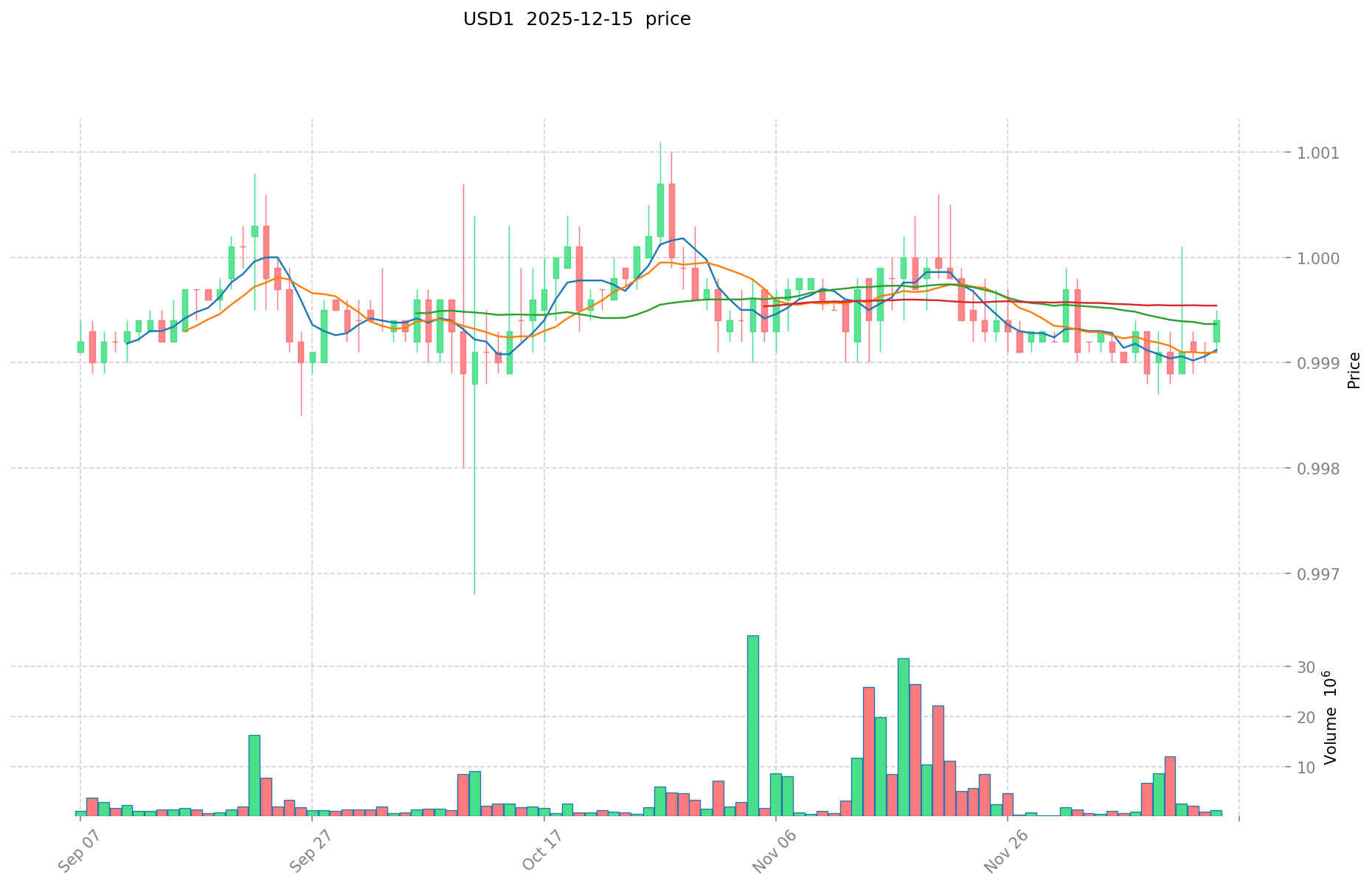
- December 16, 2025: Current price at $0.9993, demonstrating stabilization near the $1.00 peg target
Current USD1 Market Status (December 2025)
| Metric | Value |
|---|---|
| Current Price | $0.9993 |
| 24-Hour Change | +0.01% |
| 7-Day Change | +0.01% |
| 30-Day Change | -0.05% |
| 1-Year Change | -0.22% |
| Market Capitalization | $2,150,085,816.65 |
| 24-Hour Trading Volume | $10,460,049.12 |
| Market Ranking | 48th |
| Total Holders | 45,830 |
| Market Dominance | 0.068% |
Current real-time USD1 market data available at official exchange platforms
II. Project Overview and Fundamentals
Project Background
USD1 is a fiat-backed stablecoin launched in April 2025 by World Liberty Financial (WLFI), a fintech company headquartered in Miami, Florida. The project aims to facilitate seamless fungibility between traditional fiat currency and digital assets.
Regulatory Framework and Custody
- Issuer: BitGo Trust Company, a South Dakota-regulated trust entity
- Legal Compliance: Full compliance with U.S. regulatory standards
- Peg Mechanism: Designed to maintain 1:1 equivalence with the U.S. dollar
- Trust Structure: Regulated trust institution provides custody and asset management
Technical Specifications
| Parameter | Details |
|---|---|
| Token Standards | BEP-20, ERC-20 |
| Blockchain Networks | Binance Smart Chain (BSC), Ethereum (ETH), TRON (TRX), Solana (SOL) |
| Total Supply | 2,151,591,931 USD1 |
| Circulating Supply | 2,151,591,931 USD1 |
| Circulating Ratio | 100.0% |
| Exchange Listings | 33 exchanges |
Multi-Chain Deployment
USD1 is deployed across four major blockchain networks:
| Network | Contract Address |
|---|---|
| Binance Smart Chain | 0x8d0d000ee44948fc98c9b98a4fa4921476f08b0d |
| Ethereum | 0x8d0d000ee44948fc98c9b98a4fa4921476f08b0d |
| Solana | USD1ttGY1N17NEEHLmELoaybftRBUSErhqYiQzvEmuB |
| TRON | TPFqcBAaaUMCSVRCqPaQ9QnzKhmuoLR6Rc |
III. Market Performance Analysis
Price Volatility Assessment
Despite its stablecoin design targeting a $1.00 peg, USD1 has exhibited notable price volatility since launch:
- Historical high: $1.971 (June 2, 2025) — 97.1% premium to peg
- Historical low: $0.9663 (June 27, 2025) — 3.37% discount to peg
- Current price deviation: -0.07% from $1.00 peg
- Price range: 3.08 percentage points between ATH and ATL
Trading Activity and Liquidity
- 24-hour volume: $10.46 million USD
- Total market capitalization: $2.15 billion USD
- Fully diluted valuation: $2.15 billion USD (100% of market cap)
- Listed on 33 cryptocurrency exchanges, providing reasonable liquidity access
Short-term Price Trends
| Time Period | Change |
|---|---|
| 1 Hour | -0.01% |
| 24 Hours | +0.01% |
| 7 Days | +0.01% |
| 30 Days | -0.05% |
| 1 Year | -0.22% |
IV. Key Observations and Market Position
Regulatory Advantages
- BitGo Trust Company custody model provides institutional-grade asset security
- South Dakota trust charter ensures compliance with U.S. regulatory frameworks
- Transparent fiat backing mechanism supports confidence in redemption capabilities
Market Adoption
- USD1 ranks 48th by market capitalization among all cryptocurrencies
- 45,830 active token holders indicates growing adoption
- Multi-chain deployment across four major networks ensures accessibility
Risk Factors
- Historical deviation from $1.00 peg, particularly the $1.971 peak, suggests potential market speculation
- Concentrated market with 0.068% market dominance indicates limited systemic significance
- Early-stage project performance requires continued monitoring for regulatory or operational changes
V. Data Sources and Verification
All market data current as of December 16, 2025, sourced from blockchain explorers and cryptocurrency market data providers. Contract addresses and network information verified through official blockchain explorers (BSCScan, Etherscan, Solana Explorer, Tron Scan).
Disclaimer: This report provides factual market data and technical information only. It does not constitute investment advice or recommendations for any particular course of action.
World Liberty Financial USD (USD1) Investment Analysis Report
Report Date: December 16, 2025
Data Source: Gate Crypto Data Platform
Asset: World Liberty Financial USD (USD1)
I. Executive Summary
World Liberty Financial USD (USD1) is a fiat-backed stablecoin launched in April 2025, designed to maintain a 1:1 equivalence with the U.S. dollar. As of December 16, 2025, USD1 ranks 48th by market capitalization, with a total market cap of approximately $2.15 billion and 2.15 billion tokens in circulation. The asset is issued and managed by BitGo Trust Company, a South Dakota-regulated trust entity, ensuring compliance with U.S. regulatory standards.
II. Core Factors Influencing USD1 Investment Viability
Supply Mechanism and Price Stability
USD1 operates as a fiat-backed stablecoin with a fully diluted valuation matching its current market capitalization ($2,150,085,816.65), indicating a 1:1 peg design. The total supply of 2,151,591,931 tokens equals the circulating supply, representing 100% circulation ratio. This structure differentiates USD1 from volatile crypto assets—its value proposition depends on maintaining dollar equivalence rather than supply scarcity appreciation.
Price Performance Data:
- Current Price: $0.9993
- All-Time High: $1.971 (June 2, 2025)
- All-Time Low: $0.9663 (June 27, 2025)
- 24-Hour Range: $0.9989 - $1.00
- 30-Day Change: -0.05%
- 1-Year Change: -0.22%
The historical price deviation from the $1.00 peg (reaching $1.971 at peak) suggests potential deviations from intended peg maintenance, which represents a stability concern for a stablecoin asset.
Market Adoption and Liquidity
USD1 demonstrates reasonable market adoption metrics:
- Exchange Distribution: Available on 33 trading exchanges
- 24-Hour Trading Volume: $10,460,049.12
- Active Holders: 45,830 addresses
- Market Share: 0.068% of total cryptocurrency market capitalization
- Blockchain Deployment: Available on 4 major chains (BSC, Ethereum, TRON, Solana)
The multi-chain deployment provides accessibility and reduces single-chain dependency risk. However, the trading volume relative to market cap ($10.46 million volume against $2.15 billion market cap) indicates a volume-to-cap ratio of approximately 0.49%, suggesting moderate liquidity conditions.
Regulatory Framework and Institutional Structure
USD1 benefits from clear regulatory positioning:
- Issuer: World Liberty Financial (WLFI), headquartered in Miami, Florida
- Custodian: BitGo Trust Company, a regulated entity in South Dakota
- Regulatory Alignment: Full compliance with U.S. regulatory standards
- Asset Backing: Fiat-backed structure with institutional custody
This regulatory clarity represents a competitive advantage compared to unbacked stablecoins and provides institutional investors with risk mitigation through established custody and compliance frameworks.
Technical Infrastructure
USD1 operates on multiple blockchain protocols:
- ERC-20 Standard (Ethereum network)
- BEP-20 Standard (Binance Smart Chain)
- Additional Chains: TRON and Solana networks
This technical flexibility enables interoperability across major DeFi ecosystems and trading venues, though introduces complexity in reserve management and peg maintenance across multiple chains.
III. Price Volatility Assessment
Despite stablecoin designation, USD1 exhibits notable volatility:
| Time Period | Price Change |
|---|---|
| 1 Hour | -0.01% |
| 24 Hours | +0.01% |
| 7 Days | +0.01% |
| 30 Days | -0.05% |
| 1 Year | -0.22% |
The cumulative negative performance over longer periods, combined with historical peaks significantly above $1.00, suggests occasional peg pressure—a critical stability metric for stablecoin evaluation.
IV. Investment Considerations
Advantages:
- Regulatory compliance with U.S. standards through BitGo Trust Company custody
- Established fiat backing mechanism
- Multi-chain deployment for ecosystem integration
- Reasonable market adoption (33 exchanges, 45,830 holders)
- Clear institutional structure with transparent custody arrangement
Risk Factors:
- Historical peg deviation (peak of $1.971) indicates maintenance challenges
- Moderate trading liquidity relative to market size
- Recent negative price performance (-0.22% over 1 year)
- Relatively new asset (launched April 2025) with limited operational history
- Concentration risk in stablecoin market dominated by established competitors
V. Conclusion
USD1 functions as a regulatory-compliant, fiat-backed stablecoin with institutional custody safeguards. Its investment suitability depends on use case: those seeking dollar exposure with regulatory compliance may find value in USD1's framework; however, historical peg deviations and limited operational history warrant continued monitoring. The asset's stability relative to unregulated alternatives provides risk mitigation, but performance metrics indicate it operates within expected stablecoin parameters rather than demonstrating competitive advantages.
Data Current As Of: December 16, 2025, 00:24:57 UTC
III. USD1 Future Investment Predictions and Price Outlook
Short-term Investment Predictions (2025, short-term USD1 investment outlook)
- Conservative forecast: $0.65 - $0.99
- Neutral forecast: $0.99 - $1.32
- Optimistic forecast: $1.32 - $1.66
Mid-term Investment Outlook (2026-2028, mid-term World Liberty Financial USD(USD1) investment forecast)
-
Market stage expectations: USD1 is transitioning from initial market establishment to broader adoption phase, with increasing integration across multiple blockchain networks (BSC, Ethereum, Solana, Tron) supporting ecosystem expansion.
-
Investment return predictions:
- 2026: $0.82 - $1.67 (projected 16% upside)
- 2027: $1.02 - $1.94 (projected 41% upside)
- 2028: $1.37 - $2.08 (projected 67% upside)
-
Key catalysts: Regulatory clarity from U.S. authorities, expansion of institutional adoption, integration with decentralized finance protocols, and increased cross-chain liquidity.
Long-term Investment Outlook (Is USD1 a good long-term investment?)
-
Base case scenario: $1.21 - $2.29 (assuming steady regulatory compliance and moderate market adoption of fiat-backed stablecoins)
-
Optimistic scenario: $2.29 - $3.05 (assuming significant institutional adoption, broader mainstream acceptance, and favorable regulatory environment through 2030)
-
Risk scenario: $0.64 - $1.21 (assuming regulatory challenges, market consolidation favoring competing stablecoins, or macroeconomic headwinds)
Explore USD1 long-term investment and price predictions: Price Prediction
2025-2030 Long-term Outlook
-
Base case: $1.21 - $2.29 USD (corresponding to stable regulatory compliance and steady stablecoin market adoption)
-
Optimistic scenario: $2.29 - $3.05 USD (corresponding to large-scale institutional adoption and favorable market conditions)
-
Transformative scenario: $3.05 USD and above (contingent on breakthrough ecosystem developments and mainstream adoption)
-
Predicted high by end of 2030: $3.05 USD (based on optimistic development assumptions)
Disclaimer: This analysis is for informational purposes only and should not be construed as investment advice. Stablecoin valuations are primarily determined by reserve backing and regulatory compliance rather than speculative market forces. Past performance does not guarantee future results. All cryptocurrency investments carry risks, including potential regulatory changes, market volatility, and liquidity considerations.
| 年份 | 预测最高价 | 预测平均价格 | 预测最低价 | 涨跌幅 |
|---|---|---|---|---|
| 2025 | 1.319208 | 0.9994 | 0.64961 | 0 |
| 2026 | 1.66939776 | 1.159304 | 0.82310584 | 16 |
| 2027 | 1.9376607056 | 1.41435088 | 1.0183326336 | 41 |
| 2028 | 2.078247183072 | 1.6760057928 | 1.374324750096 | 67 |
| 2029 | 2.70306214262784 | 1.877126487936 | 1.33275980643456 | 87 |
| 2030 | 3.045825439324953 | 2.29009431528192 | 1.213749987099417 | 129 |
World Liberty Financial USD (USD1) Investment Analysis Report
I. Executive Summary
USD1 is a fiat-backed stablecoin launched in April 2025 by World Liberty Financial (WLFI), a Miami-based fintech company. Designed to maintain a 1:1 equivalence with the U.S. dollar, USD1 aims to streamline digital transactions by providing seamless fungibility between fiat currency and digital assets. The stablecoin is issued and managed by BitGo Trust Company, a South Dakota-regulated trust entity, ensuring compliance with U.S. regulatory standards.
II. Market Position and Performance Metrics
Current Market Status (as of December 16, 2025)
| Metric | Value |
|---|---|
| Current Price | $0.9993 |
| Market Capitalization | $2.15 billion |
| Circulating Supply | 2.15 billion USD1 |
| 24-Hour Trading Volume | $10.46 million |
| Market Ranking | 48th |
| Market Dominance | 0.068% |
Price Performance
| Time Period | Price Change |
|---|---|
| 1 Hour | -0.01% |
| 24 Hours | +0.01% |
| 7 Days | +0.01% |
| 30 Days | -0.05% |
| 1 Year | -0.22% |
Historical Price Range
- All-Time High: $1.971 (June 2, 2025)
- All-Time Low: $0.9663 (June 27, 2025)
- High (24H): $1.00
- Low (24H): $0.9989
III. Technical Specifications and Infrastructure
Blockchain Networks
USD1 is deployed across multiple blockchain networks:
- Binance Smart Chain (BSC): 0x8d0d000ee44948fc98c9b98a4fa4921476f08b0d
- Ethereum (ETH): 0x8d0d000ee44948fc98c9b98a4fa4921476f08b0d
- TRON (TRX): TPFqcBAaaUMCSVRCqPaQ9QnzKhmuoLR6Rc
- Solana (SOL): USD1ttGY1N17NEEHLmELoaybftRBUSErhqYiQzvEmuB
Token Standards
USD1 operates on BEP-20 and ERC-20 standards, enabling compatibility across major blockchain ecosystems.
Adoption Metrics
- Number of Exchanges: 33
- Token Holders: 45,830
IV. Investment Strategy and Risk Management
Investment Methodology
Stablecoin Characteristics:
USD1, as a fiat-backed stablecoin, functions differently from volatile cryptocurrencies. Its primary purpose is capital preservation and transactional utility rather than capital appreciation.
- Capital Preservation: Suitable for investors seeking to maintain dollar-equivalent value within blockchain ecosystems
- Liquidity Management: Appropriate for traders using stablecoins as a intermediary between volatile assets
- Cross-chain Transfers: Enables efficient fund movement across multiple blockchain networks
Risk Management
Asset Allocation Considerations:
For portfolios incorporating stablecoins, typical allocations vary by investor profile:
- Conservative Investors: Stablecoins as 10-20% portfolio allocation for liquidity reserves
- Active Traders: 20-50% allocation for position sizing and risk hedging
- Institutional Investors: Strategic allocation based on operational treasury management needs
Storage and Security:
- Hot Wallets: For frequent transactions and trading activity (smaller amounts)
- Cold Storage: For long-term holding and capital preservation
- Custodial Services: Institutional-grade security through regulated custodians
V. Investment Risks and Challenges
Market Risks
- Peg Stability Risk: Although designed to maintain 1:1 parity with USD, historical data shows deviation (trading as low as $0.9663), indicating potential depeg scenarios
- Liquidity Risk: 24-hour trading volume of $10.46 million may be insufficient for large institutional withdrawals
- Counterparty Risk: Dependence on BitGo Trust Company's operational integrity and regulatory compliance
Regulatory Risks
- U.S. Regulatory Uncertainty: Evolving stablecoin regulations could impact USD1's operational framework
- State-Level Compliance: Multi-jurisdiction requirements for a South Dakota-based trust entity
- Policy Changes: Potential changes in money transmission laws and digital asset regulations
Technical Risks
- Multi-chain Deployment Risk: Managing consistency across four separate blockchain networks
- Smart Contract Vulnerabilities: Potential exploits affecting token functionality across different chains
- Network Congestion: Performance degradation during high blockchain network traffic periods
VI. Conclusion: Is USD1 a Good Investment?
Investment Value Summary
USD1 presents a specialized value proposition distinct from traditional investment cryptocurrencies. As a regulated, fiat-backed stablecoin, it prioritizes capital preservation and transactional utility over capital appreciation. The current market price of $0.9993 demonstrates effective peg maintenance, though historical deviations warrant monitoring.
Key Considerations:
- Primary Use Case: Treasury management, cross-chain transfers, and trading pairs on decentralized exchanges
- Risk-Return Profile: Low volatility (appropriate for capital preservation) but minimal upside appreciation potential
- Regulatory Advantage: South Dakota trust framework provides legal clarity compared to unregulated stablecoin alternatives
Investor Recommendations
✅ Newcomers to Crypto: USD1 serves as a safe entry point for understanding blockchain transactions and stablecoin mechanics; use for gradual cross-chain asset transfers
✅ Active Traders: Appropriate as a trading pair and liquidity management tool; maintains value during market volatility while enabling rapid position adjustments
✅ Institutional Investors: Suitable for treasury reserves and operational liquidity management; verify compliance with institutional custody requirements before deployment
⚠️ Important Disclaimer: Cryptocurrency and digital asset investments carry inherent risks. While USD1 is designed as a stablecoin with regulatory oversight, regulatory environments continue to evolve. This report is provided for informational purposes only and does not constitute investment advice. Conduct independent due diligence and consult with qualified financial advisors before making investment decisions.
Report Date: December 16, 2025
Data Source: Gate Research Database
Status: Preliminary Analysis
World Liberty Financial USD (USD1) Frequently Asked Questions
I. What is USD1 and how does it maintain its $1.00 peg?
Answer: USD1 is a fiat-backed stablecoin launched in April 2025 by World Liberty Financial (WLFI), designed to maintain a 1:1 equivalence with the U.S. dollar. The token is issued and managed by BitGo Trust Company, a South Dakota-regulated trust entity, which holds U.S. dollar reserves to back each USD1 token in circulation. This institutional custody model ensures that USD1 maintains its peg through direct fiat backing rather than algorithmic mechanisms. However, historical data shows the token has deviated from its $1.00 target, trading as high as $1.971 in June 2025 and as low as $0.9663, indicating occasional peg pressure that investors should monitor.
II. On which blockchain networks can USD1 be used?
Answer: USD1 is deployed across four major blockchain networks to maximize accessibility and reduce single-chain dependency risk: Binance Smart Chain (BSC), Ethereum (ETH), TRON (TRX), and Solana (SOL). Each network has distinct contract addresses, allowing users to transfer USD1 across different blockchain ecosystems. This multi-chain deployment enables seamless integration with decentralized finance protocols, trading venues, and cross-chain bridges, making USD1 available on 33 cryptocurrency exchanges as of December 2025.
III. What are the main risks associated with investing in USD1?
Answer: Key risks include peg stability risk—despite its stablecoin design, USD1 has historically deviated from $1.00, suggesting potential depeg scenarios; counterparty risk from dependence on BitGo Trust Company's operational integrity; liquidity risk, as 24-hour trading volume of $10.46 million may be insufficient for large institutional transactions; regulatory risk from evolving U.S. stablecoin policies; and technical risk from managing consistency across four separate blockchain networks. Additionally, as a relatively new project launched in April 2025, USD1 has limited operational history compared to established stablecoin competitors.
IV. Is USD1 suitable for long-term investment and capital appreciation?
Answer: USD1 is not designed for capital appreciation in the traditional investment sense. As a fiat-backed stablecoin, its primary purpose is capital preservation and transactional utility rather than price growth. The asset's value proposition centers on maintaining dollar equivalence within blockchain ecosystems, making it appropriate for treasury management, cross-chain transfers, and trading pair liquidity rather than wealth accumulation. Investors seeking capital appreciation should consider other cryptocurrency assets; those requiring stable value storage within digital asset environments may find USD1 suitable as a portfolio component for risk management and liquidity purposes.
V. How does USD1 compare to other regulated stablecoins in the market?
Answer: USD1 differentiates itself through its South Dakota trust charter framework managed by BitGo Trust Company, providing institutional-grade custody and U.S. regulatory compliance. Unlike some stablecoins lacking clear regulatory oversight, USD1 benefits from established legal structures and transparent reserve backing. However, USD1 operates in a competitive market dominated by larger, more established stablecoins with greater liquidity and adoption. With a market capitalization of $2.15 billion and ranking 48th among cryptocurrencies, USD1 maintains reasonable market position but represents a smaller share of total stablecoin market dominance at 0.068%, indicating it functions as a specialized solution rather than a market leader.
VI. What should investors know about USD1's historical price performance?
Answer: USD1's price history reveals important volatility patterns despite its stablecoin designation. Since launch in April 2025, the token reached an all-time high of $1.971 (June 2, 2025)—representing a 97.1% premium to the intended peg—and an all-time low of $0.9663 (June 27, 2025)—representing a 3.37% discount to peg. Current pricing at $0.9993 demonstrates stabilization near target levels. However, short-term metrics show negative performance: 30-day change of -0.05% and 1-year change of -0.22%. These deviations from perfect peg maintenance suggest that USD1 experiences occasional market pressure, requiring investors to maintain realistic expectations about price stability relative to traditional dollar holdings.
VII. Who should consider using USD1 and for what purposes?
Answer: USD1 is most appropriate for: (1) cryptocurrency newcomers seeking a safe entry point to understand blockchain transactions and stablecoin mechanics; (2) active traders requiring trading pairs and liquidity management tools during market volatility; (3) institutional investors needing treasury reserves and operational liquidity management with regulatory compliance; and (4) users requiring cross-chain asset transfers across BSC, Ethereum, TRON, and Solana networks. USD1 is less suitable for investors seeking capital appreciation, as its design prioritizes value preservation over growth potential. Users should verify compatibility with their custody requirements and conduct independent due diligence regarding regulatory compliance before deployment.
VIII. What regulatory advantages does USD1 offer compared to unregulated stablecoins?
Answer: USD1 provides significant regulatory advantages through its institutional structure: BitGo Trust Company, a regulated entity chartered in South Dakota, manages USD1's issuance and custody, ensuring compliance with U.S. regulatory standards. This transparent trust framework provides institutional investors with legal clarity and reduces counterparty risk compared to stablecoins lacking regulated custodianship. The fiat-backing mechanism, combined with institutional oversight, supports redemption confidence and regulatory acceptance across financial institutions. However, the regulatory landscape for stablecoins continues evolving, and future policy changes could impact USD1's operational framework. Investors should monitor regulatory developments and verify USD1's ongoing compliance status before making investment decisions, as regulatory uncertainty remains a material risk factor despite current compliance positioning.
Report Date: December 16, 2025
Disclaimer: This FAQ provides informational content only and does not constitute investment advice. All cryptocurrency investments carry substantial risks, including potential regulatory changes and market volatility. Conduct independent due diligence and consult qualified financial advisors before making investment decisions.
Share
How to Buy Cryptocurrency


Trending Cryptocurrencies



XZXX: A Comprehensive Guide to the BRC-20 Meme Token in 2025

Bitcoin Fear and Greed Index: Market Sentiment Analysis for 2025

Top Crypto ETFs to Watch in 2025: Navigating the Digital Asset Boom
5 ways to get Bitcoin for free in 2025: Newbie Guide

Bitcoin Market Cap in 2025: Analysis and Trends for Investors

2025 Bitcoin Price Prediction: Trump's Tariffs' Impact on BTC

What is ICP: A Comprehensive Guide to Internet Computer Protocol and Its Revolutionary Impact on Decentralized Computing

What is PI: A Comprehensive Guide to Understanding the Mathematical Constant and Its Applications in Science and Engineering

What is HTX: A Comprehensive Guide to the Leading Cryptocurrency Exchange Platform

What is ENA: A Comprehensive Guide to European Nucleotide Archive and Its Role in Biological Data Management

What is PEPE: A Comprehensive Guide to the Viral Meme Coin and Its Cultural Impact