What is KSM: A Comprehensive Guide to Kusama Network and Its Role in the Polkadot Ecosystem


Kusama (KSM) Research Report
Kusama's Positioning and Significance
Kusama (KSM) is a public blockchain established as a testing ground for major experiments on the Polkadot network. It provides a real-world environment to validate network protocols and security mechanisms before implementation on Polkadot, ensuring the stability and safety of the broader ecosystem.
As a canary network for Polkadot, Kusama plays a critical role in the multi-chain infrastructure and interoperability sector. It enables validators, parachain teams, and ecosystem developers to rehearse and prepare in advance, creating a controlled yet realistic testing environment for blockchain innovation.
As of December 2025, Kusama has established itself as a fundamental infrastructure asset with a market cap of $126.83 million and 17.48 million KSM in circulation across 266,873 token holders. The network continues to serve as an incubation ground for cutting-edge blockchain experiments and protocol upgrades.
Origins and Development History
Background and Creation
Kusama was created to address the critical need for a realistic testing environment in blockchain ecosystems. The Polkadot development team recognized that major network upgrades and experimental features required rigorous testing without risking the security of the main network. Kusama emerged as the solution—a "canary network" designed to validate innovations before their deployment on Polkadot.
By providing a near-production environment, Kusama enables network participants including validators, parachain teams, and tool builders to conduct comprehensive rehearsals and preparations. This approach significantly reduces the risk of protocol failures and security vulnerabilities in the main Polkadot network.
Key Milestones
- 2019: Kusama network launched, establishing a testing ground for Polkadot experiments
- 2020–2021: Network matured with the introduction of parachains and cross-chain bridge functionality
- 2021: KSM reached its all-time high of $621.71 (May 18, 2021), demonstrating strong market confidence in the testing infrastructure model
- Ongoing: Kusama continues to host experimental features, governance innovations, and real-world use cases that later inform Polkadot development
Under the continued development and community governance model, Kusama remains an essential component of the Polkadot ecosystem, continuously optimizing its technology, security mechanisms, and protocol innovations.
How Kusama Works
Decentralized Network Architecture
Kusama operates on a globally distributed network of independent nodes, eliminating dependence on centralized authorities such as banks or governments. These nodes collaborate to validate transactions and maintain the network's integrity, creating a transparent, tamper-resistant system that grants users genuine control over their assets while enhancing overall network resilience.
Relay Chain Foundation
At the core of Kusama lies the Relay Chain—the primary blockchain where all Kusama nodes operate. The Relay Chain serves as the central coordination layer for the entire network, maintaining the security and consensus of the system.
This architecture supports a public, immutable digital ledger that records every transaction. Transactions are grouped into blocks cryptographically linked together, forming an unbreakable chain. Any participant can inspect these records directly, establishing trust without intermediaries. This transparency is fundamental to Kusama's value proposition as a testing platform.
Multi-Parachain Ecosystem
Beyond the Relay Chain, Kusama's infrastructure includes:
- Parachains: Parallel blockchains that connect to the Relay Chain, each maintained by its own network validators called Collators. This design allows specialized use cases and increases overall system throughput.
- Bridges: Special blockchains that connect Kusama's parachains to external networks such as Bitcoin and Ethereum, enabling cross-chain interoperability and data exchange.
This multi-layered architecture enables Kusama to host diverse experimental projects while maintaining security through shared consensus mechanisms.
Governance-Driven Security
Kusama employs a Proof-of-Stake (PoS) consensus mechanism where validators secure the network by staking KSM tokens. Validators propose blocks and participate in consensus; in return, they receive block rewards in KSM.
A distinctive feature of Kusama compared to Polkadot is its accelerated governance parameters, which facilitate faster network evolution:
- Voting period: 7 days (versus longer periods on Polkadot)
- Implementation period: 8 days after voting conclusion
This faster cadence makes Kusama ideal for rapid experimentation and protocol iteration, distinguishing it as a true canary network rather than simply a smaller duplicate of Polkadot.
Cryptographic Security
Kusama employs industry-standard public-private key cryptography to secure transactions:
- Private keys function as secret credentials for signing transactions and proving authorization
- Public keys serve as account identifiers for receiving assets and verifying transaction authenticity
This mechanism ensures that only token holders with valid private keys can move their assets, preventing unauthorized access and maintaining transaction integrity. The cryptographic foundation provides strong security guarantees while enabling pseudonymous participation.
KSM Token Functions
KSM is the native utility token of the Kusama network with multiple critical functions:
Governance: KSM token holders can participate in network governance by voting on proposed changes and upgrades, directly influencing the network's evolution.
Consensus Participation: Relay Chain validators are required to stake KSM tokens to operate nodes and participate in block validation, directly linking token holders to network security.
Parachain Integration: Projects seeking to become parachains on Kusama must stake KSM tokens, aligning economic incentives with network participation.
Transaction Fees: KSM is used to pay transaction fees for cross-chain message transmission and other network operations.
Market Performance
Current Market Data (As of December 17, 2025)
- Current Price: $7.255
- Market Cap: $126.83 million
- 24-Hour Volume: $185,205.47
- Circulating Supply: 17,481,470.78 KSM
- Maximum Supply: Unlimited
- Market Ranking: #301
Price Dynamics
- 1-Hour Change: +0.22%
- 24-Hour Change: +1.99%
- 7-Day Change: -14.33%
- 30-Day Change: -27.31%
- 1-Year Change: -80.93%
- All-Time High: $621.71 (May 18, 2021)
- All-Time Low: $0.876572 (January 15, 2020)
The significant year-over-year decline reflects broader market conditions and the evolving role of canary networks in the blockchain ecosystem. However, KSM maintains its fundamental utility as a testing and governance token within the Polkadot infrastructure.
Network Adoption
Kusama is listed on 35 exchanges globally, ensuring liquidity and accessibility for participants. The network supports 266,873 token holders, demonstrating sustained community engagement and interest in the testing infrastructure model.
Conclusion
Kusama represents a sophisticated approach to blockchain innovation—providing a dedicated, secure environment for testing and experimentation while maintaining genuine real-world conditions. Its accelerated governance parameters, multi-parachain architecture, and robust cryptographic security make it an indispensable component of the Polkadot ecosystem.
For developers, validators, and projects seeking to experiment with novel blockchain features before mainstream deployment, Kusama offers an unparalleled sandbox. For investors and participants, KSM represents exposure to next-generation blockchain infrastructure and governance participation rights.
As the blockchain industry continues to mature, Kusama's role in risk management and innovation validation becomes increasingly valuable, securing its place as a critical infrastructure asset in the multi-chain future.
For more information and to trade KSM, visit Gate.com, a leading cryptocurrency exchange supporting diverse trading pairs and market access.
Kusama's Market Performance
Circulation Overview
As of December 17, 2025, Kusama (KSM) has a circulating supply of 17,481,470.78 KSM, with a total supply of 17,481,470.78 KSM. The network operates under an inflationary model, with new tokens continuously entering the market through validator rewards and network participation incentives, which influences the supply and demand dynamics of KSM.
Price Fluctuations
Kusama reached its all-time high of $621.71 on May 18, 2021, driven by the broader cryptocurrency market bull run and growing institutional interest in the Polkadot ecosystem. Conversely, its all-time low stood at $0.876572 on January 15, 2020, during the early market consolidation phase.
As of the current reporting date, KSM is trading at $7.255, reflecting a -80.93% decline over the past year. Recent 24-hour price action shows a +1.99% increase, while the 7-day and 30-day periods have experienced contractions of -14.33% and -27.31% respectively. These fluctuations reflect shifting market sentiment, evolving adoption patterns, and the broader cryptocurrency market conditions.
View current KSM market price on Gate.com
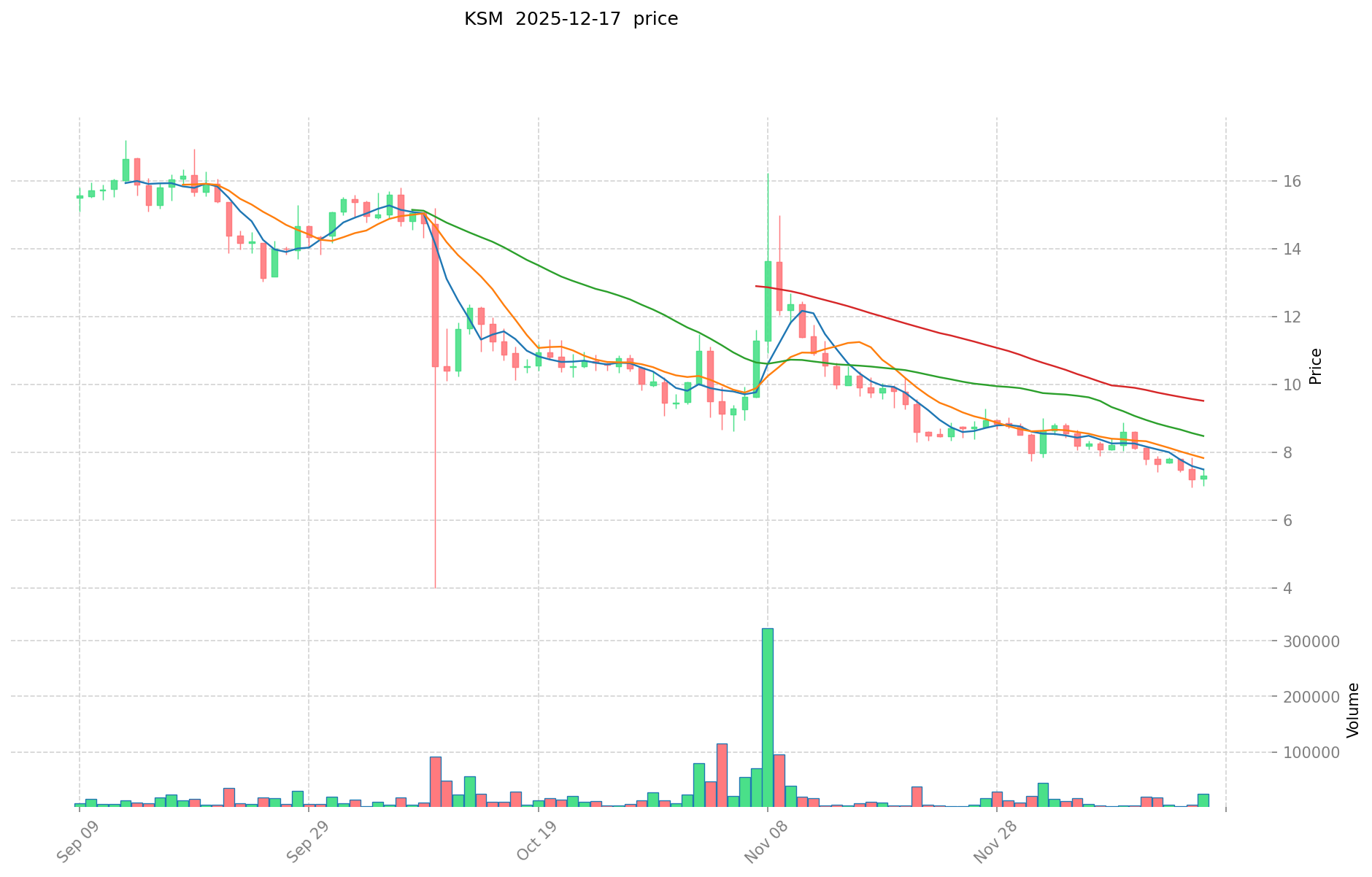
Market Capitalization and Trading Activity
- Market Capitalization: $126,828,070.50 (Ranking: #301)
- 24-Hour Trading Volume: $185,205.47
- Market Dominance: 0.0040%
- Number of Token Holders: 266,873 addresses
- Exchange Listings: Available on 35 exchanges, including Gate.com
Kusama (KSM) Comprehensive Research Report
Overview
Kusama (KSM) is a public blockchain established as an experimental network for Polkadot. As of December 17, 2025, KSM is trading at $7.255 with a 24-hour trading volume of $185,205.47, ranking #301 by market capitalization at approximately $126.83 million.
Key Metrics
| Metric | Value |
|---|---|
| Current Price | $7.255 |
| 24H Change | +1.99% |
| 7D Change | -14.33% |
| 30D Change | -27.31% |
| 1Y Change | -80.93% |
| All-Time High | $621.71 (May 18, 2021) |
| All-Time Low | $0.876572 (January 15, 2020) |
| Circulating Supply | 17,481,470.78 KSM |
| Total Supply | 17,481,470.78 KSM |
| Max Supply | Unlimited (∞) |
| Market Cap Dominance | 0.0040% |
| Total Holders | 266,873 |
Project Introduction
Purpose and Functionality
Kusama provides a realistic testing environment for the Polkadot network, ensuring the security and stability of major Polkadot experiments before they are deployed on the mainnet. It enables future Polkadot participants—including validator nodes, parachain teams, and ecosystem tool builders—to rehearse and prepare in advance.
KSM Token Utilities
KSM is the native utility token of the Kusama network, serving four primary functions:
- Governance: KSM token holders can initiate and vote on network governance proposals.
- Consensus Staking: Relay Chain validators must stake KSM tokens to operate nodes and secure the network.
- Parachain Onboarding: Parachains are required to stake KSM tokens when joining the network.
- Transaction Fees: KSM is used to pay fees for cross-chain message transmission and network operations.
Key Differences from Polkadot
Kusama differentiates itself from Polkadot through faster network evolution:
- Voting Period: 7 days (compared to Polkadot's longer governance cycles)
- Implementation Period: 8 days following vote conclusion
- Purpose: Acts as a "canary network" for testing avant-garde features
Network Architecture
Infrastructure Components
Kusama's infrastructure comprises three main layers:
-
Relay Chain: The primary blockchain of the Kusama network, hosting all Kusama nodes and serving as the central hub for network coordination and security.
-
Parachains: Parallel blockchains connected to the Relay Chain, each maintained by its own network validators called Collators. Parachains can operate independently while benefiting from Relay Chain security.
-
Bridges: Special blockchains that connect Parachains with external networks, including Bitcoin and Ethereum, enabling cross-chain interoperability.
Trading Information
Exchange Availability
KSM is listed on 35 major cryptocurrency exchanges, including Gate.com, providing comprehensive trading accessibility.
Price Performance Analysis
- 1-Hour Change: +0.22% ($0.0159 increase)
- 24-Hour Range: $7.00 - $7.52
- Weekly Decline: -14.33%, indicating recent downward pressure
- Monthly Performance: -27.31%, reflecting consolidation phase
- Yearly Performance: -80.93%, showing significant long-term correction from all-time highs
Volume Metrics
- 24H Trading Volume: $185,205.47
- Market Capitalization: $126,828,070.50
- Fully Diluted Valuation: $126,828,070.50 (100% of market cap, as circulating supply equals total supply)
Official Resources
- Official Website: https://kusama.network/
- Blockchain Explorer: https://assethub-kusama.subscan.io/
- Community Statistics: https://kusama.polkastats.io/
- Community Forum: https://forum.kusama.network/
- X (Twitter) Channel: @kusamanetwork
How to Participate in Kusama
1. Purchase KSM Tokens
KSM is available for purchase on Gate.com and 34 other major exchanges, offering multiple trading pairs and order types for different investment strategies.
2. Secure Storage
Store KSM tokens securely using hardware wallets or reputable software wallets that support the Kusama network.
3. Network Participation
- Validator Operation: Run a Kusama validator node by staking KSM tokens to help secure the network.
- Governance Participation: Stake KSM and vote on network proposals through the governance mechanism.
- Parachain Launch: Teams can auction parachain slots by locking KSM tokens in crowdfunds.
4. Development and Ecosystem Contribution
Explore the Kusama Developer Portal to build applications, parachains, or contribute to the ecosystem through code contributions and innovation.
Investment Considerations
Strengths
- Testing Ground: Serves as a reliable proving ground for Polkadot innovations
- Faster Governance: Enables rapid network evolution and experimentation
- Interoperability: Bridges connect to major external blockchains (Bitcoin, Ethereum)
- Active Ecosystem: Supports multiple parachains and decentralized applications
- Community Driven: Governance-focused design empowers token holders
Challenges and Risks
- Price Volatility: KSM has experienced significant long-term depreciation (-80.93% annually), reflecting market cycles and broader crypto sentiment.
- Canary Status: As an experimental network, Kusama carries higher technical risks compared to mature blockchains.
- Regulatory Uncertainty: Crypto regulatory frameworks continue evolving globally, potentially affecting token utility and trading.
- Competition: Other interoperability solutions and parachain platforms present ongoing competitive pressures.
- Network Adoption: Reliance on parachain ecosystem growth for sustained utility and value proposition.
Market Position
With a current ranking of #301 by market capitalization and 0.0040% market dominance, Kusama maintains a specialized position within the broader cryptocurrency ecosystem. Its focus as Polkadot's experimental network distinguishes it from general-purpose blockchains but ties its long-term success to Polkadot's mainstream adoption.
Conclusion
Kusama serves a critical function within the Polkadot ecosystem as an avant-garde testing network, enabling safe experimentation and network evolution. The KSM token provides essential functionality for network security, governance, and parachain participation.
While Kusama has experienced significant price depreciation in the past year, reflecting broader market cycles and investor sentiment shifts, its technical architecture and role as a bridge between experimental features and Polkadot mainnet remain valuable to the ecosystem.
Investors and participants should recognize both the innovative potential and inherent risks of engaging with an experimental blockchain network. Whether through trading, staking, or development participation, Kusama offers multiple avenues for engagement within the Polkadot ecosystem.
For updated information, trading opportunities, and community engagement, visit the official website, monitor community forums, and follow official social media channels.
Report Generated: December 17, 2025
Data Source: Gate.com Cryptocurrency Research Database
Share
Content
Kusama's Positioning and Significance
Origins and Development History
How Kusama Works
KSM Token Functions
Market Performance
Conclusion
Kusama's Market Performance
Overview
Project Introduction
Network Architecture
Trading Information
Official Resources
How to Participate in Kusama
Investment Considerations
Market Position
Conclusion
Trending Cryptocurrencies



XZXX: A Comprehensive Guide to the BRC-20 Meme Token in 2025

Bitcoin Fear and Greed Index: Market Sentiment Analysis for 2025

Top Crypto ETFs to Watch in 2025: Navigating the Digital Asset Boom

5 ways to get Bitcoin for free in 2025: Newbie Guide

Bitcoin Market Cap in 2025: Analysis and Trends for Investors
2025 Bitcoin Price Prediction: Trump's Tariffs' Impact on BTC

Is Movement Network (MOVE) a good investment?: A Comprehensive Analysis of Tokenomics, Technology, and Market Potential

Xenea Daily Quiz Answer December 17, 2025

Is Arkham (ARKM) a good investment?: A comprehensive analysis of token fundamentals, market potential, and risk factors for 2024

Is DigiByte (DGB) a good investment?: A Comprehensive Analysis of Risks, Opportunities, and Market Potential in 2024

Is Unibase (UB) a good investment?: A comprehensive analysis of tokenomics, market potential, and risk factors for 2024