As decentralized finance (DeFi) continues to expand rapidly, on-chain asset swaps have become a key function within the blockchain ecosystem. From in-wallet swaps to decentralized exchanges and trading aggregators, many types of applications need efficient and secure trade execution. However, performing trade matching entirely on-chain often leads to high Gas costs and lower execution efficiency, which means on-chain trading infrastructure needs a more flexible solution.
0x Protocol emerged in response to this need as a decentralized trading protocol. By handling order matching off-chain while executing final asset settlement on-chain, it improves trading efficiency while preserving transparency and security. This mechanism not only lowers on-chain transaction costs, but also provides wallets, DEXs, and DeFi applications with more efficient liquidity infrastructure, making it an important part of the on-chain trading ecosystem.
What Is the Trading Process of 0x Protocol?
The trading process of 0x Protocol is mainly divided into two stages: off-chain order creation and broadcasting, followed by on-chain order settlement.
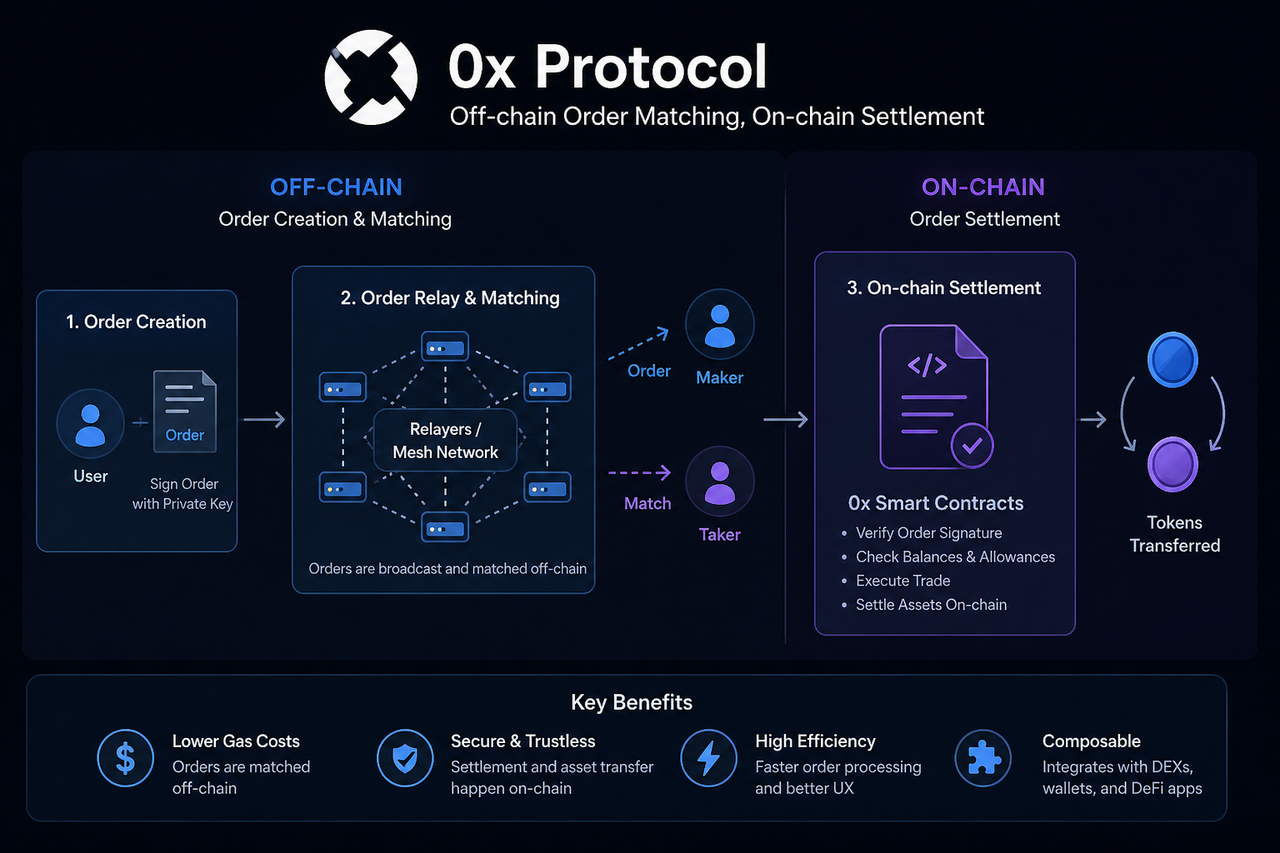
First, a user creates an order containing details such as the trading price, amount, and expiration time, then signs the order with their private key. The order is not submitted to the blockchain immediately. Instead, it is broadcast off-chain through relay services. Other trading participants or liquidity aggregators can access these orders and look for matching opportunities.
Once an order meets the conditions for execution, the matching party submits the signed order to 0x smart contracts. The smart contract verifies the signature, checks balances, and executes the asset swap. Throughout the entire process, only the final executed trade is recorded on-chain, reducing the number of blockchain interactions.
What Is the Off-Chain Order Broadcasting Mechanism?
Off-chain order relay is one of the core design features of 0x Protocol. After a user creates an order, the order data is distributed off-chain through relayer nodes or the Mesh network instead of being written to the blockchain immediately.
The main advantage of this approach is that it reduces on-chain write operations. Order creation, updates, and cancellations can all take place off-chain, while on-chain interaction is only required when an order is filled. This significantly lowers transaction costs. For trading scenarios where orders need to be updated frequently, this mechanism is more efficient than a fully on-chain order book.
Off-chain broadcasting also improves trading flexibility, allowing different applications to share order liquidity and improve overall matching efficiency.
How Does On-Chain Settlement Protect Transaction Security?
Although orders are distributed off-chain, the final asset exchange is completed through on-chain smart contracts. 0x Protocol’s smart contracts are responsible for verifying order signatures, checking asset balances and approval allowances, and executing the trade once all conditions are met.
This means off-chain broadcasting does not weaken transaction security, because actual asset transfers are still controlled by on-chain smart contracts. Only orders with valid signatures that meet the required conditions can be filled, which prevents malicious tampering.
Through this design, 0x Protocol improves efficiency while preserving the transparency and verifiability of blockchain transactions, allowing users to exchange assets without trusting an intermediary.
How Does 0x Protocol Reduce Gas Costs?
In a traditional on-chain order book model, every order placement, cancellation, and update requires an on-chain operation, which results in relatively high Gas fees. In 0x Protocol, however, most order-related activities happen off-chain. On-chain settlement is only required when a trade is executed.
This means multiple order state changes can be completed off-chain without consuming blockchain resources. Users only pay on-chain fees when a trade actually takes place, so overall transaction costs are significantly reduced. This design can greatly improve capital efficiency, especially in scenarios where orders change frequently.
Lower Gas costs make 0x better suited as the underlying infrastructure for in-wallet swaps and trading aggregation services.
How Do the Core Components of 0x Protocol Work Together?
0x Protocol relies on the coordination of multiple components to execute trades, including Relayer, the Mesh network, 0x API, and Exchange Proxy.
Relayer handles order relay and broadcasting. The Mesh network shares order information among nodes. 0x API provides a unified quote interface. Exchange Proxy is responsible for on-chain settlement and liquidity routing. After a user submits a trade request, the API obtains quotes from different liquidity sources, orders are distributed through the off-chain network, and final settlement is completed by smart contracts.
This modular design allows 0x to remain open as a protocol while providing developers with a unified trading interface, improving integration efficiency.
Why Is This Model Suitable for On-Chain Liquidity Aggregation?
0x Protocol’s off-chain matching mechanism allows it to aggregate liquidity from different sources efficiently. Because orders do not need to be submitted on-chain immediately, quotes from different markets and market makers can be quickly combined, with the best route selected for execution during on-chain settlement.
This is especially important for wallets and aggregators, which need to find the best price across multiple liquidity sources. Relying entirely on on-chain matching would be both costly and less efficient. With 0x, price discovery can happen off-chain, while asset settlement happens on-chain, creating a balance between efficiency and security.
For this reason, 0x is widely regarded as an important part of on-chain trading aggregation infrastructure.
Conclusion
0x Protocol separates order matching from asset settlement through an architecture that combines off-chain order broadcasting with on-chain settlement, allowing decentralized trading to become more efficient while maintaining security. Off-chain broadcasting reduces the number of on-chain interactions and lowers Gas costs, while on-chain smart contracts ensure that trade execution remains transparent and trustworthy.
This design makes 0x an important underlying trading infrastructure for wallets, DEXs, and DeFi aggregators. Understanding this mechanism helps explain how on-chain trading systems strike a balance between efficiency and decentralization.
FAQs
Why does 0x Protocol use off-chain matching?
Off-chain matching reduces the number of on-chain operations, lowering Gas costs and improving order processing efficiency.
Is off-chain order broadcasting secure?
Order broadcasting happens off-chain, but asset settlement is completed by on-chain smart contracts, so transaction security is still protected by the blockchain.
How does 0x Protocol enable low-cost trading?
It keeps order placement and order updates off-chain, requiring on-chain settlement only when a trade is executed. This reduces overall on-chain fees.
Who executes on-chain settlement in 0x Protocol?
0x smart contract components, such as Exchange Proxy, execute order verification and asset swaps.
What use cases is 0x Protocol suitable for?
It is mainly suitable for in-wallet swaps, DEX aggregators, DeFi platforms, and applications that need on-chain asset exchange capabilities.







