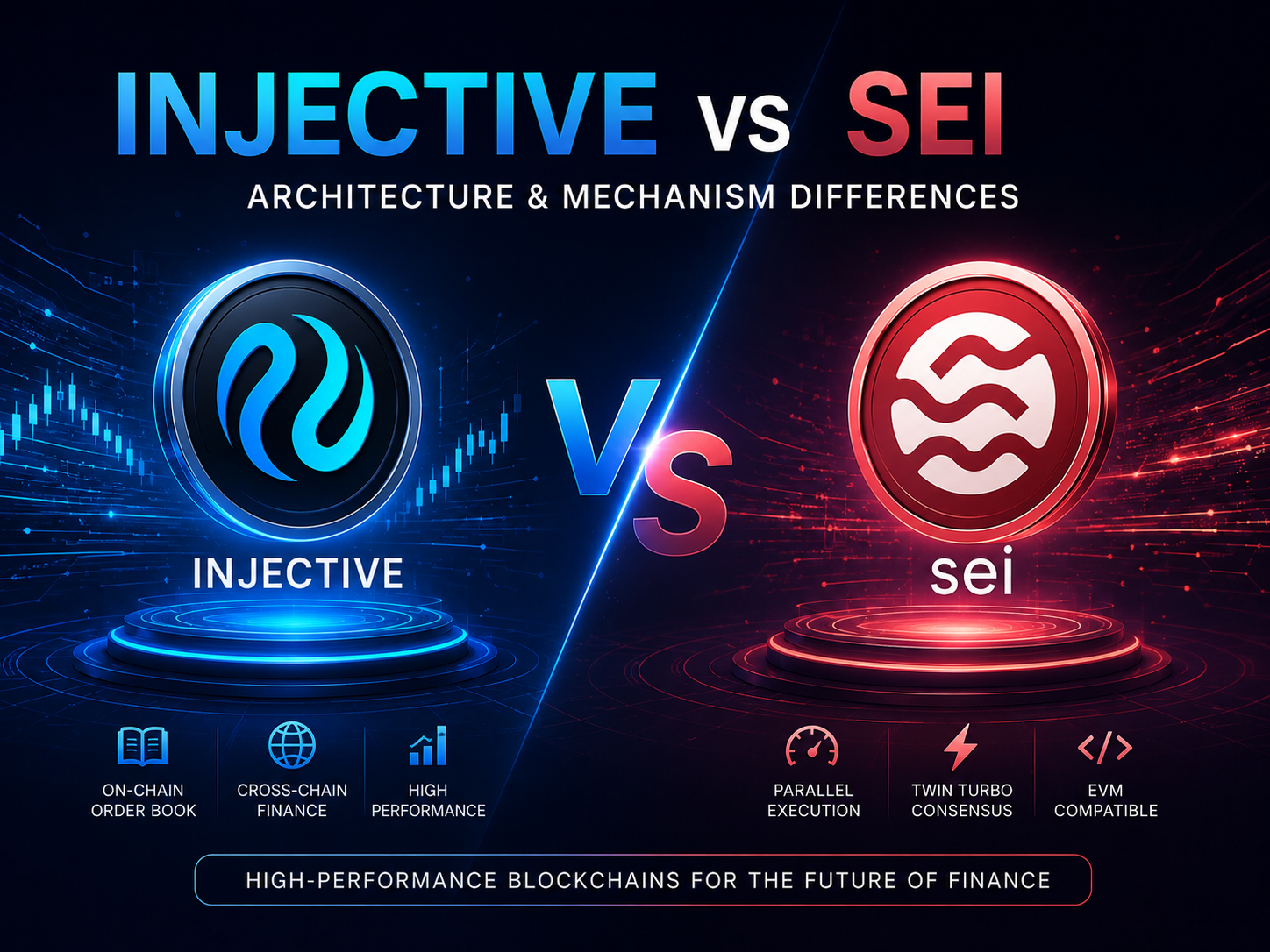
Users who search for Injective vs Sei are usually trying to understand how these two high-performance public blockchains differ in architecture, trade execution, and ecosystem positioning. Both serve high-frequency applications and on-chain trading scenarios, but their underlying designs are not the same.
This question usually involves several layers, including underlying architecture, order execution, incentive mechanisms, data control, ecosystem applications, and suitable use cases. Only by comparing these dimensions separately can we avoid simply grouping both networks under the broad label of “high-performance public blockchains.”
What Is Injective?
Injective can be understood as a Layer 1 public blockchain optimized for on-chain financial use cases. Its core purpose is to provide native infrastructure for trading, derivatives, cross-chain assets, and financial applications. Injective is not positioned simply as a general-purpose contract environment. Instead, it builds an on-chain trading network around the financial execution layer.
Structurally, Injective is built on the Cosmos SDK and combines IBC, CosmWasm, order book modules, and financial application modules. Official materials describe Injective as a high-performance Layer 1 optimized for DeFi applications, with an emphasis on scalability, security, and interoperability.
First, users can trade spot assets, derivatives, and cross-chain assets on Injective. The system then processes trading requests through its on-chain order book and validator network. Next, related applications can build products on top of native financial modules. Ultimately, Injective forms an ecosystem structure centered on trading and financial markets.
The importance of this design is that Injective embeds trading infrastructure directly on-chain, rather than relying entirely on external applications to build their own matching and settlement systems.
What Is Sei?
Sei can be understood as a Layer 1 blockchain built for high-performance applications and trading scenarios. Its core focus is improving the operating efficiency of on-chain applications through parallel execution, optimized consensus, and EVM compatibility. Sei is not focused only on financial applications. It also supports on-chain applications that require low latency and high throughput.
Structurally, Sei uses technical components such as Twin Turbo Consensus, parallel execution, and SeiDB. Sei’s official documentation states that Twin Turbo Consensus aims to achieve low finality of around 400 milliseconds and improves transaction throughput through block construction and consensus optimization.
First, users submit transactions or interact with applications on Sei. The system then processes transactions through optimized consensus and parallel execution. Next, underlying components such as SeiDB improve state access efficiency. Finally, developers can deploy high-performance applications in the Sei EVM environment.
This mechanism means Sei places greater emphasis on execution efficiency and the EVM developer experience, making it suitable for applications that require fast confirmation and high-concurrency processing.
How Do Injective and Sei Differ in Underlying Architecture?
The key architectural difference between Injective and Sei is that the former is more finance-module-oriented, while the latter is more focused on a high-performance execution environment. Injective is built around order books, cross-chain assets, and financial modules, while Sei is built around consensus optimization, parallel execution, and EVM expansion.
Structurally, Injective’s foundation relies on the Cosmos SDK and IBC interoperability, with native modules supporting on-chain trading, derivatives, and cross-chain finance. Sei, by contrast, emphasizes Twin Turbo Consensus, Parallelization Engine, and SeiDB. Official documentation describes these capabilities as core designs for improving throughput, parallel transaction execution, and state access efficiency.
| Comparison Dimension |
Injective |
Sei |
| Core positioning |
On-chain financial infrastructure |
High-performance EVM public blockchain |
| Architectural focus |
Financial modules and cross-chain interoperability |
Consensus optimization and parallel execution |
| Trading structure |
Native order book and financial modules |
High-throughput transaction execution |
| Development environment |
Cosmos, CosmWasm, MultiVM |
Sei EVM and related tools |
| Ecosystem direction |
DeFi, derivatives, RWA |
High-frequency applications, DeFi, EVM applications |
This comparison shows that Injective’s advantage comes from native financial functionality, while Sei’s advantage comes from execution-layer performance optimization. Both target high-performance use cases, but they do not follow the same technical path.
How Do Injective and Sei Differ in Order Execution?
Injective’s order execution mechanism is closer to an on-chain exchange model, while Sei’s execution mechanism is closer to a high-performance application chain model. Injective processes trades through an on-chain order book and batch auction mechanism, while Sei improves transaction confirmation efficiency through parallel execution and fast consensus.
Injective’s trading flow usually works as follows. First, users submit orders. The orders then enter the on-chain order book. Next, the system reduces the impact of MEV through matching and batch processing mechanisms. Finally, trading results are settled on-chain. Its focus is order management, price discovery, and fairness in financial trading.
Sei’s transaction flow places greater emphasis on throughput and execution efficiency. First, users or applications submit transactions. The system then uses Twin Turbo Consensus to optimize block propagation and consensus. Next, the parallel execution mechanism handles transactions that can be processed in parallel. Finally, transactions are confirmed within a shorter period of time. Sei documentation clearly emphasizes parallel execution and low finality as important parts of its performance design.
Therefore, Injective is better suited to trading scenarios that require order books, derivatives, and financial market structure, while Sei is better suited to high-frequency interactions, EVM applications, and concurrent transaction scenarios.
How Are Injective and Sei’s Incentive Mechanisms Designed?
Injective and Sei both design their incentive mechanisms around PoS network security, but their economic priorities differ. Injective places more emphasis on INJ governance, staking, and burn mechanisms, while Sei emphasizes SEI staking, validator security, and network participation.
From Injective’s perspective, INJ is both a governance asset and a staking asset, and it is also connected to burn mechanisms such as the Burn Auction. Injective’s official materials state that the Burn Auction includes part of ecosystem fees and revenue in auctions, reducing supply through INJ burns.
From Sei’s perspective, SEI is mainly used for network fees, staking, and governance. Sei’s official documentation explains that staking is an important part of the Sei blockchain, with validators and delegators maintaining network security and consensus through delegated proof of stake.
First, users can participate in staking on both chains. The system then maintains security through validator networks. Next, token rewards and governance rights are distributed to participants. Finally, network security and ecosystem operation form an economic loop. The difference is that Injective highlights the relationship between protocol revenue and burns, while Sei highlights staking and validator participation within a high-performance network.
How Do Injective and Sei Differ in Data Control?
Injective’s data control leans more toward financial trading data and cross-chain asset state management, while Sei’s data control focuses more on high-throughput state access and support for parallel execution. Both need to process on-chain data efficiently, but their data service goals are different.
Injective’s system needs to handle order book data, trading status, cross-chain asset records, and financial market parameters. First, users submit trades or orders. The system then records order status and account balances. Next, on-chain modules process matching, settlement, and cross-chain information. Finally, applications can use this data to form trading markets.
Sei’s data control, by contrast, serves execution performance more directly. SeiDB is used to optimize state access and works with parallel execution and consensus optimization to improve overall throughput. Sei’s official documentation lists SeiDB alongside Twin Turbo Consensus and parallel execution as an important component for performance improvement.
This difference means Injective is more concerned with how financial data enters the trading system and completes settlement, while Sei is more concerned with how large numbers of transactions can be read, executed, and confirmed quickly.
How Do Injective and Sei Differ in Ecosystem Application Direction?
Injective’s ecosystem application direction is more concentrated on on-chain finance, while Sei’s ecosystem direction is closer to a high-performance EVM application platform. Both can support DeFi, but their ecosystem priorities are not exactly the same.
Injective applications usually revolve around decentralized trading, perpetual contracts, cross-chain assets, RWA, and financial markets. Because Injective has native order book and cross-chain modules, developers can more easily build financial products around trading and asset movement.
Sei’s application direction covers DeFi, trading applications, NFTs, games, social applications, and other high-frequency on-chain applications. Sei’s official documentation emphasizes developer resources such as Sei EVM, precompiled contracts, Solidity tools, and cross-virtual-machine communication, showing that its ecosystem places more weight on EVM application migration and a high-performance execution environment.
First, developers choose an underlying network based on application needs. Financial applications then focus more on trading modules and liquidity structure. High-frequency interactive applications, by contrast, focus more on execution efficiency and compatibility. Ultimately, Injective and Sei develop different ecosystem roles.
Which Use Cases Are Injective and Sei Best Suited For?
Injective is better suited to on-chain financial markets, while Sei is better suited to high-performance EVM applications and low-latency interaction scenarios. The two are not simple substitutes for each other. Instead, they show different strengths under different application requirements.
From a use-case perspective, Injective is better suited to projects that need order books, derivatives, cross-chain assets, and financial settlement. Examples include decentralized trading platforms, perpetual contract markets, RWA trading applications, and on-chain structured products, all of which rely more heavily on Injective’s financial modules.
Sei is better suited to applications that need high throughput, low latency, and EVM compatibility. Examples include high-frequency DeFi, on-chain games, consumer applications, trading aggregation tools, and large-scale interactive applications, all of which need fast execution and developer tooling support.
First, project teams need to determine whether their application depends on financial modules. They then need to evaluate trading frequency, user interaction, and the development environment. Next, they can choose the more suitable on-chain execution layer. Ultimately, the application scenario determines whether Injective or Sei is the better fit.
Conclusion
The key difference in Injective vs Sei is not which chain is more performant, but which core scenarios each one serves.
Injective places greater emphasis on on-chain financial infrastructure, with a focus on order books, derivatives, cross-chain assets, and the INJ economic mechanism. Sei places greater emphasis on a high-performance execution environment, with a focus on Twin Turbo Consensus, parallel execution, SeiDB, and EVM application expansion.
In terms of process, users first need to identify their application requirements. They can then compare financial modules, execution performance, and ecosystem compatibility. Next, they should evaluate incentive mechanisms and data structures. Only then can they judge whether Injective or Sei is more suitable for a specific scenario.
FAQs
What Is the Biggest Difference Between Injective vs Sei?
Injective leans more toward on-chain financial infrastructure, focusing on order books, derivatives, and cross-chain assets. Sei leans more toward a high-performance EVM execution environment, focusing on low latency, parallel execution, and application expansion.
Are Both Injective and Sei Suitable for DeFi?
Both are suitable for DeFi, but their focus differs. Injective is better suited to order book trading and derivatives markets, while Sei is better suited to DeFi applications that require high throughput and low-latency interactions.
What Does Sei’s Twin Turbo Consensus Do?
Twin Turbo Consensus is used to optimize block propagation and consensus efficiency. Its goal is to improve transaction confirmation speed and on-chain throughput, making Sei more suitable for high-frequency application scenarios.
What Are the Advantages of Injective’s Order Book Mechanism?
Injective’s order book mechanism supports limit orders and matching logic that are closer to traditional financial markets, making it suitable for derivatives, spot trading, and professional financial applications.
Which Is Better for Developers, Injective or Sei?
Injective is a better match for developers focused on financial modules and on-chain trading infrastructure. Sei is a better match for developers focused on EVM compatibility, high throughput, and low-latency applications.







