Users usually look into WARD to understand how Warden Protocol keeps its AI Agent network running, as well as WARD’s specific role within the Intent execution mechanism. Traditional public chain tokens are usually responsible only for Gas and governance, while WARD also participates in Solver network coordination and automated execution incentives.
WARD’s mechanism typically involves governance voting, network security, Intent execution rewards and ecosystem operations. This topic usually spans four layers: the AI Agent network, Intent architecture, Solver incentives and multi-chain execution mechanisms.
What Role Does WARD Play in Warden Protocol
WARD’s core role is to maintain governance and execution coordination within the Warden Protocol Intent network. WARD is closer to a protocol-layer infrastructure token than a standard application token.
First, WARD participates in Warden Protocol’s on-chain governance. It is then used to incentivize the Solver network to complete Intent execution tasks. In addition, WARD also contributes to network security and ecosystem collaboration.
Structurally, WARD’s main functions include:
-
Network governance
-
Solver incentives
-
Security collaboration
-
Ecosystem operations
This mechanism means WARD is not just a medium of exchange. Its more important role is to help maintain the long-term stability of the AI Agent automated execution network.
How WARD Is Used for Network Governance and Security Mechanisms
WARD participates in Warden Protocol’s protocol operations through the governance system and network security mechanisms. Warden Protocol’s governance focuses on coordinating the Solver network, ecosystem upgrades and protocol parameter adjustments.
First, WARD holders can submit governance proposals. The community then uses WARD for on-chain voting. Warden Protocol subsequently implements protocol updates based on governance outcomes.
| Governance Module |
Role of WARD |
| Proposal system |
Community governance |
| Voting mechanism |
Protocol upgrades |
| Network security |
Collaborative verification |
| Ecosystem coordination |
Parameter adjustments |
Official materials indicate that some of WARD’s functions also involve network security and verification mechanisms, so WARD is not just an ordinary governance token.
How WARD Supports AI Agent Network Operations
WARD participates in incentive coordination within the AI Agent automated execution network. AI Agents usually need support from an on-chain execution layer, while Warden Protocol completes automated operations through its Solver network.
First, an AI Agent submits an Intent request. The Solver network then matches an execution path. Warden Protocol subsequently uses WARD to incentivize Solvers to process the task.
This mechanism helps AI Agents automatically complete cross-chain interactions and on-chain operations without requiring users to manually execute complex transactions. Unlike traditional wallet interactions, Warden Protocol places greater emphasis on Intent-driven execution.
How WARD Participates in On-Chain Execution Incentives
One of WARD’s key roles is to incentivize the Solver network to process on-chain Intent execution. Solvers serve as automated execution nodes in Warden Protocol, so they need a continuous incentive mechanism.
First, users submit Intent requests. The Solver network then matches the optimal execution path. Next, Solvers process on-chain transactions and cross-chain operations. Finally, some Solver nodes can receive execution rewards through WARD.
Unlike traditional blockchain validator nodes, Solvers in Warden Protocol focus more on automated task execution. As a result, WARD’s incentive structure is more oriented toward on-chain collaboration and Intent execution.
How Is WARD Different from Traditional Public Chain Tokens
Traditional public chain tokens are usually used mainly for Gas and on-chain governance, while WARD places greater emphasis on the Intent network and AI Agent coordination.
Structurally, traditional public chain networks mainly serve transaction validation, while Warden Protocol emphasizes goal-oriented execution. WARD needs to support the coordinated operation of AI Agents, Solvers and multi-chain automated execution systems.
| Type |
Core Role |
| Traditional public chain token |
Gas and governance |
| WARD |
Intent execution and AI collaboration |
This difference means WARD is more of an infrastructure token for an automated execution network than a standard on-chain transaction token.
How Are WARD’s Total Supply and Economic Model Designed
Official documentation shows that WARD has a total supply of 1 billion tokens. WARD’s economic model is mainly built around the community ecosystem, network security, core contributors and long-term protocol operations.
WARD’s token allocation mainly includes:
| Allocation Category |
Share |
Main Use |
| Community and ecosystem |
35% |
Network incentives and ecosystem expansion |
| Core contributors |
20% |
Long-term development and protocol maintenance |
| Foundation and protocol |
20% |
Governance and network operations |
| Investors |
20% |
Ecosystem financing support |
| Liquidity and market |
5% |
Market liquidity and trading support |
Official materials state that part of WARD’s allocation uses a long-term unlock structure to reduce network pressure caused by concentrated short-term releases. The Solver network and ecosystem incentives will continue to operate around the long-term demand for Intent execution.
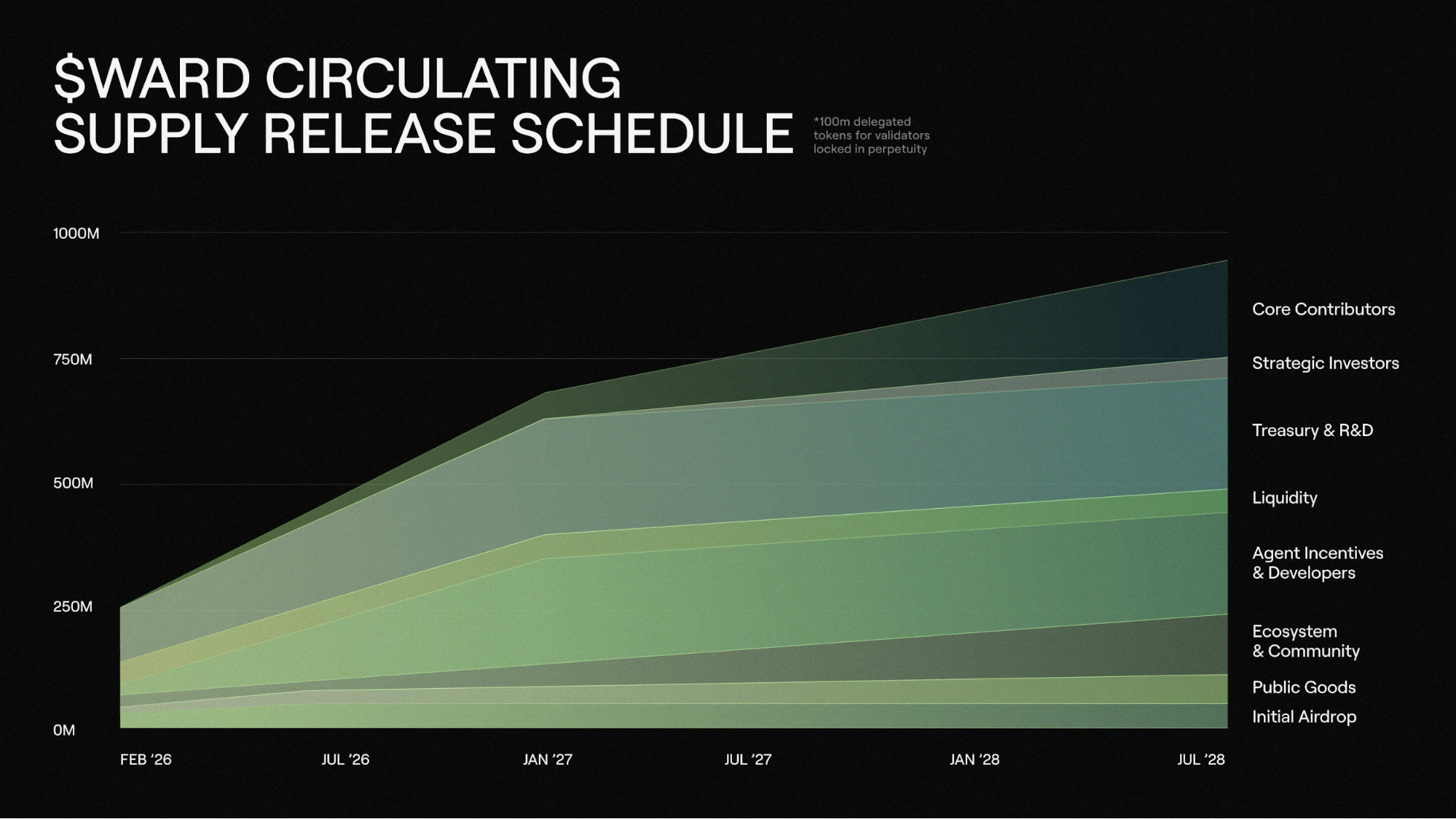
Structurally, WARD is closer to a long-term protocol-layer operating model than a short-cycle liquidity model. The value of WARD depends more on the long-term usage demand of the Warden Protocol Intent network.
What Limitations Does WARD’s Token Model Face
Intent networks usually require extensive execution coordination, so WARD is affected by the scale of the Solver network and ecosystem activity. AI Agent automated execution also depends on stable on-chain demand.
If Warden Protocol lacks sufficient application integration, network demand for WARD may decline. Insufficient Intent execution volume may also affect the efficiency of Solver incentives.
Multi-chain collaboration often involves complex verification processes, so Warden Protocol also needs to keep improving execution efficiency and security. AI Agent automated execution also involves permission control and the risk of incorrect execution.
Summary
WARD is the core protocol-layer token in the Warden Protocol network. It is mainly responsible for governance, Solver incentives, network security and AI Agent execution coordination.
Compared with traditional public chain tokens, WARD places greater emphasis on Intent execution and automated network coordination. Through WARD, Warden Protocol supports the long-term operation of its Solver network, multi-chain interactions and AI Agent automated execution ecosystem.
FAQs
What Does WARD Do?
WARD is mainly used for Warden Protocol network governance, Solver incentives, network security and AI Agent automated execution coordination.
What Is the Total Supply of WARD?
Official documentation shows that WARD has a total supply of 1 billion tokens, allocated around the community ecosystem, protocol operations and network incentives.
How Does WARD Support the AI Agent Network?
WARD is used to incentivize the Solver network to complete Intent execution, helping AI Agents automatically process on-chain tasks and multi-chain interactions.
How Is WARD Different from Traditional Public Chain Tokens?
Traditional public chain tokens mainly handle Gas and governance, while WARD places greater emphasis on Intent execution, Solver coordination and the AI Agent automated network.
Why Does the Solver Network Need WARD?
The Solver network needs WARD to receive execution incentives, allowing it to continuously process on-chain Intent requests and automated tasks.
How Does WARD Participate in Governance?
WARD holders can participate in Warden Protocol protocol upgrades and ecosystem coordination through on-chain voting and governance proposals.







