Image source: Storj Official Website
Storj is positioned as distributed cloud infrastructure, delivering object storage capabilities via an S3-compatible API. Actual data storage and distribution rely on a decentralized network of storage nodes. The ecosystem token STORJ powers the network’s economic cycle, including settlement, incentives, and liquidity for both users and providers. Mechanisms evolve with product and compliance requirements. The key advantage: enterprises can achieve a public cloud-like storage experience while shifting some infrastructure risk away from highly centralized vendors to an auditable, adjustable distributed topology and contract-based incentive framework.
As cloud and AI workloads drive up data volumes and egress (outbound traffic) costs, “hyperscaler complexity + egress fees + tiered pricing” often constrain both cost and architectural flexibility. Storj’s narrative has expanded from “cheaper storage” to “predictable costs, reduced lock-in, and bringing data closer to compute” as a path for enterprise modernization. Industry trends now include integrating decentralized data infrastructure with private market data operating systems. In October 2025, Inveniam Capital Partners announced its acquisition of Storj, planning to integrate distributed storage and compute into its data orchestration platform. Storj continues as a subsidiary, with service contracts, pricing, and leadership remaining stable for now. The STORJ token remains a core ecosystem element, directly linking its token narrative to enterprise data platform integration.
From a blockchain and digital asset perspective, Storj represents a hybrid approach: “off-chain large-scale availability + on-chain value tools.” Storage and bandwidth performance are delivered by the engineered network, while the token mainly coordinates, incentivizes, and settles—not forcing every transaction onto public chain consensus.
What Is Storj (STORJ)? Project Background and Development
Storj began as a decentralized storage protocol and community experiment, gradually evolving into an enterprise-ready object storage solution. Its brand emphasizes enterprise-grade availability, durability, and secure governance, with ongoing solution narratives around backup and recovery, media workflows, data lakes, and AI/ML pipelines published on its website and blog.
In October 2025, Inveniam announced a definitive agreement to acquire Storj, aiming to integrate distributed storage and compute into its data operating system for private market applications. Storj continues as a standalone subsidiary, with CEO Colby Winegar remaining and Ben Golub joining Inveniam’s board. For ecosystem participants, this clarifies Storj’s business path as “data platform integration,” and STORJ is officially committed to ongoing ecosystem support and potential discussions about “utility and alignment” within a larger platform.
In February 2026, Storj partnered with TenrecX, which will resell its enterprise-grade distributed cloud platform—including S3-compatible object storage, Object Mount (file access), and Cloud Compute (storage-optimized cloud mining)—for buyers seeking less hyperscaler dependency and complexity. The official blog provides performance and cost comparisons (e.g., storage cost, download performance vs. traditional hyperscalers, 99.95%+ availability, and 11 nines durability). These should be viewed as vendor materials and verified against your own PoC (proof of concept) metrics.
Industry integrations like NodeShift focus on combining distributed hot storage and compute for AI Agents, large model datasets, and intensive analytics. Storj’s recent “news” consistently points toward stronger enterprise channels and sales leverage, along with integration for AI/data-intensive workloads.
STORJ Tokenomics and Incentive Mechanisms
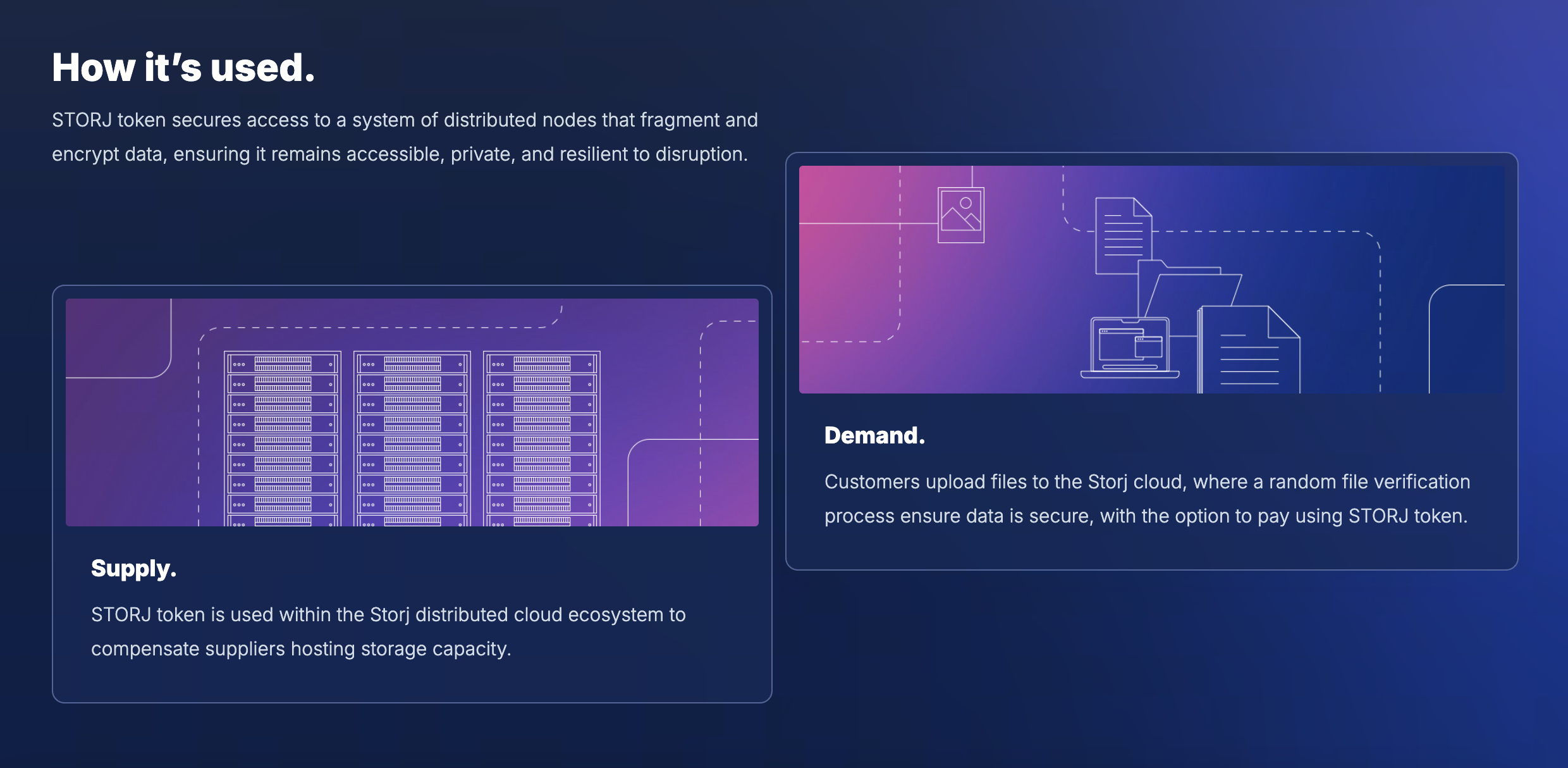
STORJ serves as the value medium for Storj’s network economy, facilitating incentives between user payments, storage nodes, and ecosystem participants. Most commercial delivery occurs in off-chain account and billing systems, with the token mechanism shaped by product design, compliance, and market liquidity.
Three key layers to understand:
- Functional: Is STORJ used for settlement, cashback, loyalty, or deductions?
- Incentive: How are node providers attracted and constrained (availability, bandwidth, reputation, penalties)?
- Financial market: Secondary market prices are driven by macro sentiment, liquidity, unlocking, and M&A news—not necessarily correlated with short-term network usage.
Public information has referenced token buybacks, staking, and supply management (see project disclosures and quarterly reports). For investors and researchers, treat token updates as ongoing disclosures: monitor quarterly reports on balances and flows, incentive parameter adjustments, and whether platform integration post-acquisition changes payment or custody arrangements.
Storj Core Technology and Network Architecture
Storj’s engineering is structured as “client—coordination service—storage node”:
- Objects and encryption: Clients encrypt and shard data before upload, making it difficult for node operators to read plaintext (implementation evolves with client/service versions).
- Erasure coding and redundancy: Compared to simple replication, erasure coding delivers fault tolerance with lower storage overhead, but demands higher repair bandwidth, node selection, and governance.
- Satellite: Coordination component for metadata, billing, orchestration, and policy execution (deployment varies); connects customers to massive Storage Nodes.
- S3-compatible API: Reduces migration cost, enabling object storage applications to switch or dual-deploy with minimal changes.
- Object Mount / Compute: Combines object storage, file access, and near-data compute for data pipeline workflows—a focus in recent enterprise blogs and partnerships.
The architecture excels at engineering integration and scalable cost structure. Challenges include trust boundaries, quality variance from node heterogeneity, and compliance explanation costs for enterprise clients across regions.
Storj vs. Traditional Cloud Storage
Storj differs from traditional hyperscaler object storage in:
- Supply-side structure: Centralized clouds rely on single-operator data center clusters for SLAs; Storj organizes distributed resources into services via cryptography, economic incentives, and monitoring.
- Billing and lock-in: Hyperscalers have egress fees, cross-region replication, and complex tiering, leading to uncertain bills; Storj offers “transparent costs and reduced lock-in,” but real TCO must be workload-specific.
- Responsibility model: Traditional cloud procurement offers mature contracts, audits, and compliance; distributed cloud requires understanding both vendor compliance (e.g., SOC 2 Type II) and your own data governance needs.
Storj is not just an “AWS S3 reskin,” but uses a different resource model to trade for different risk and cost curves.
Storj Use Cases in Decentralized Storage
Typical Storj applications, based on official solutions and recent partnerships, include:
- Backup and recovery / active archiving: Long-term retention, low access frequency, high recoverability.
- Media and global collaboration: Large file distribution, cross-region access, workflows focused on download performance and cost.
- Data lakes and analytics: Scalable object storage as a data lake foundation, possibly enhanced with near-data compute.
- AI / ML data pipelines: High-throughput access to large datasets during training and inference; integration narratives focus here.
- CDN origin and content distribution object layer: Object storage as a content source to cut origin and outbound costs (architecture-dependent).
Choosing Storj is not about “decentralization” as a slogan, but about whether throughput, latency, consistency, tiering, support, and audit materials fit production needs.
Storj vs. Other Decentralized Storage Projects
Common comparisons include Filecoin, Arweave, and Sia. Avoid arbitrary single-metric comparisons; focus on product form, consensus/proof mechanisms, retrieval performance, and enterprise integration:
- Filecoin emphasizes proof-based storage markets and miner economics, with high chain complexity; Storj is more enterprise object storage and S3-compatible.
- Arweave is linked to permanent storage and one-time payment commitments; Storj is closer to variable object storage and ongoing enterprise workloads.
- Sia has historically focused on protocol and bilateral market experiments (check each project’s latest version).
For buyers, “which is more Web3” is not the core standard; the key is which network delivers stable operations under your SLA, RPO/RTO, compliance, and cost constraints.
Risks to Consider When Investing in STORJ
Despite positive business progress, STORJ remains a tradable asset with significant uncertainties:
- Technical and operational risk: Distributed networks can face node fluctuations, audit/monitoring failures, client compatibility issues; major incidents impact brand and cash flow.
- Token and secondary market risk: High price volatility, fragmented liquidity, information asymmetry; M&A may change token use but not guarantee price appreciation.
- Regulatory and compliance risk: Jurisdictions differ on token classification, marketing, and payment requirements, potentially limiting use case adoption.
- Competitive risk: Hyperscalers keep cutting prices and launching new archival/tiered products; other decentralized storage and enterprise software vendors compete for data infrastructure budgets.
- Disclosure and expectation management risk: Performance and cost claims in official materials require independent verification; equating partnerships with revenue growth is a common misjudgment.
Storj (STORJ) Future Directions and Market Potential
Break down “potential” into verifiable questions:
- Can partners like TenrecX consistently deliver paying customers and replicable profiles?
- Can Inveniam’s data orchestration system make Storj’s storage and compute a default, high-frequency component?
- Can near-data compute, reduced egress, and predictable billing win repeatedly in PoCs for the AI data stack?
- Do quarterly disclosures and incentive adjustments improve transparency and trust?
If these links close, Storj could secure a place in “enterprise IT modernization + AI data pipelines.” If channel expansion or integration costs fall short, the market may price it as “stable infrastructure, volatile token narrative.”
Summary
Storj is distributed cloud infrastructure built around S3-compatible object storage, supported by coordination services and global storage nodes. The STORJ token coordinates ecosystem incentives and value, but its price does not simply track short-term network usage. Since 2025, the Inveniam acquisition and enterprise partnerships with TenrecX have aligned it more closely with traditional IT procurement and AI workloads, while embedding the token narrative in a broader data platform integration. Evaluate the project based on engineering metrics, enterprise contracts and disclosures, and independent token market risks.
FAQs
Q: Is Storj data truly decentralized?
A: Data objects are distributed across multiple nodes, but user experience depends on coordination services, software stack, and commercial support. “Decentralization” describes resource organization, not the absence of centralized operations and governance.
Q: Will Storj stop supporting STORJ after the acquisition?
A: According to public disclosures in 2025, STORJ will remain an ecosystem component, but ongoing monitoring of disclosures and product changes is recommended.
Q: How can enterprises verify Storj’s suitability for their workloads?
A: Use real datasets for PoC, compare latency, throughput, repair time, billing, and support response, and review compliance materials for industry requirements.
Q: Is STORJ suitable for long-term investment?
A: Token investment is influenced by liquidity, regulation, competition, and integration progress. Assess your own risk tolerance independently and consult licensed compliance advisors as needed.







