With the rise of Bitcoin Layer 2 and the BTCFi concept, the market has started exploring ways to provide BTC with greater scalability and Smart Contract capabilities without compromising the security of the Bitcoin main chain. Compared to Ethereum, which already has a mature Layer 2 and DeFi ecosystem, Bitcoin has long lacked a unified scaling roadmap, leading to rapid development across different technical approaches.
In this context, Citrea and Stacks have become two of the most closely watched Bitcoin Layer 2 projects. While both aim to expand the Bitcoin ecosystem and drive on-chain BTC finance, they differ significantly in technical architecture, security models, execution environments, and ecosystem roadmaps.
What Is Citrea?
Citrea, a ZK Rollup network built on Bitcoin, is designed to provide Smart Contracts and BTCFi capabilities for BTC while inheriting Bitcoin’s security.
Citrea uses a Type-2 zkEVM as its execution environment. Through zero-knowledge proofs (ZK Proofs) and the BitVM verification mechanism, it settles final state back to the Bitcoin main chain. Compared to traditional sidechains, Citrea emphasizes a "Bitcoin-native" structure, aiming to reduce reliance on custodial bridges, multi-signature verifiers, and external security networks.
From an ecosystem perspective, Citrea focuses more on BTCFi, stablecoins, lending, and the Bitcoin DeFi market.
| Citrea Key Features |
Description |
| Technical Approach |
ZK Rollup |
| Execution Environment |
Type-2 zkEVM |
| Data Availability |
Bitcoin DA |
| Verification Mechanism |
BitVM |
| Ecosystem Direction |
BTCFi |
What Is Stacks?
Stacks, one of the earliest Bitcoin Smart Contract networks, aims to provide a programmable application layer for Bitcoin.
Unlike Rollups, Stacks is essentially an independent blockchain that connects to Bitcoin through the Proof of Transfer (PoX) mechanism. Stacks uses Clarity as its Smart Contract language and has built its own node network, ecosystem, and STX token economy.
Compared to Citrea, Stacks is closer to an "independent chain with Bitcoin anchoring."
After years of development, Stacks has formed a relatively mature Bitcoin application ecosystem, covering Bitcoin NFTs, Ordinals, on-chain identity, and Bitcoin-native applications.
What Are the Core Differences Between Citrea and Stacks?
The biggest difference between Citrea and Stacks lies in network structure and security model.
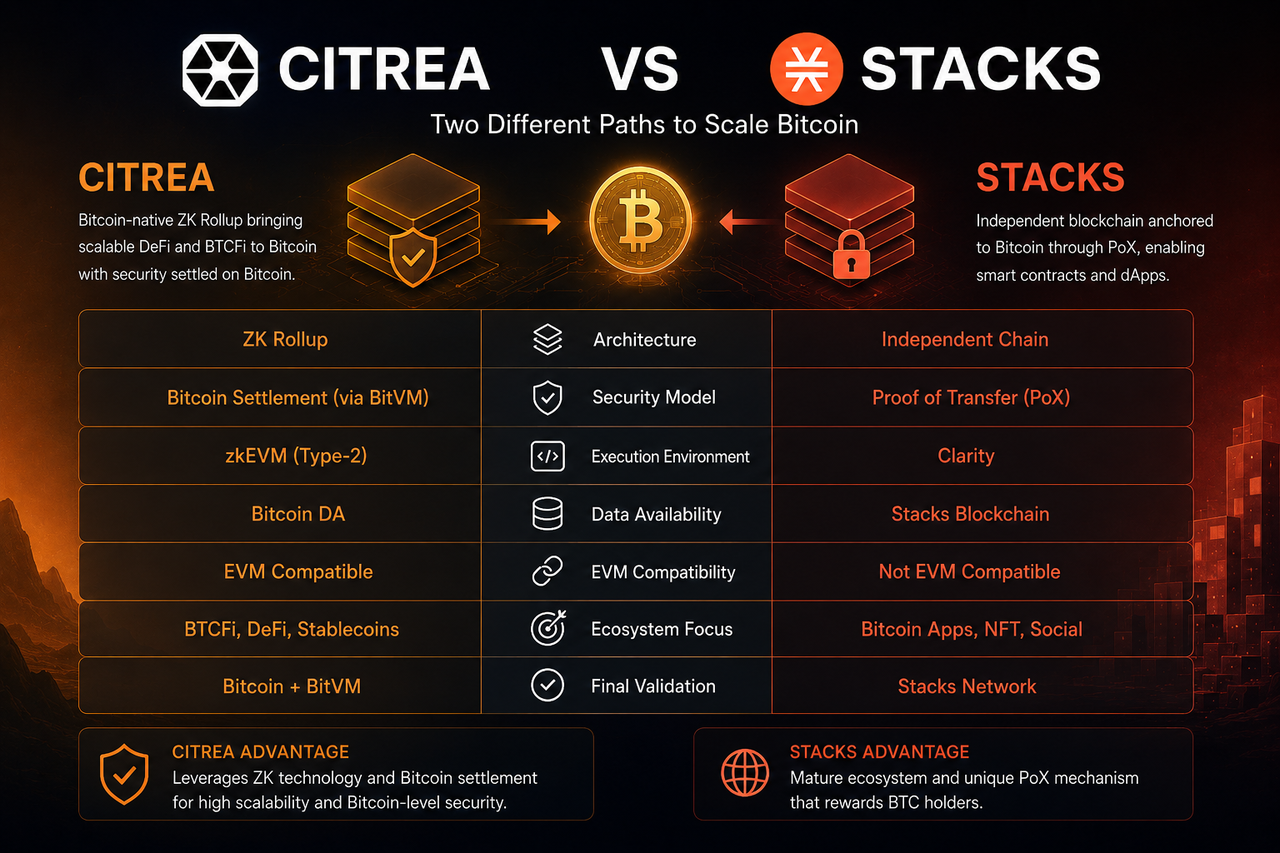
Citrea uses a ZK Rollup architecture: transactions execute on Layer 2, while the final state is verified on Bitcoin via ZK Proofs and BitVM. Consequently, Citrea stresses that "ultimate security belongs to Bitcoin."
Stacks, on the other hand, runs its own independent chain and anchors to Bitcoin through PoX. State verification and block production on Stacks depend primarily on its own network.
In simple terms:
- Citrea is closer to a Bitcoin Rollup
- Stacks is closer to a Smart Contract chain built around Bitcoin
This structural difference also dictates their divergence in scaling methods, verification logic, and ecosystem direction.
| Comparison Dimension |
Citrea |
Stacks |
| Network Structure |
ZK Rollup |
Independent Chain |
| Security Model |
Bitcoin Settlement |
PoX + Stacks Nodes |
| Smart Contracts |
zkEVM |
Clarity |
| Compatibility |
Ethereum EVM |
Independent Language |
| Ecosystem Direction |
BTCFi |
Bitcoin Application Layer |
| Final Verification |
Bitcoin + BitVM |
Stacks Network |
What Is the Difference Between BitVM and PoX?
BitVM and PoX are two fundamentally different approaches to Bitcoin scaling.
The core goal of BitVM is to enable off-chain computation verification without modifying Bitcoin’s consensus rules. Citrea uses BitVM to verify Rollup state, thereby letting Bitcoin itself participate in security confirmation as much as possible.
PoX (Proof of Transfer) is Stacks' core consensus mechanism. Stacks nodes submit BTC to participate in block production and receive STX incentives.
Therefore, the main difference is:
- BitVM is more oriented toward Rollup state verification
- PoX is more oriented toward independent chain consensus
Citrea’s relationship with Bitcoin is closer to "Layer 2 settlement," while Stacks is more like a "new chain built around Bitcoin."
What Is the Difference Between zkEVM and Clarity?
Citrea uses Type-2 zkEVM, while Stacks uses the Clarity Smart Contract language.
The advantage of zkEVM is its compatibility with Ethereum development tools and Solidity contracts, making it easier for many Ethereum DeFi applications to migrate to Citrea. For teams already experienced with Solidity, the migration cost is typically lower.
Clarity, on the other hand, is a Smart Contract language specifically designed for Bitcoin applications, emphasizing security and predictability.
However, because Clarity is not compatible with Solidity, Ethereum developers usually need to relearn and restructure their application logic.
| Comparison Dimension |
zkEVM |
Clarity |
| Compatible with Ethereum |
Yes |
No |
| Development Language |
Solidity |
Clarity |
| DeFi Migration Difficulty |
Lower |
Higher |
| Tooling Ecosystem |
Ethereum Toolchain |
Stacks Native Tools |
| Learning Cost |
Relatively Low |
Relatively High |
Thus, Citrea is better positioned to adopt Ethereum DeFi, while Stacks emphasizes Bitcoin-native applications.
How Do the BTCFi Roadmaps of Citrea and Stacks Differ?
Although both Citrea and Stacks involve BTCFi, their ecosystem priorities are clearly distinct.
Citrea focuses on Bitcoin Rollups, stablecoins, lending, and BTC on-chain capital efficiency, aiming to establish a financial system closer to Ethereum DeFi through zkEVM and Bitcoin settlement.
Stacks leans more toward the Bitcoin application layer, including NFTs, Ordinals, social applications, and on-chain identity.
Thus, they are not exactly direct competitors; rather, they represent different roles within the Bitcoin scaling ecosystem:
- Citrea is more focused on BTCFi and on-chain finance
- Stacks is more focused on Bitcoin-native applications
Which Type of Developer Is More Suited to Citrea or Stacks?
For Ethereum developers, Citrea’s zkEVM architecture generally makes it easier to migrate existing applications.
If a development team already has Solidity contracts and Ethereum DeFi products, the adaptation cost for Citrea may be lower.
For developers looking to build Bitcoin-native applications, the Ordinals ecosystem, or Clarity contracts, Stacks may be a better fit.
This difference also reflects their distinct ecosystem positioning and developer roadmaps.
Summary
Both Citrea and Stacks are important projects in the Bitcoin Layer 2 space, but they differ significantly in technical approach, security model, and ecosystem positioning.
Citrea emphasizes ZK Rollups, Bitcoin settlement, and BTCFi, aiming to provide programmable financial capabilities for BTC through zkEVM and BitVM.
Stacks leans toward an independent Smart Contract network, building a Bitcoin application layer ecosystem via PoX and Clarity.
FAQs
What is the biggest difference between Citrea and Stacks?
Citrea is a Bitcoin ZK Rollup, while Stacks is an independent Smart Contract network running on PoX.
Is Citrea a Bitcoin Rollup?
Yes. Citrea belongs to the Bitcoin Rollup and Bitcoin Layer 2 direction.
What Smart Contract language does Stacks use?
Stacks uses the Clarity Smart Contract language.
Why does Citrea use zkEVM?
zkEVM is compatible with the Ethereum toolchain and Solidity contracts, making it easier to migrate DeFi applications.
What is the difference between BitVM and PoX?
BitVM is used for Rollup state verification, while PoX is the consensus mechanism of Stacks.