With market volatility now a constant, a single market can no longer satisfy the demands of strategic traders. This article explores how Gate TradFi Contracts incorporate Contract for Difference (CFD) trading into the crypto platform. By supporting multi-market assets, a USDx-denominated settlement mechanism, and robust risk management, Gate empowers users to engage in forex, index, and commodity markets simultaneously within a familiar trading environment, enhancing overall strategy flexibility and capital efficiency.
When a Single Market Isn’t Enough, Expand Your Trading Perspective
Market volatility is now the norm. Yet, it’s not just price swings that determine trading outcomes—it’s whether traders can quickly access the markets where volatility is happening. When macro events cause sharp moves in forex, indices, or commodities, keeping capital locked in a single crypto market limits strategic flexibility.
Gate identified these structural constraints and has formally integrated TradFi contract for difference (CFD) trading into its platform, seamlessly embedding it in the Gate App. This enables users to engage in traditional financial market price movements within the crypto trading environment they already know.
TradFi CFD: Trade Price Movements, Not Asset Ownership
Gate’s TradFi contracts follow the core philosophy of the CFD market: users trade on price changes themselves, rather than taking ownership of forex, stocks, or commodities. This structure brings trading back to directional judgment and risk management, eliminating the complexities of asset settlement, custody, and extra account setup.
Currently, supported instruments include forex, indices, precious metals, major commodities, and select popular stocks—enabling users to monitor and trade across multiple markets on one platform.
USDx Design Makes Fund Transfers Effortless
For TradFi contract accounts, Gate uses USDx as the display and settlement unit. USDx is an internal accounting unit pegged 1:1 with USDT. When users transfer USDT into a TradFi account, the system automatically completes the conversion—no manual setup required. This design ensures a consistent valuation method when moving funds between crypto and TradFi accounts, allowing traders to maintain their established capital management and risk control strategies.
A Trading System Aligned with Traditional CFDs
Unlike perpetual contracts common in crypto markets, Gate’s TradFi contracts are purposefully designed to follow mainstream CFD market rules. Trading features clearly defined opening and closing times, leverage ratios preset by the platform (not user-adjustable), and a cross-margin system.
Within the same trading pair, long and short positions can be hedged by lot size, and profits and losses are settled at the counterparty price. When the market is closed, overnight fees apply according to the rules, making the trading experience closely mirror traditional financial markets.
Leverage and Fees Tailored to Each Asset Type
Gate’s TradFi contracts set leverage limits based on the risk profile of each market. Forex and index products offer up to 500x leverage, while stock CFDs are capped at 5x to prevent excessive risk from amplified price movements.
For trading costs, the platform offers a transparent fee structure, with transaction fees as low as $0.018 per trade—making it easier for traders to assess costs when building strategies.
MT5 Integration Delivers Both Professional Tools and Convenience
Operationally, Gate’s TradFi contracts support the MT5 (MetaTrader 5) system. Users can view account balances, positions, and trading records simultaneously through both the Gate App and the MT5 client, striking a balance between mobile convenience and professional trading interfaces.
For risk management, the platform sets forced liquidation procedures based on margin ratios. If an account’s margin ratio drops to 50% or below, the system will implement risk controls in sequence to minimize the impact of excessive exposure on the trading environment.
Lowering the TradFi Learning Curve Through Trial Offers
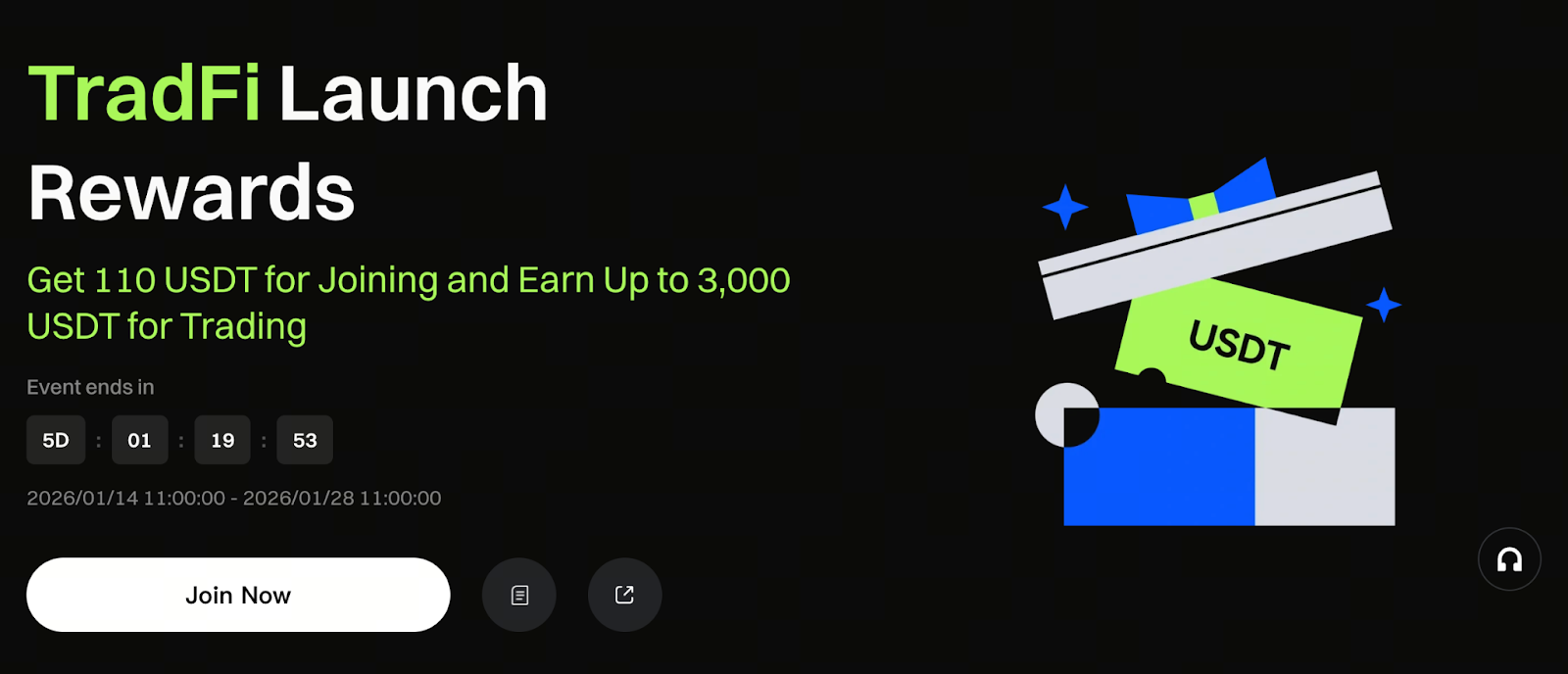
To help users quickly grasp the mechanics of TradFi contracts, Gate has launched a series of trial activities. After signing up, users can receive up to 110 USDT in trial funds and, by completing real trades, gradually unlock up to 3,000 USDT in additional rewards. This approach allows users to become familiar with the trading process under lower psychological pressure, steadily building hands-on experience in the TradFi CFD market.
Multi-Market Integration for Strategic Flexibility
With the addition of TradFi contracts, Gate is evolving from a single crypto trading platform into a venue for multi-market price participation. Traders can conduct cross-market analysis, hedge strategies, and allocate capital—all within a single account system—reducing the friction and costs of constantly switching platforms.
Conclusion
Gate’s launch of TradFi contracts is not simply about adding new trading options. It’s a response to traders’ real need for multi-market strategic flexibility. With standardized CFD rules, a transparent fee structure, robust risk controls, and deep integration with crypto account systems, Gate is building a cross-market trading framework that spans both crypto and traditional finance—empowering strategic traders with broader and more agile trading opportunities.
Author: Allen
Disclaimer
* The information is not intended to be and does not constitute financial advice or any other recommendation of any sort offered or endorsed by Gate.
* This article may not be reproduced, transmitted or copied without referencing Gate. Contravention is an infringement of Copyright Act and may be subject to legal action.
Analyze current gold price trends alongside authoritative five-year forecasts, integrating an evaluation of market risks and opportunities. This gives investors insight into the potential trajectory of gold prices and the main drivers expected to shape the market over the next five years.
Stablecoins were originally designed as dollar substitutes within exchanges, primarily used for asset pricing and trade settlement. As on-chain financial ecosystems have matured, their role has expanded beyond simple payments to include collateral assets, cross-chain liquidity mediums, and unified settlement units. In particular, as AI systems and automated agents begin to participate directly in economic activity, demand has risen sharply for programmable value units capable of instant settlement. This shift is pushing stablecoins toward the role of foundational financial infrastructure.
Aster and Hyperliquid are the two representative protocols of the "purpose-built L1 path" within the current decentralized perpetual exchange (Perp DEX) sector. As a pioneer in the field, Hyperliquid has built a deep liquidity moat through its highly mature order book architecture and strong community consensus. Conversely, Aster, as a rising challenger, seeks to leapfrog the competition in high-performance trading through more aggressive multi-chain aggregation logic, private transaction modules, and an underlying execution environment optimized for 2026 market demands.
Most Web3 identity systems remain confined to on-chain environments and struggle to achieve meaningful adoption in real world settings. Through a DePIN architecture and physical verification hardware, Humanity Protocol aims to bring decentralized identity into access control systems, hospitality, public services, and offline events, allowing on-chain identity to function not just as a digital credential, but as foundational infrastructure for real world access.
AERO is the native token of Aerodrome Finance, a core decentralized exchange and liquidity protocol in the Base ecosystem. It is primarily used for liquidity incentives and ecosystem operations. veAERO is a governance NFT that users receive by locking AERO, representing both voting power and the right to share protocol revenue. Through a dual track structure of AERO as a utility token and veAERO as a governance credential, Aerodrome separates liquidity usage value from long term governance power, allowing participants to act as liquidity providers, governance decision makers, and revenue sharers within the same system.
In the competition for DeFi liquidity, high-inflation mining alone is no longer enough to build lasting advantages. Aerodrome applies the ve(3,3) economic model to redesign token emissions, voting mechanisms, and revenue distribution, creating a liquidity flywheel centered on governance and cash flow. This article examines AERO tokenomics, the veAERO locking mechanism, and protocol revenue models to explain how Aerodrome builds a sustainable DeFi economic system.