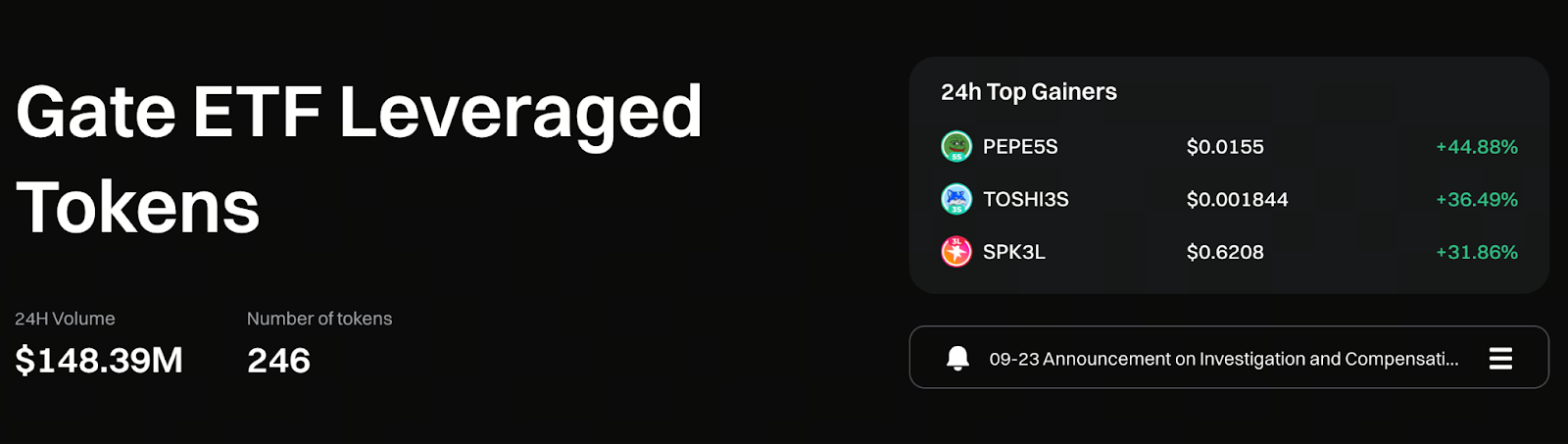
With the accelerating market pace, the traditional passive allocation role of ETFs is facing growing constraints. Leveraged ETFs, as a strategy amplifier bridging spot and futures, preserve familiar trading methods while significantly boosting capital efficiency during price fluctuations. This article examines the structural design, rebalancing mechanism, risk profile, and optimal strategies for Gate Leveraged ETFs, equipping traders to utilize capital efficiently and implement flexible trading strategies in short-term market cycles.
ETFs Evolve with Changing Market Dynamics
Traditionally, ETFs have been viewed as tools that lower trading frequency, valued for their ability to diversify risk and smooth out volatility. They allow investors to engage with the market while minimizing intervention. As the market shifts toward higher volatility and frequent, short-term reversals, the old logic of simply trading time for returns can no longer satisfy efficiency- and rhythm-focused trading needs.
In this landscape, capital management is no longer just about how long you hold an asset—it's about whether you can adjust exposure in real time. ETFs are moving beyond passive allocation; they're being reimagined and repurposed as direct instruments for executing trading strategies.
Leveraged ETFs Bridge the Gap Between Spot and Futures
In fast-moving markets, single-exposure spot positions often fall short of capturing the full value of trading insights, while traditional futures trading brings higher learning curves and real-time risk management stress. Leveraged ETFs sit squarely between these approaches. They retain the operational familiarity of spot trading but amplify price movements' impact on capital. For most traders, leveraged ETFs aren't meant to replace spot or futures—they're designed to magnify exposure, striking a balance between intuitive operation and strategic efficiency.
Key Structural Features of Gate Leveraged ETF Tokens
Gate Leveraged ETF Tokens derive their actual exposure from corresponding perpetual futures positions, which are managed entirely by the system. Users experience trading that feels much like ordinary token transactions, rather than contract operations.
This structure means traders don't need to handle:
Leveraged ETFs are dynamic, not static. To keep actual exposure within the targeted leverage range, the system periodically rebalances the underlying futures positions. These adjustments are invisible to users but are essential for long-term product operation. As a result, leveraged ETFs aren't simply price multipliers—they're dynamic strategy systems, with performance shaped by market paths and volatility structures. Traders can focus on the essentials: identifying trends and timing entries and exits.
Amplify Market Participation Without Futures Contracts
For some traders, the real challenge isn't leverage itself, but the real-time, unforgiving risk controls required in futures trading. Leveraged ETFs don't eliminate risk—they transform it into a more intuitive form, with price fluctuations directly reflected in token net value.
This design frees traders from facing liquidation or forced closure events, allowing them to refocus on trend analysis and capital allocation, and easing the psychological burden of operational risk.
Capital Efficiency Rises as Market Direction Becomes Clear
In trending or unilateral markets, leveraged ETFs multiply price changes, enabling capital to work more efficiently within the same timeframe. Combined with rebalancing, the product can deliver a rolling accumulation effect during favorable trends. As such, leveraged ETFs are often used as transitional tools before fully adopting leveraged strategies—they let traders test strategy resilience without shouldering the full risk management pressure of futures contracts up front.
Structural Limitations You Need to Understand
Leveraged ETFs aren't advantageous in every market environment. When trends are lacking and prices fluctuate, rebalancing can gradually erode net value, leading to outcomes that diverge from intuitive expectations. Final returns aren't simply the underlying asset's price change multiplied by leverage—trading costs, volatility, and price path all influence results. For this reason, leveraged ETFs are generally not suitable for long-term holding as asset vehicles.
Daily Management Fee: Role and Purpose
Gate Leveraged ETFs charge a daily management fee of 0.1% to cover essential costs for stable product operation, including:
Opening and closing fees for perpetual contracts
Funding rate expenses
Hedging and position adjustment costs
Slippage during rebalancing
These costs aren't additional charges—they're fundamental to maintaining leveraged ETF stability over time.
When to Use Leveraged ETFs
Leveraged ETFs aren't passive investment vehicles—they're modules for strategy execution. They're best suited for strategies with clear market views, well-defined entry and exit plans, and tolerance for short-term volatility—not for long-term buy-and-hold. When users fully understand their structure, costs, and applicable scenarios, leveraged ETFs can truly enhance capital efficiency.
Summary
Leveraged ETFs don't make trading easier—they make strategy execution more direct. They amplify price swings and elevate the importance of each decision. For traders who can master market dynamics and actively manage risk, Gate Leveraged ETFs are powerful tools for boosting capital efficiency. But overlooking their structural features and cost implications can lead to risks beyond expectations.
Author: Allen
Disclaimer
* The information is not intended to be and does not constitute financial advice or any other recommendation of any sort offered or endorsed by Gate.
* This article may not be reproduced, transmitted or copied without referencing Gate. Contravention is an infringement of Copyright Act and may be subject to legal action.
Stablecoins were originally designed as dollar substitutes within exchanges, primarily used for asset pricing and trade settlement. As on-chain financial ecosystems have matured, their role has expanded beyond simple payments to include collateral assets, cross-chain liquidity mediums, and unified settlement units. In particular, as AI systems and automated agents begin to participate directly in economic activity, demand has risen sharply for programmable value units capable of instant settlement. This shift is pushing stablecoins toward the role of foundational financial infrastructure.
Analyze current gold price trends alongside authoritative five-year forecasts, integrating an evaluation of market risks and opportunities. This gives investors insight into the potential trajectory of gold prices and the main drivers expected to shape the market over the next five years.
Aster and Hyperliquid are the two representative protocols of the "purpose-built L1 path" within the current decentralized perpetual exchange (Perp DEX) sector. As a pioneer in the field, Hyperliquid has built a deep liquidity moat through its highly mature order book architecture and strong community consensus. Conversely, Aster, as a rising challenger, seeks to leapfrog the competition in high-performance trading through more aggressive multi-chain aggregation logic, private transaction modules, and an underlying execution environment optimized for 2026 market demands.
Most Web3 identity systems remain confined to on-chain environments and struggle to achieve meaningful adoption in real world settings. Through a DePIN architecture and physical verification hardware, Humanity Protocol aims to bring decentralized identity into access control systems, hospitality, public services, and offline events, allowing on-chain identity to function not just as a digital credential, but as foundational infrastructure for real world access.
MetFi is a decentralized metaverse and web3 incubator that utilizes NFTs to share investment returns with MetFi NFT holders and members of its community. As of 2025, MetFi trades at $0.225266 USD with a $47.7M market cap, offering AI-driven trading, blockchain learn-to-earn games, and ERC-404 airdrops through its Marine Moguls project for early claim rights to promising Web3 startups.
AERO is the native token of Aerodrome Finance, a core decentralized exchange and liquidity protocol in the Base ecosystem. It is primarily used for liquidity incentives and ecosystem operations. veAERO is a governance NFT that users receive by locking AERO, representing both voting power and the right to share protocol revenue. Through a dual track structure of AERO as a utility token and veAERO as a governance credential, Aerodrome separates liquidity usage value from long term governance power, allowing participants to act as liquidity providers, governance decision makers, and revenue sharers within the same system.