Akash Network Providers are the resource suppliers within the decentralized cloud computing network, responsible for renting out GPU, CPU, and server resources to developers. As demand for AI model training and inference grows rapidly, the global GPU market is experiencing tighter supply and rising prices. This has led to more idle hash power entering the decentralized marketplace, improving resource utilization.
Against this backdrop, the Akash Provider mechanism is becoming a vital component of Web3 AI infrastructure. Unlike traditional cloud platforms, where a single corporation operates data centers, Akash enables individuals, mining farms, data centers, and cloud service operators to participate directly in the GPU marketplace. Through open bidding and on-chain leasing, Providers can turn idle GPUs into tradable computing resources and earn returns.
What Is an Akash Provider?
As node operators supplying computing resources to the Akash Network, Providers can offer GPUs, CPUs, memory, storage, and bandwidth. These resources are typically used for AI model deployment, machine learning training, inference services, Web3 node operations, and high-performance computing tasks.
Unlike traditional cloud platforms with centralized server management, Akash Providers can be located anywhere in the world. In theory, anyone with qualifying hardware can join the network and contribute hash power.
What Is the Core Role of an Akash Provider?
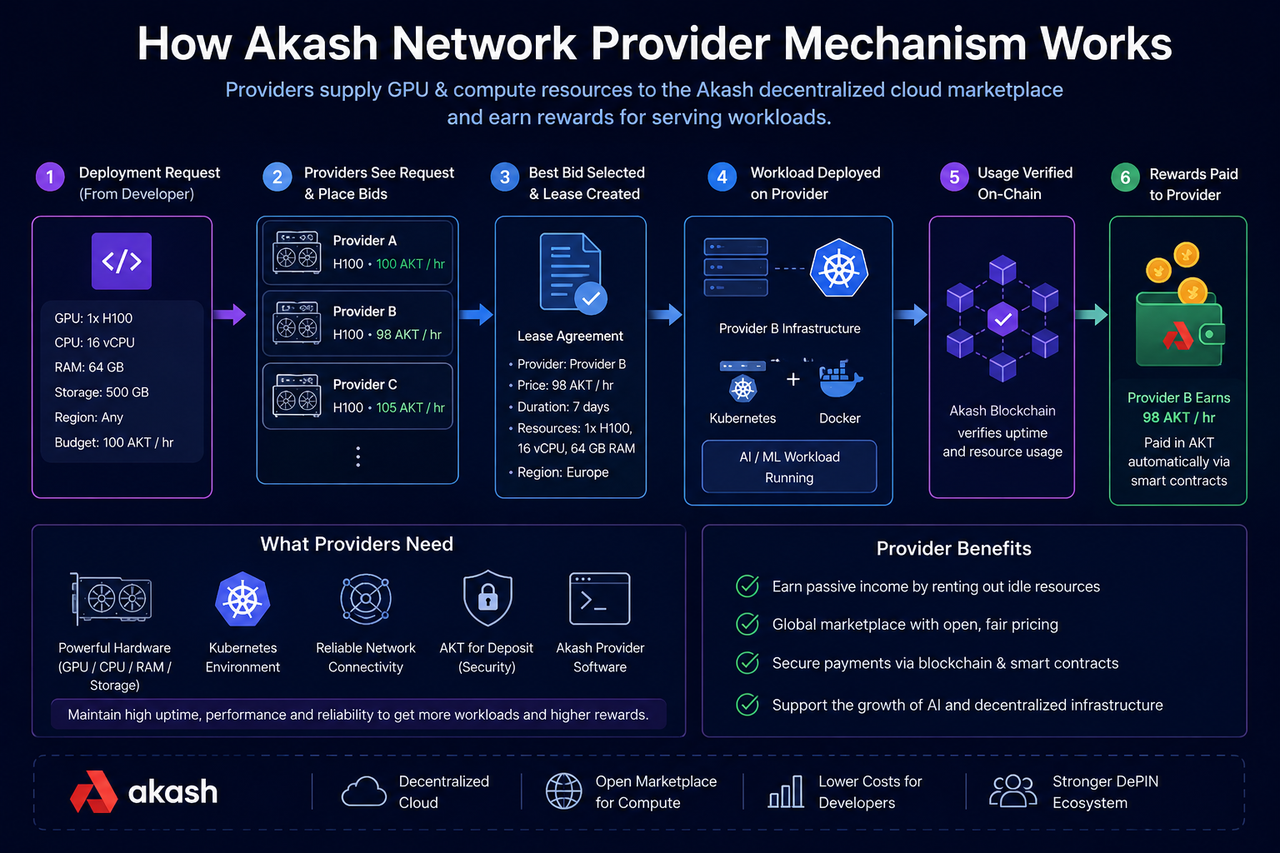
Providers form the foundation that powers Akash’s decentralized cloud marketplace. After developers submit a Deployment (deployment request), Providers bid on resource allocation based on requirements and are responsible for executing the corresponding workloads.
Providers have several key responsibilities:
Providing Computing Resources
Providers supply GPU, CPU, and server resources to run AI models and containerized applications.
Participating in Market Bidding
Providers submit offers based on resource specs, GPU type, and marketplace demand.
Operating and Maintaining Nodes
Once a lease is generated, Providers must keep servers running stably and ensure applications are properly deployed.
Earning Rental Returns
Developers’ GPU usage fees are distributed to Providers according to the lease agreement.
How Do Providers Join the Akash Network?
Providers must meet certain hardware and technical requirements to join the Akash Network.
First, Providers need to deploy a Kubernetes environment, as Akash relies on Kubernetes for managing containerized applications.
Next, nodes must install Akash Provider software and configure GPU drivers, network access, TLS certificates, wallet addresses, and resource settings. After initializing the node, Providers can post server resources to the network and start receiving Deployment requests.
Some Providers also offer high-performance GPUs like NVIDIA A100 and H100 to participate in the AI model inference and training market.
How Does the Provider Bidding Mechanism Work?
Akash uses an open market bidding system to allocate computing resources.
When a developer submits a Deployment, the system broadcasts the resource request across the network. Eligible Providers can submit Bids (offers) based on their available resources.
Offers typically include:
- GPU model
- Number of GPUs
- CPU and memory specs
- Resource price
- Node location
- Service availability
Developers choose from multiple offers, and the system then generates a Lease.
Because multiple Providers compete for orders, market prices fluctuate dynamically based on GPU supply and demand.
What Happens After a Lease Is Generated?
A Lease is an on-chain resource rental agreement within the Akash Network.
When a developer accepts a Provider’s offer, the system automatically creates a Lease, recording both parties, GPU configuration, rental period, payment terms, and deployment status. After Lease creation, the Provider automatically pulls the developer’s container image and deploys the workload on their server.
This process relies on Kubernetes and Docker container technology, allowing developers to run AI services as they would on a traditional cloud platform.
How Do Providers Earn Returns?
Providers primarily earn returns from GPU and server rental fees.
Developers pay ongoing fees while using the resources, and Providers receive returns according to the lease.
Returns are typically influenced by the following factors:
| Influencing Factor |
Description |
| GPU model |
High-end GPUs (e.g., H100, A100) generally yield higher returns |
| Node stability |
Providers with higher uptime are more likely to receive orders |
| Network bandwidth |
Higher network performance benefits AI inference workloads |
| Market demand |
AI booms drive up GPU rental demand |
| Geographic location |
Some regions may be more attractive to developers |
How Are Akash Providers Different from Traditional Cloud Service Providers?
The main distinction between Akash Providers and traditional cloud platforms lies in how resources are organized.
Traditional cloud platforms are built and operated by large enterprises managing centralized data centers, while Akash allows global participants to freely contribute hash power.
Key differences include:
| Comparison Dimension |
Akash Provider |
Traditional Cloud Service Provider |
| Resource ownership |
Distributed |
Centralized |
| Pricing mechanism |
Market bidding |
Platform pricing |
| Entry threshold |
Open participation |
Enterprise-grade operation |
| GPU source |
Global idle resources |
Official data centers |
| Resource scaling |
Dynamic scaling |
Centralized expansion |
However, traditional cloud platforms still offer strong advantages in stability, enterprise support, and service systems.
What Challenges Do Akash Providers Face?
While the Provider model increases GPU market openness, it presents real-world challenges.
Providers need technical expertise in Kubernetes operations, GPU management, and network configuration.
Hardware quality and stability vary among Providers, which can affect the developer experience.
In addition, competition in the AI GPU market is intensifying, with projects like io.net, Render, and Gensyn also building decentralized hash power markets.
Going forward, service stability, resource scale, and developer ecosystem will be crucial to Akash’s long-term competitiveness.
Summary
The Akash Network Provider mechanism integrates global GPU and server resources through an open marketplace, enabling developers to access AI computing power with greater flexibility.
Providers earn returns by bidding for Deployments, deploying workloads, and maintaining server operations, while the blockchain manages resource orders and lease settlements. This approach not only improves idle GPU utilization but also drives the advancement of decentralized AI infrastructure.
FAQs
Who Can Become an Akash Provider?
Anyone with qualifying hardware and technical expertise—whether an individual, mining farm, or data center—can become a Provider.
How Do Providers Earn Returns?
Providers earn returns by renting out GPU and server resources to developers, with payments typically settled in AKT or stablecoins.
Why Do Providers Need Kubernetes?
Akash uses Kubernetes to manage containerized applications, so Providers must run a Kubernetes environment to deploy developer workloads.
How Are Akash Providers Different from Traditional Cloud Platforms?
Traditional cloud platforms are operated by centralized enterprises, while Akash Providers use an open marketplace model that allows global participants to freely contribute hash power.
Are Akash Providers Primarily Focused on AI Applications?
Currently, AI inference, large language model deployment, and machine learning tasks are among the main use cases for Akash Providers.







