As the Solana DeFi ecosystem evolves, liquid staking is becoming a cornerstone of on-chain yield infrastructure. Unlike traditional staking, LSTs enable users to maintain staking returns while utilizing their assets for lending, DEX trading, and yield aggregation—driving more protocols to develop innovative financial use cases around LSTs.
Within Solana, JitoSOL, mSOL, and bSOL stand out as the most prominent liquid staking tokens. While all three are LSTs, they differ significantly in their sources of return, validator strategies, MEV integration, and ecosystem positioning.
JitoSOL Overview
Launched by Jito, JitoSOL is Solana’s liquid staking token. When users deposit SOL into the Jito Stake Pool, they receive an equivalent amount of JitoSOL and continue earning staking returns.
A key differentiator for JitoSOL is its integration of MEV (Maximal Extractable Value) rewards. The Jito Validator Client optimizes transaction ordering within blocks and redistributes a portion of MEV returns to stakers. As a result, JitoSOL’s yield is composed of both staking rewards and MEV incentives.
What is mSOL?
mSOL is Marinade Finance’s liquid staking token for Solana and was among the first mainstream LSTs in the ecosystem.
After depositing SOL into the Marinade Stake Pool, users receive mSOL in equal proportion. These assets are delegated across multiple validator nodes to mitigate validator centralization risk.
Unlike protocols focused on maximizing yield, mSOL prioritizes core liquid staking infrastructure and broad compatibility with Solana DeFi. Consequently, mSOL has been widely integrated into lending platforms, DEXs, and yield aggregators.
What is bSOL?
bSOL is the liquid staking token introduced by BlazeStake.
Like other LSTs, bSOL allows users to retain asset liquidity while earning staking rewards. However, BlazeStake places special emphasis on validator decentralization, aiming to enhance the network’s decentralization by supporting a larger number of small and medium-sized validators.
Thus, bSOL is positioned more as decentralized staking infrastructure rather than a yield-maximizing product.
What are the core differences between JitoSOL, mSOL, and bSOL?
Although all three are Solana LSTs, their protocol goals are distinct.
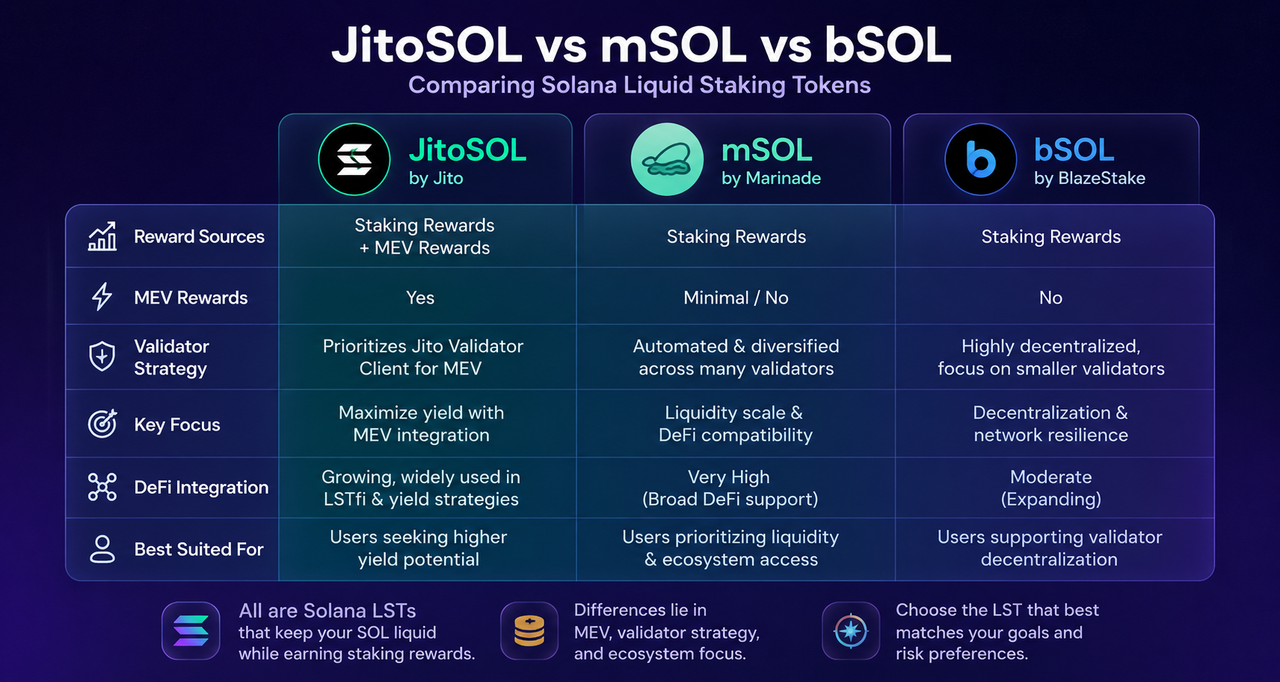
JitoSOL is focused on yield enhancement and MEV integration; mSOL emphasizes ecosystem compatibility and liquidity scale; bSOL prioritizes validator decentralization and network resilience.
| LST |
Protocol |
Sources of Return |
Includes MEV Return |
Core Features |
| JitoSOL |
Jito |
Staking + MEV |
Yes |
Yield enhancement |
| mSOL |
Marinade |
Staking |
Rarely |
Broad DeFi integration |
| bSOL |
BlazeStake |
Staking |
No |
Validator decentralization |
These strategic distinctions lead to differences in yield, risk structures, and ecosystem use cases for each LST.
How do the return structures of JitoSOL, mSOL, and bSOL differ?
Solana LSTs primarily generate returns from staking rewards, but some protocols add extra sources of yield.
JitoSOL’s standout feature is integrating MEV rewards into its staking model. In periods of high transaction activity on Solana, MEV incentives can significantly boost overall returns.
mSOL’s yield is mainly derived from traditional staking. With a focus on ecosystem compatibility, its return structure is relatively stable, but with fewer additional yield sources.
bSOL also relies on staking rewards; however, its validator decentralization strategy may impact yield performance across different market phases.
It’s important to note that LST yields fluctuate with network activity, validator performance, and broader market conditions.
How do validator strategies differ among JitoSOL, mSOL, and bSOL?
Validator delegation is a major differentiator across LST protocols.
Jito Stake Pool gives preference to validators running the Jito Validator Client in order to capture extra MEV returns.
Marinade emphasizes validator decentralization and automated delegation, using dynamic allocation to reduce network centralization risk.
BlazeStake adopts a more aggressive approach, aiming to boost participation among small and medium-sized validators, making its delegation strategy distinctly decentralization-oriented.
These strategies affect not only yield but also the protocol’s position in terms of network security and decentralization.
Which LST is more widely used in DeFi?
Ecosystem integration varies across LSTs.
mSOL, as an early entrant, has long been supported by numerous Solana DeFi protocols and is highly compatible with lending, DEX, and yield aggregator platforms.
JitoSOL is gaining importance as the Jito ecosystem expands, especially within LSTFi and restaking scenarios.
bSOL’s ecosystem is smaller but has notable influence in communities prioritizing decentralized staking.
Overall, LST adoption is closely linked to liquidity scale, protocol partnerships, and market acceptance.
How do the risk structures of JitoSOL, mSOL, and bSOL differ?
All Solana LSTs are exposed to smart contract, liquidity, and network risks, but each protocol’s risk profile is unique.
JitoSOL introduces additional transaction ordering and MEV-related risks due to its MEV reward mechanism.
mSOL’s risks are primarily associated with its extensive DeFi integrations, given its deep connections across protocols.
bSOL’s focus on validator decentralization means it may be affected by the varying reliability of smaller validators.
Additionally, all LSTs can experience temporary depegging during market volatility, with market prices occasionally diverging from theoretical value.
How should you choose between different Solana LSTs?
Each LST’s design makes it suitable for different user needs.
Users seeking higher yields will likely favor products with MEV reward mechanisms; those prioritizing DeFi liquidity and protocol compatibility may prefer assets with greater ecosystem integration; and users committed to decentralization may focus on validator distribution strategies.
However, yield, risk, and liquidity for each protocol can shift with market dynamics, so actual performance depends on Solana network activity and DeFi market conditions.
Summary
JitoSOL, mSOL, and bSOL are all Solana liquid staking tokens, yet they differ substantially in protocol objectives and operational mechanisms. JitoSOL is centered on MEV yield enhancement; mSOL prioritizes DeFi ecosystem compatibility; bSOL is focused on validator decentralization and network resilience.
As Solana’s DeFi and LSTFi ecosystems continue to grow, liquid staking assets are carving out increasingly specialized market niches.
FAQs
Why does JitoSOL offer additional yield?
JitoSOL incorporates an MEV reward mechanism, so in addition to staking rewards, users may also earn extra MEV incentives.
Why is mSOL more prevalent in DeFi?
mSOL was launched early and has long been integrated with numerous Solana DeFi protocols, resulting in strong ecosystem compatibility and liquidity.
What are the main features of bSOL?
bSOL emphasizes validator decentralization, aiming to enhance network resilience by supporting more small and medium-sized validators.
Can LSTs lose their peg?
During periods of market volatility or low liquidity, LST market prices may temporarily diverge from their theoretical value.
Which Solana LST delivers higher returns?
Returns for each LST fluctuate based on staking performance, network activity, and market conditions, so actual ROI is subject to ongoing variation.