Stage 2 Output: Native Excellence & Cultural Adaptation
With the BTCFi (Bitcoin DeFi) sector expanding rapidly, the market is once again turning its attention to Bitcoin’s financial potential. While Ethereum pioneered a full DeFi ecosystem through smart contracts, Bitcoin has long lacked native financial applications.
Stacks and sBTC now equip Bitcoin with stronger programmability and asset liquidity, and Zest Protocol has emerged as a key application-layer protocol on top of this infrastructure. The synergy among these three is becoming a vital part of the Bitcoin Layer 2 financial ecosystem.
What Is Stacks?
Stacks is a Layer 2 network built on top of Bitcoin. Its mission is to bring smart contract and decentralized application capabilities to Bitcoin without compromising the security of the Bitcoin main chain.
Whereas the Bitcoin main chain focuses on asset transfers and secure settlement, Stacks emphasizes application-layer expansion. Developers can build on Stacks:
- Decentralized applications (DApps)
- DeFi protocols
- NFT marketplaces
- DAO systems
- On-chain lending protocols
What sets Stacks apart is that its state is ultimately anchored to the Bitcoin main chain, thereby inheriting Bitcoin’s security.
What Role Does sBTC Play in Bitcoin DeFi?
Although Stacks provides a smart contract environment, Bitcoin’s native BTC cannot directly participate in smart contract interactions. That’s why BTCFi needs a form of BTC that can circulate in a Layer 2 environment.
sBTC was created to fill that gap.
Its core goal is to establish a 1:1 peg to BTC, allowing Bitcoin to enter the Stacks smart contract ecosystem. Users convert BTC into sBTC through a specific mechanism and then engage in lending, trading, and liquidity protocols on-chain.
This structure resembles Wrapped BTC (WBTC), but sBTC’s design is more aligned with the Bitcoin-native ecosystem and decentralized governance.
In the BTCFi market, sBTC serves several key functions:
| Function |
Role |
| BTC Liquidity On-Ramp |
Brings BTC into the DeFi environment |
| Smart Contract Interaction |
Enables on-chain lending and financial logic |
| BTCFi Asset Medium |
Provides programmable BTC for protocols |
| Layer 2 Asset Expansion |
Boosts Bitcoin’s on-chain financial capabilities |
For Zest Protocol, sBTC is a foundational asset in its lending market.
Why Does Zest Protocol Depend on Stacks and sBTC?
Zest Protocol’s core business is a Bitcoin DeFi lending market. Since the Bitcoin main chain doesn’t support complex smart contracts, the protocol must rely on Layer 2 and pegged asset structures.
Stacks supplies the smart contract execution environment, while sBTC provides the BTC liquidity on-ramp. Together, they form the underlying infrastructure for Zest Protocol.
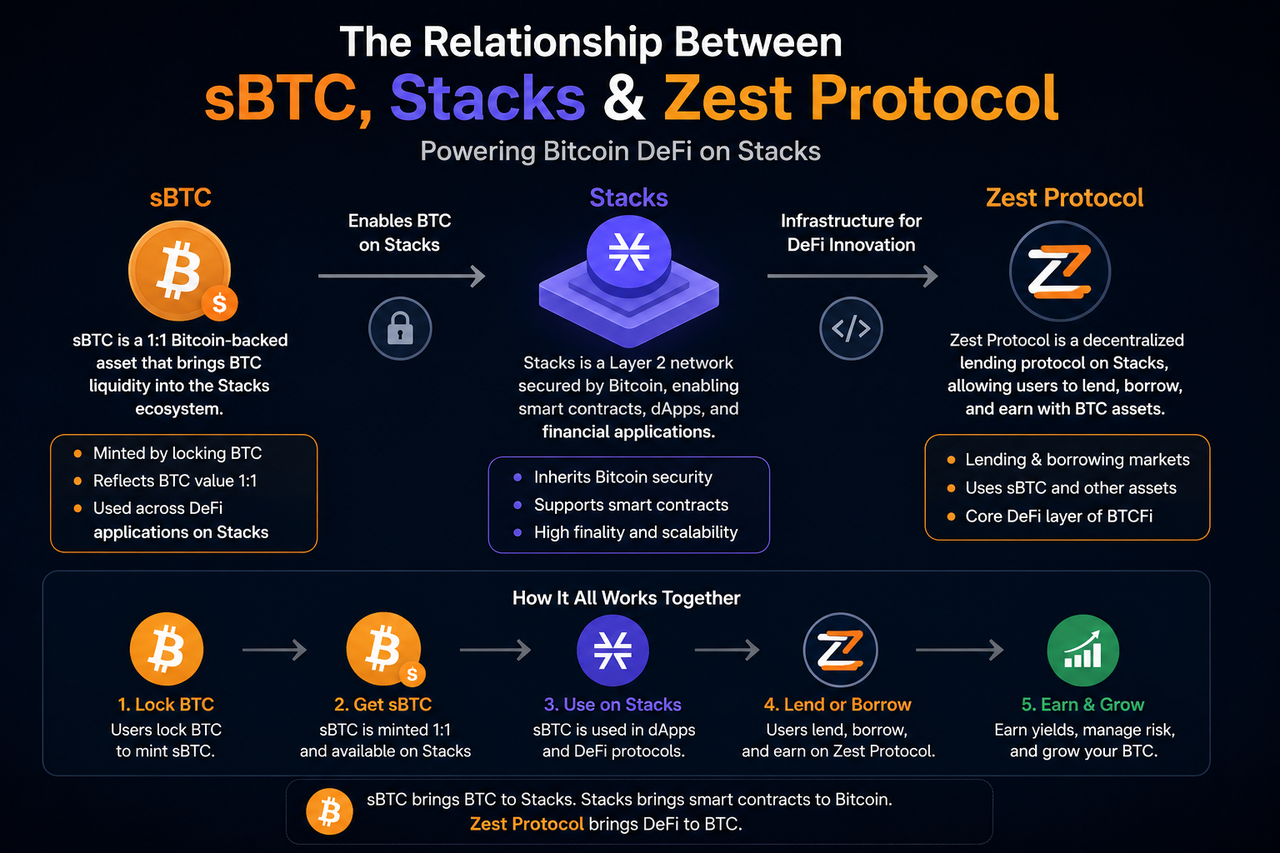
In a typical lending process:
- Users bring BTC into the protocol via sBTC
- Stacks smart contracts execute the lending logic
- Zest Protocol manages collateral, borrowing, and liquidations
- BTCFi liquidity pools provide market funding
This structure lets BTC participate in on-chain financial activities much like ETH.
Compared with the traditional Wrapped BTC model, Zest Protocol prioritizes a Bitcoin-native financial structure and a non-custodial direction—a key trend in BTCFi today.
How Does Zest Protocol’s Lending Process Work with sBTC?
In Zest Protocol, sBTC acts as a critical bridge between Bitcoin and the DeFi market.
Users typically convert BTC to sBTC, then deposit the sBTC into the protocol as collateral. The protocol calculates the borrowing limit based on the collateral ratio and allows users to borrow stablecoins or other assets.
The overall process roughly follows these steps:
- User holds BTC
- BTC is converted to sBTC
- sBTC is deposited into Zest Protocol
- Protocol generates a lending position
- User borrows stablecoin assets
- Smart contract continuously monitors the collateral ratio
This structure gives BTC on-chain liquidity without requiring users to sell their Bitcoin.
Why Is Stacks' Nakamoto Upgrade Important?
The Nakamoto Upgrade is a pivotal upgrade in the Stacks ecosystem, designed to further enhance Bitcoin Layer 2 performance and security.
Key benefits include:
- Faster transaction confirmations
- Greater network stability
- Stronger Bitcoin anchoring
- Better suitability for DeFi applications
For BTCFi protocols like Zest Protocol, Layer 2 network performance directly impacts lending, liquidations, and capital efficiency. Without Layer 2 support for high-frequency financial activity, BTCFi can’t mature. That’s why the Stacks upgrade is considered critical infrastructure for BTCFi.
What’s the Difference Between sBTC and Wrapped BTC?
Many users confuse sBTC with Wrapped BTC (WBTC), but they differ significantly in design philosophy and underlying structure.
| Comparison Dimension |
sBTC |
Wrapped BTC (WBTC) |
| Core Ecosystem |
Bitcoin + Stacks |
Ethereum |
| Primary Use |
BTCFi and Layer 2 |
Ethereum DeFi |
| Management Model |
Emphasizes decentralization |
Custodian-based model |
| Smart Contract Environment |
Stacks |
Ethereum |
| Target Direction |
Bitcoin-native finance |
BTC cross-chain liquidity |
WBTC is primarily a BTC liquidity tool for Ethereum DeFi, whereas sBTC focuses on a programmable asset structure within the Bitcoin-native ecosystem.

Why Is Bitcoin Layer 2 Gaining Attention?
Bitcoin has long been the largest asset class in crypto, yet its on-chain financial capabilities remain limited.
With the rise of BTCFi, the market is refocusing on Bitcoin Layer 2’s development potential. Rather than altering the Bitcoin main chain’s rules, Layer 2 expands financial functionality while preserving Bitcoin’s security.
Current Bitcoin Layer 2 development directions include:
- Smart contract expansion
- BTC lending markets
- Native stablecoins
- BTC yield-generating assets
- Decentralized BTC financial protocols
Stacks and sBTC are core infrastructure in this trend, and Zest Protocol is one of the key application-layer protocols.
Summary
sBTC, Stacks, and Zest Protocol form essential infrastructure for the Bitcoin DeFi (BTCFi) ecosystem.
Stacks brings smart contracts and Layer 2 expansion to Bitcoin; sBTC channels BTC into a programmable financial environment; and Zest Protocol builds a BTC lending market and on-chain financial protocol on top of these technologies.
The relationship among the three is essentially a coordinated structure: “base network + asset bridge + application protocol.” This model is transforming Bitcoin from a pure store of value into a financial asset that can participate in lending, yield generation, and on-chain liquidity.
FAQs
What is sBTC?
sBTC is an asset structure pegged 1:1 to BTC, designed to bring Bitcoin into the Stacks smart contract ecosystem and the BTCFi market.
Is Stacks a Bitcoin Layer 2?
Stacks is widely regarded as a Layer 2 network within the Bitcoin ecosystem, aiming to provide Bitcoin with smart contract and application expansion capabilities.
Why does Zest Protocol depend on sBTC?
Because Bitcoin’s native BTC cannot directly interact with smart contracts, Zest Protocol uses sBTC to bring BTC into the on-chain lending market.
What’s the difference between sBTC and WBTC?
sBTC emphasizes the Bitcoin-native ecosystem and a decentralized structure, while WBTC is primarily used in Ethereum DeFi and relies on a custodian model.
What is BTCFi?
BTCFi stands for Bitcoin DeFi, referring to the lending, stablecoin, yield asset, and on-chain financial ecosystem built around Bitcoin.
Is Zest Protocol a BTCFi Protocol?
Yes. Zest Protocol is a lending protocol in the Bitcoin DeFi ecosystem, providing on-chain lending services for BTC-related assets.