Sei and Solana are widely recognized as leading high-performance public blockchains, often compared for their technical prowess. Both platforms highlight ultra-low latency, high throughput, and real-time on-chain interaction, yet their foundational architectures and ecosystem strategies differ significantly. As the blockchain sector evolves toward more sophisticated applications, robust high-performance infrastructure has become a key battleground for public chain innovation.
Today’s on-chain applications extend far beyond simple asset transfers. Use cases like DeFi, blockchain gaming, on-chain Order Book, AI Agent, and SocialFi demand exceptional network performance and seamless user experience. Within this context, Sei and Solana have emerged as two distinct high-performance public chain models: one prioritizes EVM compatibility and parallel execution, while the other is built around an independent runtime and native high-performance framework.
Key Architectural Features of Sei
Sei is a Layer1 public blockchain purpose-built around a Parallelized EVM, aiming to boost on-chain execution efficiency and real-time responsiveness while remaining fully compatible with the Ethereum development environment.
Unlike traditional EVMs that use sequential execution, Sei’s Parallelized EVM enables non-conflicting transactions to run concurrently, significantly increasing network throughput. Sei also integrates innovations like Twin-Turbo Consensus, low-latency finality, and SeiDB to optimize system-wide performance.
A further advantage of Sei is its compatibility with Solidity and the broader Ethereum toolchain. Developers can continue leveraging MetaMask, Remix, and Solidity for deployment without having to learn an entirely new development stack.
Key Architectural Features of Solana
Solana is a Layer1 blockchain engineered for native high performance, focusing on maximizing throughput and minimizing latency through an independent execution architecture.
Solana employs the Sealevel parallel execution model, allowing multiple Smart Contracts to run in parallel, and leverages the Proof of History (PoH) mechanism to enhance node time synchronization. This design delivers superior transaction processing in high-concurrency environments.
In contrast to EVM-based chains, Solana does not support Solidity or the standard Ethereum toolchain. Developers typically build with Rust and must adapt to Solana’s unique account model and execution logic.
Solana’s independent architecture allows for greater freedom in performance optimization, but it also results in higher migration costs for developers transitioning from other ecosystems.
Sei vs. Solana: Core Differences
Both Sei and Solana are high-performance Layer1 blockchains, but Sei is positioned as a “high-performance EVM” solution, catering to projects migrating from the EVM ecosystem. Solana, meanwhile, is built around an independent ecosystem and native high-performance applications, with a development paradigm that diverges sharply from Ethereum.
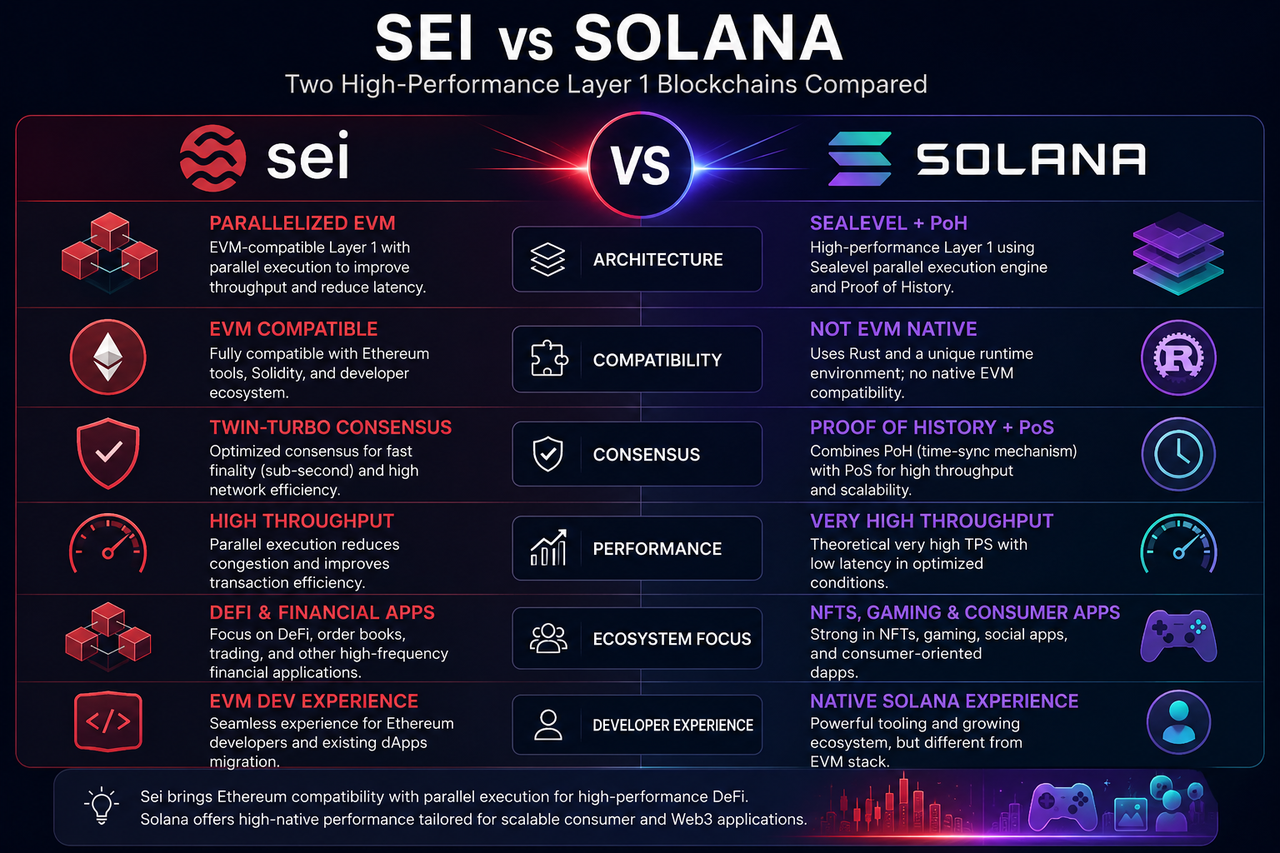
Sei’s strategy is to maximize on-chain execution efficiency via Parallelized EVM while maintaining full compatibility with Ethereum and Solidity. Solana, by contrast, employs an independent runtime and native parallel execution model, targeting unmatched throughput and ultra-low latency.
| Comparison Dimension |
Sei |
Solana |
| Network Type |
Layer1 |
Layer1 |
| EVM Compatibility |
Fully Compatible |
Non-native |
| Smart Contract Language |
Solidity |
Rust |
| Execution Model |
Parallelized EVM |
Sealevel |
| Consensus Mechanism |
Twin-Turbo Consensus |
Proof of History |
| Ecosystem Focus |
High-Performance EVM |
Native High-Performance Apps |
| Developer Migration Cost |
Relatively Low |
Relatively High |
| Typical Use Cases |
DeFi, Order Book Trading |
Blockchain Gaming, Consumer Apps |
How Do Sei and Solana Differ in EVM Compatibility?
EVM compatibility stands out as a fundamental distinction between Sei and Solana.
Sei is designed for seamless integration with the Ethereum ecosystem. Developers can port Solidity Smart Contracts directly and continue using established EVM tools, lowering the barrier to entry and attracting mature EVM projects into the Sei ecosystem.
Solana, on the other hand, operates within an independent runtime and does not natively support EVM. While some third-party solutions attempt to bridge this gap, the overall development model remains distinct from Ethereum.
For Solidity-proficient developers, migrating to Sei is typically much easier. Solana is better suited to teams ready to embrace a new architecture and development workflow.
How Do Sei and Solana Implement Parallel Execution Differently?
Both Sei and Solana prioritize parallel execution, but their technical approaches diverge.
Sei’s Parallelized EVM is built with EVM compatibility in mind. The network detects state conflicts between transactions and executes non-conflicting ones in parallel, directly addressing the bottlenecks of traditional EVM sequential processing.
Solana’s Sealevel is a native, low-level parallel execution engine. Developers must explicitly declare which account data each transaction will access, enabling the system to optimize parallel scheduling.
Due to these architectural differences, Solana often achieves higher theoretical throughput at the native level, while Sei offers a balanced approach between performance and EVM compatibility.
How Do Developer Ecosystems and Experiences Differ Between Sei and Solana?
The developer ecosystem is another major distinction between these two platforms.
Ethereum’s extensive toolkit, educational resources, and established developer network give the EVM ecosystem powerful network effects. Sei’s Solidity compatibility allows it to easily attract existing EVM developers and applications.
Solana has built a standalone developer ecosystem. Its frameworks, account structures, and execution logic differ significantly from EVM, requiring developers to learn new tools and design patterns.
Nevertheless, Solana has cultivated a strong community in blockchain gaming, consumer apps, and high-performance interactive applications, drawing many native development teams.
How Do Sei and Solana Differ in Application Focus?
While both are high-performance public blockchains, their ecosystem priorities diverge.
Sei is optimized for high-performance EVM use cases, including on-chain Order Book, Perpetual Futures, DeFi, and High Frequency trading systems—targeting enhanced performance within the EVM landscape.
Solana excels in blockchain gaming, NFT, consumer-grade apps, and real-time on-chain interactions. Thanks to its native performance edge, Solana is often the platform of choice for applications requiring extremely high throughput.
Summary
Sei and Solana are both at the forefront of high-performance public blockchain innovation, but they pursue fundamentally different technical paths.
Sei’s focus is on delivering higher performance while preserving Ethereum compatibility, with Parallelized EVM addressing the inefficiencies of sequential EVM execution. Solana, in contrast, leverages an independent runtime and native parallel execution to achieve superior throughput and minimal latency.
These two approaches represent distinct directions in high-performance blockchain evolution: one prioritizes compatibility with the established EVM ecosystem, while the other builds a standalone ecosystem around native high-performance architecture.
FAQs
What is the main difference between Sei and Solana?
The primary difference is EVM compatibility. Sei is fully compatible with the Ethereum toolchain, while Solana uses its own independent runtime and development framework.
Do Sei and Solana both support parallel execution?
Yes. Sei utilizes Parallelized EVM, while Solana features the Sealevel parallel execution engine.
Is Sei compatible with Solidity?
Yes. Developers can deploy Smart Contracts on Sei using Solidity.
Why isn’t Solana EVM compatible?
Solana’s independent architecture and runtime were not designed around EVM compatibility.
Which blockchain is better suited for DeFi applications?
Both support DeFi, but Sei is especially tailored for high-performance EVM DeFi scenarios, while Solana excels in native high-performance trading and consumer-grade applications.
Are Sei and Solana both Layer1 blockchains?
Yes. Both are standalone Layer1 public blockchain networks.







