As artificial intelligence enters the era of AI Agents and AGI, the market is shifting away from competition based purely on large models and toward competition around AI infrastructure and AI automation ecosystems. Against this trend, more projects are beginning to explore the integration of AI and blockchain, aiming to build open, decentralized AI networks.
As an important part of the ASI Alliance, Fetch.ai combines blockchain, artificial intelligence, and automation technology to provide foundational support for Web3 AI, smart cities, DeFi automation, and enterprise AI applications.
What Is Fetch.ai?
As a Web3 AI infrastructure project that combines AI, blockchain, and Autonomous Agents, or autonomous AI Agents, Fetch.ai aims to build an intelligent economic network where agents can collaborate independently and execute tasks automatically. Today, Fetch.ai is not only an important project in the AI Crypto sector, but also one of the core technical layers of the Artificial Superintelligence Alliance (ASI) ecosystem, with significant industry influence on AI Agents and decentralized AI networks.
What Is Fetch.ai’s Core Goal?
Fetch.ai’s core goal is to build a network of Autonomous Economic Agents, allowing AI to complete tasks, search for resources, and collaborate with other systems on its own.
Most automation systems on the traditional internet still require coordination by centralized platforms. Fetch.ai aims to use AI Agents and blockchain technology to let software based intelligent agents independently complete transactions, exchange data, and call services.
Put simply, Fetch.ai wants to enable AI to automatically find resources, execute tasks, complete transactions, and collaborate autonomously with other AI Agents. This model is also seen as an important direction for the future AI Economy.
What Is an AI Agent?
AI Agent is one of the most important technical concepts behind Fetch.ai.
An AI Agent can be understood as a software based intelligent agent capable of executing tasks autonomously. Unlike traditional programs, an AI Agent does not simply run according to fixed rules. It can dynamically adjust its behavior based on objectives and interact with the external environment on its own.
For example, a logistics AI Agent can automatically analyze transportation routes, locate warehousing resources, coordinate delivery systems, and complete automatic payments. In DeFi scenarios, an AI Agent may even analyze the market, identify yield opportunities, and execute trading strategies automatically.
Fetch.ai hopes to build a truly autonomous digital economy through the collaboration of large numbers of AI Agents.
How Does Fetch.ai’s Technical Architecture Work?
Fetch.ai’s technical architecture mainly consists of AI Agents, Agentverse, a blockchain network, and an AI services layer.
AI Agents are responsible for task execution and automated collaboration. Agentverse is the Agent creation and deployment platform launched by Fetch.ai, allowing developers to quickly create Agents and connect them to the network.
Once deployed, Agents can automatically discover services, call AI models, exchange data, execute on-chain transactions, and communicate with other Agents. At the same time, the Fetch.ai blockchain provides a trusted network environment and ensures that interactions between Agents can be recorded transparently.
This architecture makes Fetch.ai more than just an AI platform. It is closer to a decentralized operating system for AI Agents.
What Is Agentverse?
Agentverse is a core development platform in the Fetch.ai ecosystem.
It functions like a runtime environment for AI Agents, where developers can quickly create, test, and deploy Agents.
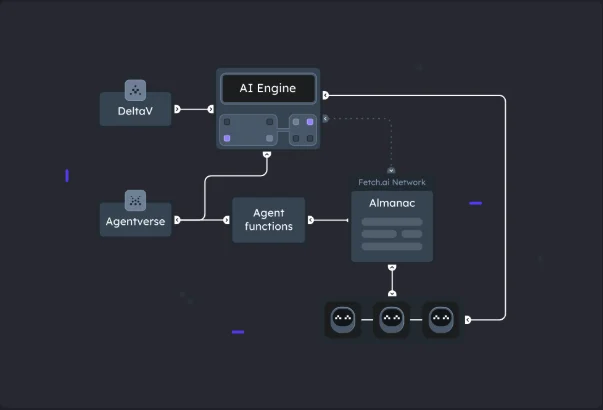
Through Agentverse, developers do not need to build complex AI infrastructure from scratch in order to create automated AI services.
For example, automated customer service, intelligent data analysis, automated trading systems, supply chain management Agents, and smart IoT coordination systems can all run autonomously within the Fetch.ai network.
As AI Automation becomes more widespread, Agentverse is also regarded as one of the important infrastructure layers of the Web3 AI Agent ecosystem.
What Is the Relationship Between Fetch.ai and the Artificial Superintelligence Alliance?
Fetch.ai is one of the core members of the Artificial Superintelligence Alliance (ASI).
The ASI Alliance consists of Fetch.ai, SingularityNET, and CUDOS, with the goal of building the world’s largest decentralized AGI infrastructure.
Within this ecosystem, Fetch.ai is mainly responsible for AI Agents and automation networks. SingularityNET is responsible for the AI Marketplace, while CUDOS provides distributed GPU computing power.
In this sense, Fetch.ai effectively serves as the “AI execution layer” of the entire ASI ecosystem.
In the future, if AI Agents become a core part of the AI Economy, Fetch.ai’s importance within ASI may continue to grow.
What Is the FET Token Used For?
FET is the core token of the Fetch.ai and ASI ecosystems. Its first function is network payment. Users need to pay FET when calling AI services, running Agents, or accessing data resources.
At the same time, FET also supports Agent transaction settlement, staking, network governance, and ecosystem incentives.
For example, after an AI Agent automatically completes a task, the system can use FET to settle the value transfer automatically.
Therefore, FET is not merely an ordinary cryptocurrency. It is the value medium of the entire AI Agent network.
What Are the Use Cases of Fetch.ai?
Fetch.ai’s use cases are continuing to expand.
In DeFi, AI Agents can automatically execute yield strategies, monitor markets, and manage assets.
In smart cities, AI Agents can optimize transportation systems, energy allocation, and logistics networks.
In enterprise settings, Fetch.ai can help companies implement automated customer service, supply chain automation, data analysis, intelligent procurement, and AI Workflow Automation.
In addition, in IoT, or the Internet of Things, AI Agents can help devices collaborate automatically with one another. Together, these scenarios form important directions for Fetch.ai’s long term development.
What Are Fetch.ai’s Core Advantages?
Fetch.ai’s biggest advantage lies in its AI Agent technology path.
Compared with traditional AI projects, Fetch.ai places greater emphasis on autonomous AI collaboration, rather than focusing only on AI models themselves. At the same time, Fetch.ai combines blockchain, decentralized networks, AI Automation, and autonomous economic systems. This means it is not only an AI Crypto project, but also part of Web3 AI infrastructure.
What Challenges Does Fetch.ai Face?
Although Fetch.ai has a strong technical narrative, AI Agent networks are still in the early stages of development.
First, large scale AI Agent collaboration places high demands on network efficiency and stability.
Second, the AI industry is still dominated by major technology companies such as OpenAI and Google, so Web3 AI projects need time to build user scale.
In addition, AI regulation, data security, and privacy issues may also bring challenges to decentralized AI networks.
At the same time, Fetch.ai must also compete with AI Crypto projects such as Bittensor and Render.
Conclusion
Fetch.ai is one of the most representative projects in today’s AI Crypto and Web3 AI sectors. Its core direction is to build an autonomous economic network through AI Agents. Through Agentverse, blockchain, and AI automation technology, Fetch.ai is pushing AI from the traditional tool based model toward a model of autonomous collaboration.
As a core member of the Artificial Superintelligence Alliance, Fetch.ai not only serves as AI Agent infrastructure, but is also an important part of the decentralized AGI ecosystem.
FAQs
What Is an AI Agent?
An AI Agent is a software based intelligent agent that can execute tasks autonomously, including analysis, collaboration, and transactions.
What Is the Relationship Between Fetch.ai and ASI?
Fetch.ai is one of the core members of the Artificial Superintelligence Alliance and is mainly responsible for the AI Agent network.
What Is the FET Token Used For?
FET is used for AI service payments, Agent transactions, staking, and ecosystem governance.
What Is Agentverse?
Agentverse is the AI Agent creation and deployment platform launched by Fetch.ai.