Users searching for SATO use cases usually want to know whether it is simply a Meme Coin, or whether it has already formed a more specific community ecosystem. SATO’s application logic does not depend on complex financial protocols. Instead, it is built around community takeover, cultural communication, NFT participation, and Base onchain interaction.
This question usually involves three layers: how SATO is used as a community asset, how NFTs and gaming expand community participation, and how Meme content drives community communication within the Base ecosystem.
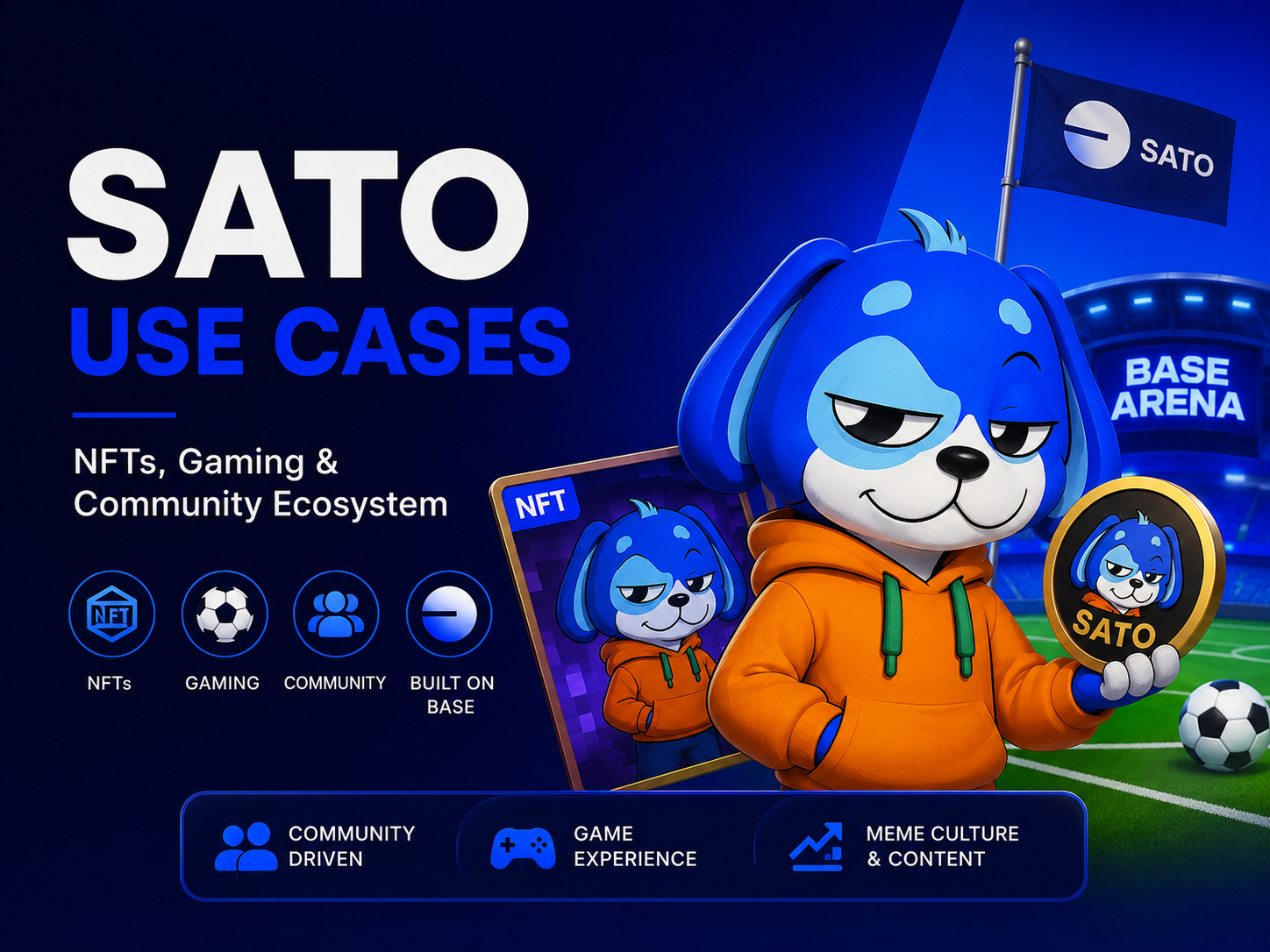
What Are SATO’s Core Use Cases
SATO’s core use cases lie in connecting Base onchain circulation, community culture, and an interactive ecosystem. It is not a protocol token centered on a complex yield model, but a Base ecosystem asset built around community participation and Meme communication.
Structurally, SATO’s applications can be divided into token circulation, NFT identity, community content, gaming interaction, and governance collaboration. Users first obtain SATO through the Base network, then enter interactive scenarios such as community discussions, NFT collecting, or Base Arena. They then participate in the ecosystem through content creation, community activities, or governance discussions, eventually forming a usage loop centered on community culture.
| Use Case |
Main Role |
| Token circulation |
Supports Base onchain trading |
| SATO NFTs |
Strengthen community identity |
| Base Arena |
Expands gaming interaction |
| Meme content |
Drives community communication |
| Community governance |
Coordinates ecosystem direction |
This structure shows that SATO’s application value does not come only from the token itself, but from the cultural and interactive scenarios built by the community around the token. For a community takeover Meme Coin, the key to use cases is not protocol complexity, but whether the community can continue creating reasons for people to participate.
The role of SATO NFTs is to bring together community identity, Meme culture, and a commemorative symbol for long term participants. The official website shows that the original team once launched around 5,000 NFTs. After the community takeover, the project side launched a new limited collection of 100 NFTs to commemorate community members who continued supporting SATO during a difficult period.
From a mechanism perspective, SATO NFTs are not art assets detached from the community. They are an extension of community culture. Holding an NFT represents a user’s connection to the SATO community narrative, the history of the Community Takeover, and Base Meme culture. In this structure, NFTs serve as a form of identity expression, not just as tradable objects.
First, users encounter SATO through Meme content or community activities. NFTs then become a tool for community members to express identity and participation. Next, the community can build content creation, activity design, or onchain interaction around NFTs. In the end, NFTs give SATO’s community culture a more concrete visual carrier.
The importance of this connection is that it moves Meme Coin community identity beyond token holding alone. Through NFT imagery, commemorative meaning, and community stories, SATO forms stronger cultural stickiness.
How Base Arena Expands the SATO Ecosystem
Base Arena is a gamified application scenario within the SATO ecosystem, positioned as a fast and dynamic mini football game experience. The official website states that Base Arena was launched through collaboration between Krypto Cock Coin and SATO, and serves as one of the onchain interaction gateways in the SATO ecosystem.
Structurally, the significance of Base Arena is not that it provides a complex GameFi yield model. Rather, it gives the community a lightweight interactive scenario. Meme Coin projects usually need ongoing content and social interaction to maintain attention, and a gaming module can extend community focus from simple trading to participatory experiences.
First, users enter Base Arena through the SATO community or the official website. The game then supports community participation through lightweight interaction. Next, players, content creators, and community members can create discussions, shareable materials, and community activities around the gaming experience. In the end, Base Arena helps SATO expand from a single Meme Coin into a more interactive community ecosystem.
The importance of this design is that it gives SATO an ecosystem entry point that users can experience directly. Even though the game itself is not the same as a complete blockchain gaming system, it can still strengthen community participation and create more space for content distribution.
How SATO Participates in Base Onchain Interaction
SATO participates in Base onchain interaction mainly through token trading, community asset circulation, NFT access, and ecosystem application entry points. The official website shows that SATO runs on the Base network, can be traded through Uniswap, and is also listed in centralized trading venues such as GroveX.
From a mechanism perspective, Base provides SATO with a low cost environment for onchain trading and community application deployment. Users can complete token swaps, NFT access, and community ecosystem participation through the Base network, while SATO serves as the community asset that connects these scenarios.
First, users acquire SATO on the Base network. They can then enter related communities, NFT pages, or Base Arena. Next, onchain trading, social content, and ecosystem interaction work together to increase community activity. In the end, SATO forms a connection path within the Base ecosystem, from token circulation to community participation.
The importance of this onchain interaction is that SATO does not rely only on social platform communication. It also has a verifiable onchain asset foundation. For a Base Meme Coin, onchain accessibility and community participation scenarios jointly determine ecosystem activity.
Community content creation is an important part of the SATO ecosystem because the sustainability of a Community Takeover project depends heavily on organic community communication. The white paper describes SATO as a cultural experiment centered on community ownership, creativity, transparency, and fun. It also mentions possible expansion into art, gaming, entertainment, storytelling, and AI interaction.
Structurally, SATO’s content ecosystem consists of Meme creation, character storytelling, community images, video distribution, and community discussions. Since the project does not have a traditional centralized team leading it over the long term, the creative capacity of community members directly affects the project’s visibility.
First, community members create Memes, images, or videos around the Sato character. These pieces of content are then shared across social platforms and community channels. Next, new users learn about SATO’s community background and Base ecosystem positioning through that content. In the end, content creation becomes the main way the community spreads outward and builds cultural memory.
The importance of this mechanism is that the vitality of a Meme Coin usually comes from sustained storytelling. For SATO, content creation is both a communication method and a reflection of the community’s ability to collaborate.
What Are the Features of SATO’s Meme Communication Mechanism
The core of SATO’s Meme communication mechanism is the combination of a dog character, the Base ecosystem, the community takeover story, and a decentralization narrative. Unlike ordinary short cycle Meme Coins, SATO’s communication foundation comes not only from an animal image, but also from the experience of the project being reorganized by its community.
Structurally, SATO’s Meme communication includes character image communication, community story communication, NFT visual communication, and gamified content communication. Users first recognize the project through the blue dog image. They then understand the community background through the Community Takeover story. Next, they participate in communication through NFTs, Base Arena, and social content. In the end, this forms a community culture loop around the SATO character.
The feature of this communication mechanism is that SATO does not rely on a single Meme image. Instead, it combines character, onchain identity, and community history. Official materials also emphasize that SATO aims to become a digital character that can extend across Memes, gaming, NFTs, and AI.
For this reason, SATO’s Meme communication is closer to a community IP path. Its long term effect depends on whether the community can continue producing content and encourage users to see SATO as a cultural symbol within the Base ecosystem.
What Limitations Exist in SATO’s Application Ecosystem
The limitations of SATO’s application ecosystem mainly come from its Meme Coin nature, limited community resources, the fact that its applications are still expanding, and its high dependence on community participation for governance and content production. The official website disclaimer also clearly states that SATO is a Meme Coin intended for entertainment purposes, has no intrinsic value, and should not be regarded as an investment product.
Structurally, SATO’s NFTs, Base Arena, and community content have already formed basic application directions, but these scenarios are still clearly different from mature protocols or large scale blockchain games. They lean more toward community interaction and cultural expression than complex financial functions or high frequency application loops.
First, users need to understand SATO’s positioning as a Meme Coin. Whether its community applications can continue operating then depends on member participation, resource coordination, and content updates. Next, if community enthusiasm declines, the activity of NFTs, gaming, and communication content may also be affected. In the end, SATO’s application ecosystem is shaped by both community organization capacity and the external market environment.
This limitation does not deny SATO’s community value. Rather, it shows that its use cases are better understood from the perspective of cultural ecosystem building and community interaction, instead of being evaluated as mature protocol functions.
Conclusion
The main use cases of Sato The Dog (SATO) revolve around Base onchain circulation, NFT based community identity, Base Arena gaming interaction, Meme content distribution, and community governance collaboration.
From an ecosystem structure perspective, SATO is not a protocol token centered on a complex DeFi model. It is a Base Meme cultural asset formed after the community takeover. NFTs provide a visual carrier for community identity, Base Arena offers lightweight gaming interaction, and content creation helps the community continue spreading.
Together, these applications form the foundation of SATO’s community ecosystem. Its strengths lie in a clear character image, strong community participation, and a clear onchain entry point. Its limitations lie in the fact that ecosystem expansion depends heavily on sustained community collaboration.
FAQs
What Are the Use Cases of Sato The Dog (SATO)
SATO’s use cases include Base onchain trading, NFT based community identity, Base Arena gaming interaction, Meme content distribution, and community governance collaboration. Together, these scenarios form the foundation of its community ecosystem.
What Are SATO NFTs Used For
SATO NFTs are mainly used for community identity expression and Meme culture communication. The limited collection of 100 NFTs launched after the community takeover also carries a commemorative community meaning for long term supporters.
What Is Base Arena
Base Arena is a mini football game experience within the SATO ecosystem, launched through collaboration between Krypto Cock Coin and SATO. It is mainly used to expand community interaction and gamified participation scenarios.
How Does SATO Participate in Base Onchain Interaction
SATO runs on the Base network, and users can participate in the ecosystem through onchain trading, NFT access, and community applications. The Base network provides SATO with the foundation for onchain circulation and interaction.
What Are the Features of SATO’s Meme Communication
SATO’s Meme communication combines the blue dog character, the Base ecosystem, the community takeover story, and NFT visual content. Its communication focus is community creation and character culture.
What Limitations Does SATO’s Application Ecosystem Have
SATO’s limitations include its Meme Coin nature, application scenarios that are still expanding, limited community resources, and long term activity that depends on community content production and governance collaboration.