In today’s AI industry, data acquisition and annotation costs consume the majority of development resources, yet traditional models suffer from data silos, inconsistent annotation quality, and centralized control. Tagger addresses these core issues of data credibility and circulation efficiency through a decentralized architecture and data authentication protocol.
From a blockchain and digital assets perspective, Tagger is more than just a data tool—it’s “data economy infrastructure.” By turning data production, annotation, and validation into quantifiable network activities, Tagger transforms data into a tradable, incentivized value asset, accelerating the convergence of AI and Web3.
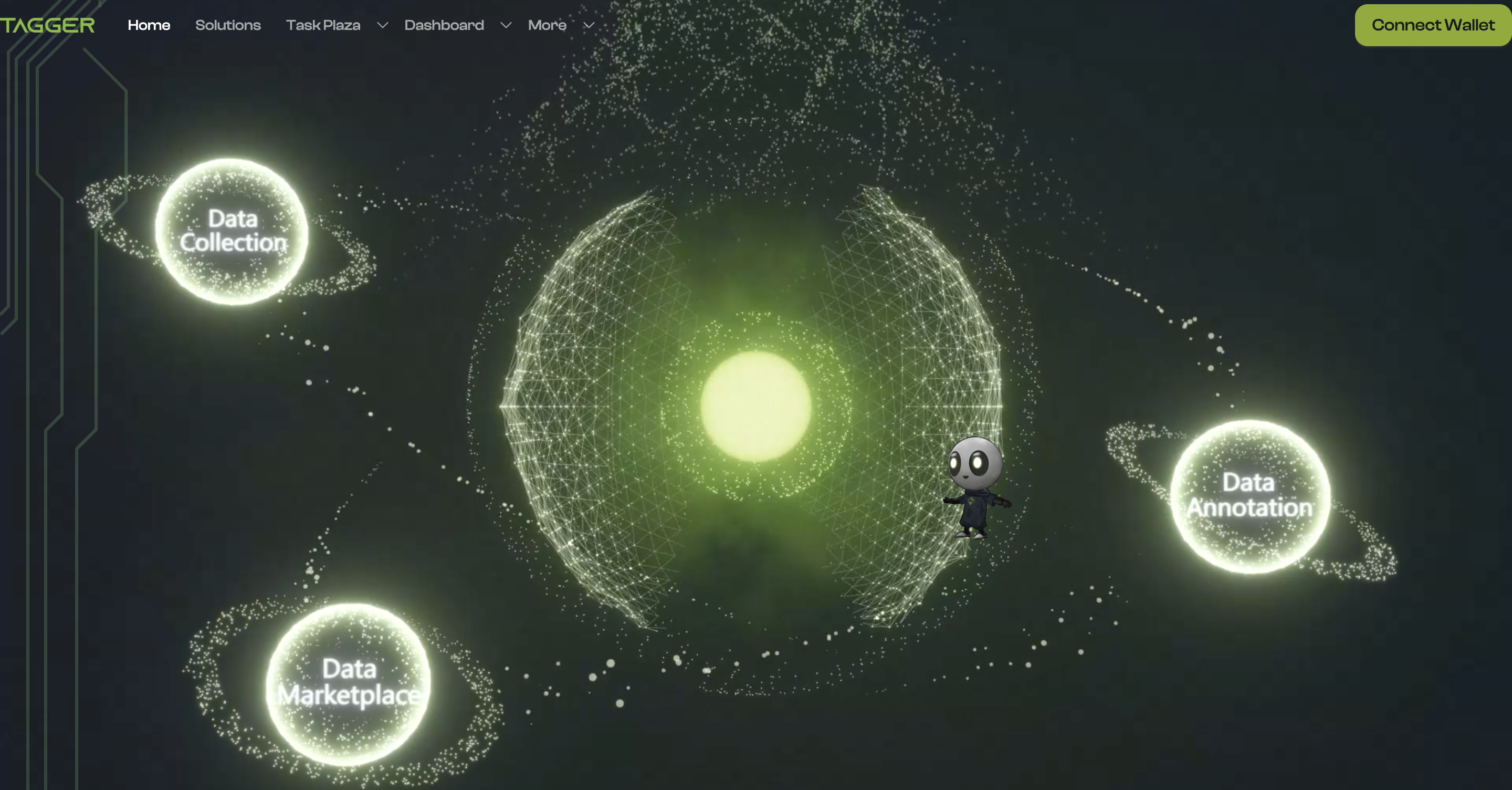
Source: tagger.pro
What Is Tagger (TAG)
Tagger is a decentralized platform designed for the entire AI data lifecycle, spanning data collection, annotation, validation, management, and trading. Its core mission is to build a permissionless data collaboration network powered by Web3 technology.
Unlike traditional platforms, Tagger leverages blockchain to establish a data authentication framework, enabling verification of data sources, annotation processes, and usage rights. This structure drives greater transparency and trust in data.
Participants can join the network as data providers, annotators, or validators, earning rewards by contributing data or completing tasks. This crowdsourcing model dramatically scales data production capacity.
Ultimately, Tagger frees the AI data processing workflow from centralized platforms, building an open, collaborative, and decentralized data network.
Tagger’s Core Positioning: AI Data Annotation and Data Value Network
Tagger is positioned to connect global AI data demand with supply, creating an open marketplace for data annotation and circulation. In AI model training, high-quality data directly determines model performance, making data a mission-critical resource.
The traditional data annotation industry is dominated by a handful of companies, resulting in high costs, low efficiency, and a lack of transparency. Tagger’s decentralized crowdsourcing model distributes annotation tasks to a global pool of contributors, driving higher efficiency and lower costs.
Tagger also introduces the concept of a data value network, where data not only trains models but can also be traded and circulated in the marketplace. This shift turns data from a “consumable” into a true “asset.”
On a macro level, Tagger is building a complete ecosystem that connects data production, processing, and consumption, making the AI data supply chain more efficient and equitable.
Tagger’s Technical Architecture: Data Annotation, Validation, and Task Distribution
Tagger’s technical architecture includes a data acquisition layer, annotation layer, validation layer, and trading layer, creating a closed-loop data processing system. Each layer is orchestrated through blockchain and Smart Contracts.
For task distribution, the system assigns annotation tasks to suitable participants based on data type and requirements, functioning as a decentralized task marketplace that optimizes resource matching.
In the validation layer, Tagger employs multi-party validation and algorithmic checks to ensure annotation accuracy. The data authentication protocol records the annotation process, ensuring traceability.
The architecture emphasizes “data credibility + process transparency,” providing high-quality data for AI models and reducing trust costs.
Tagger’s Operating Mechanism: Data Annotation, Validation, and Delivery
Tagger operates as a “data production pipeline,” transforming raw data into high-quality assets for AI training. The process starts with data upload, where providers (enterprises or developers) submit raw data and set annotation rules—such as classification standards, granularity, and quality requirements. This initial stage shapes the structure of data tasks and directly impacts the usability and value of the final dataset.
During task execution, Tagger’s decentralized task distribution breaks annotation needs into smaller tasks and assigns them to global participants. Unlike traditional outsourcing, this crowdsourcing structure mobilizes a vast workforce in a short time, enabling large-scale data processing. The platform can also integrate AI-powered tools (like pre-annotation or Auto classification) to boost efficiency and lower manual costs, making “human-machine collaboration” the core production mode.
Data validation is a critical step. Tagger uses multi-layer validation—such as multi-annotator consistency checks, cross-review, and AI model-assisted detection—to reduce error rates and prevent single-point failures from impacting data quality. For key datasets, reputation or staking mechanisms can give high-quality contributors more weight, further enhancing data reliability.
Validated data is then organized and delivered to users, with the option to record key metadata or Hashes on-chain for traceability and auditability. This “annotation—validation—on-chain” loop transforms data from a one-off resource to a reusable, verifiable long-term asset, establishing a robust data production and delivery system.
TAG Token Utility: Payments, Incentives, and Network Coordination
TAG is the core economic unit of the Tagger network, serving as both a payment medium and the incentive engine for the entire data production ecosystem. Data buyers use TAG to post annotation tasks and purchase processed data, making TAG the direct unit of value for data services and connecting supply with demand.
TAG also incentivizes network participants. Annotators earn token rewards for completing tasks; validators receive additional incentives for quality control. This ensures a steady supply of participants and maintains data production efficiency. The reward structure dynamically adjusts based on task difficulty and quality scores, so higher-quality contributions receive greater compensation.
TAG also supports governance and security. Participants can stake TAG to boost their reputation or engage in key decisions, influencing task allocation and network rules. This design links economic incentives with behavioral constraints, helping the network remain orderly and reliable in an open environment.
In summary, TAG creates a “data demand → annotation production → incentive distribution” cycle. As data volume and demand grow, token liquidity and usage rise, powering a data value-driven economy.
Tagger Use Cases: AI Training, Data Crowdsourcing, and Web3 Data Marketplaces
Tagger’s use cases center on AI data needs—especially machine learning model training, where high-quality annotated data is essential. Whether for image recognition, speech processing, or natural language understanding, vast amounts of structured data are required, and Tagger enables scalable data production.
In data crowdsourcing, Tagger’s decentralized network brings together global contributors, freeing annotation from reliance on a single organization. This model lowers costs and dramatically accelerates processing. For large-scale image classification or speech transcription, crowdsourcing completes tasks quickly, while validation mechanisms ensure quality.
Tagger also functions as a Web3 data marketplace, making data a tradable asset. Providers can sell or license data on the platform, while users access specific datasets as needed. This breaks down data silos, enabling data flow across applications and maximizing utilization.
As AI and blockchain integration deepens, Tagger’s use cases will expand into areas like autonomous driving training, medical data annotation, and industrial data processing—scenarios demanding even higher data quality and scale, for which decentralization offers a robust solution.
Traditional data annotation platforms are centralized: enterprises manage task allocation, data storage, and revenue distribution. While easy to administer, this model leads to data monopolies, opaque revenue sharing, and high entry barriers. Users rarely control their data ownership, and value accrues mainly to the platform.
Tagger, by contrast, redefines annotation through decentralization. Anyone can join as a data producer or validator, lowering barriers and expanding supply. Blockchain-based recording and trading ensure transparency and reduce information asymmetry.
Tagger emphasizes “user control” over data ownership. Providers determine how their data is used and licensed, rather than leaving all authority to the platform. This strengthens data security and transforms data into a truly tradable digital asset.
Overall, Tagger marks a shift from “platform-driven” to “network-driven.” Data is no longer tied to a single organization but is produced, validated, and traded through decentralized protocols, building a more open data ecosystem.
Tagger’s Advantages, Limitations, and Common Misconceptions
Tagger’s main advantages are its decentralized structure and incentive mechanisms, which make data production more open and efficient. Crowdsourcing enables rapid expansion of data supply, while validation mechanisms safeguard quality. Data authentication and on-chain records further enhance credibility, making Tagger suitable for high-value AI applications.
Challenges remain. Quality control is more complex in a decentralized system, requiring multi-layer validation and robust reputation systems. Participant skill variance can affect consistency, and task distribution and coordination costs are higher, demanding advanced system design.
Economically, the incentive model must balance cost control with participant rewards. Too little reward reduces engagement; too much increases costs. Designing a sustainable economic model is critical for long-term viability.
A common misconception is to view Tagger as just a “data crowdsourcing platform.” In reality, it’s a comprehensive data economy infrastructure—covering production, validation, circulation, and value distribution. Its long-term success depends on establishing a stable balance among efficiency, quality, and incentives.
Summary
Tagger (TAG) fuses blockchain with AI data processing to build a decentralized data annotation and trading network. Its core innovation is transforming data from a “passive resource” into a “verifiable, tradable asset,” powered by token incentives to drive global collaborative production.
This approach optimizes the AI data supply chain and provides foundational infrastructure for the Web3 data economy. As demand for high-quality AI data grows, networks like Tagger are poised to play an increasingly vital role in the evolving data marketplace.
FAQ
What problems does Tagger (TAG) primarily solve?
Tagger addresses low AI data annotation efficiency, data silos, and lack of data credibility.
What is the function of the TAG token?
TAG is used to pay for data annotation, incentivize participants, and support network operations.
Is Tagger only for AI data?
Tagger mainly serves AI data but can be extended to other data processing and validation scenarios.
What are the benefits of decentralized data annotation?
It reduces costs, increases efficiency, and improves data transparency and verifiability.
Is data on Tagger secure?
Data authentication protocols and blockchain technology ensure verifiable and secure data management.







