


Futures
Access hundreds of perpetual contracts
TradFi
Gold
One platform for global traditional assets
Options
Hot
Trade European-style vanilla options
Unified Account
Maximize your capital efficiency
Demo Trading
Introduction to Futures Trading
Learn the basics of futures trading
Futures Events
Join events to earn rewards
Demo Trading
Use virtual funds to practice risk-free trading
Launch
CandyDrop
Collect candies to earn airdrops
Launchpool
Quick staking, earn potential new tokens
HODLer Airdrop
Hold GT and get massive airdrops for free
Launchpad
Be early to the next big token project
Alpha Points
Trade on-chain assets and earn airdrops
Futures Points
Earn futures points and claim airdrop rewards


More





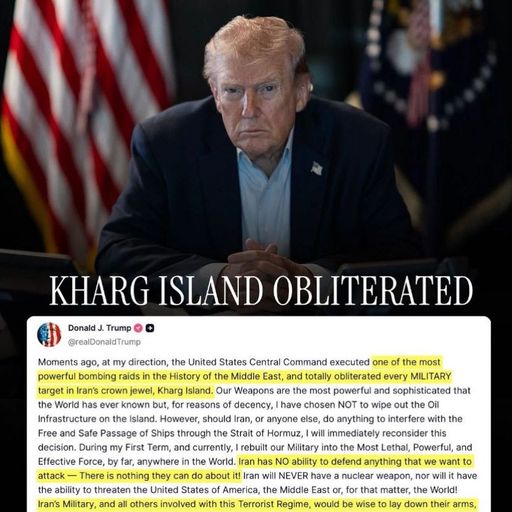
Brent Oil Holds Steady Above 103 Dollars, WTI Approaches 100 Dollars! US Strikes Iran's Oil Hub, Global Oil Market Ignites New Rally
CNBC Finance APP has learned that after the United States launched an attack on Iran’s key crude oil export hub, Kharg Island oil facilities, international oil prices surged by as much as 3.3% intraday. This military action marks a significant escalation in regional conflict. Due to ongoing hostilities, global energy-consuming countries have been forced to deal with a disruption in energy supplies from the region for nearly two weeks.
Brent crude oil prices have surged over 40% in the past two weeks, currently trading at about $105 per barrel, while WTI crude oil prices are approaching $100 per barrel. Following the U.S. attack on Iran’s Kharg Island military facilities, the Islamic Republic of Iran immediately launched retaliatory strikes against Israel and Arab countries. As a core hub for Iran’s oil exports, Kharg Island handles most of the country’s crude oil transportation.
The bombing of Kharg Island significantly expanded the scope of the geopolitical conflict. The International Energy Agency (IEA) released a report last week indicating that this round of conflict has caused the most severe supply disruptions in the history of the global oil market. The strategic route connecting the Persian Gulf to international markets—the Strait of Hormuz—has seen almost complete shipping stoppages since the conflict erupted.
Warren Patterson, Head of Commodity Strategy at ING, analyzed: “Although the attack on Kharg Island has not directly damaged oil infrastructure, supply-side risks continue to accumulate. Any further transportation disruptions will tighten market supply and demand further.”
U.S. Attacks on Kharg Island
U.S. President Donald Trump issued a stern warning: if Iran continues to block the Strait of Hormuz shipping lane, the U.S. will take action against Iran’s oil assets. Iran responded by stating that oil exports from Kharg Island are still proceeding normally. Meanwhile, intelligence indicates that certain areas in Doha and Dubai, which host U.S. military personnel, could be targeted in attacks within the next few hours.
According to a senior aide to President Trump, the U.S. Department of Defense assesses that the Iran conflict, which has lasted three weeks, is expected to continue for another four to six weeks. Kevin Hassett, Director of the White House National Economic Council, emphasized that the final decision on when the war will end remains in the President’s hands.
Last weekend, Trump signaled a willingness to resolve the conflict through negotiations. However, Iranian Foreign Minister Amir Abdollahian immediately clarified that the Islamic Republic currently has no intention of negotiating or seeking a ceasefire.
Trump further increased diplomatic pressure, publicly calling for the reopening of the Strait of Hormuz shipping lane and urging allies to send warships to escort vessels. According to sources, the U.S. government is planning to announce that multiple countries have agreed to form a multinational joint escort coalition, but the timing of the operation is still under discussion—whether to deploy before hostilities end or after the conflict subsides.
In the UAE, shipping operations at the key energy hub of Fujairah Port were forced to halt last Saturday after a drone attack. Since the Strait of Hormuz remains blocked, this attack cut off the UAE’s only crude oil export route. Fortunately, after emergency repairs, port operations fully resumed last Sunday.
As a clear sign of the global crude oil supply being squeezed by the war, the International Energy Agency announced last Sunday that it will immediately supply an unprecedented amount of crude oil reserves to Asia. The agency had already received detailed implementation plans for the record-breaking release of 400 million barrels of oil announced last week prior to issuing the statement.
“Most of the geopolitical risk premiums have already been fully reflected in oil prices last week,” said Harris Kurshid, Chief Investment Officer at Karobaar Capital LP in Chicago. “Therefore, traders are generally cautious, waiting for more concrete evidence of actual supply losses before prices rise substantially.” He further added that after the attack on Kharg Island, “market dynamics show that current pricing is more about risk premiums for supply disruptions rather than a full supply shock.”
As of press time, Brent crude for May delivery rose 0.58%, to $103.74 per barrel. WTI crude for May delivery increased 0.15%, to $96.99 per barrel.