












#PredictionMarketsInfluenceBTC?
Do Prediction Markets Influence Bitcoin? A New Balance of Power in 2026
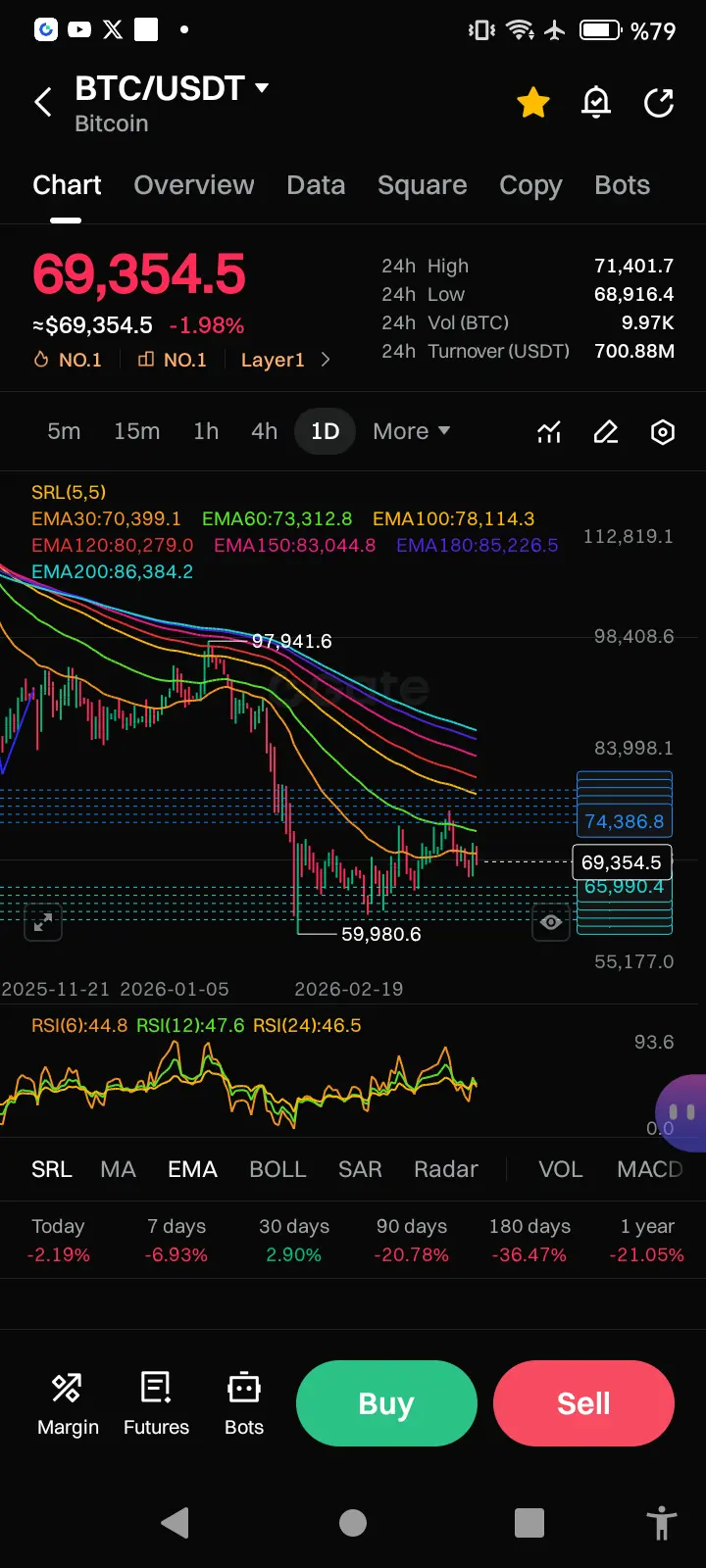
In the last week of March 2026, Bitcoin is fluctuating around the $70,000 mark. Following the correction from the 2025 peak of $126,000, investors are seeking new avenues in both the spot market and alternative instruments. This is where prediction markets come into play. Platforms like Polymarket and Kalshi price not only election results but also Bitcoin's hourly, daily, and yearly price movements with billions of dollars in volume. But do these markets truly influence the Bitcoin price, or are they merely a reflection? Current data and analysis suggest both are true.
First, let's look at the numbers. Polymarket's monthly trading volume exceeded $7 billion in February 2026, surpassing its 2024 election peak. The "What price will Bitcoin reach in March?" market alone reached a volume of $75 million. The daily 5-minute "BTC up or down?" market... Bets exceeded $60 million in a single day. Kalshi is similarly intensifying competition by listing short-term Bitcoin contracts. With the integration of Robinhood and Coinbase into these platforms, prediction markets have transformed from a mere betting tool into a mainstream financial infrastructure. It's no coincidence that Kalshi is projected to reach a valuation of $11 billion and Polymarket $8 billion by the end of 2025; crypto investors are finding ways to profit even from a spot market downturn.
So how do these volumes affect the Bitcoin price? The most direct impact comes through "crowd wisdom." On Polymarket, the question "Will Bitcoin reach $80,000 in 2026?" currently shows a 74% probability, while $90,000 is at 53%, and $150,000 is only at 10%. On the same platform, the probability of a bottom below $45,000 is priced at a significant 46%. These probabilities are updated more quickly and transparently than traditional analyses. An investor checks these signals on Polymarket before opening a long position in the spot market because the money here is driven by real money and real information flow. High-liquidity short-term contracts (e.g., 15-minute up/down bets) are dominated by high-frequency traders and AI bots, which can fuel short-term volatility. A sudden influx of a few million dollars creates a "market waiting" perception on social media, slightly pushing the spot price.
Historical examples confirm this interaction. Polymarket's early pricing of a Trump victory in the 2024 US elections with a 60%+ probability pumped the crypto market weeks in advance. Similarly, when Bitcoin reached $126,000 in 2025, the "end of 2025 $125,000" contracts on prediction markets closed as "yes," providing high returns to winners. Today, however, the outlook for 2026 is more cautious: While most analysts predict a range of $120,000-$170,000, prediction markets are not yet fully embracing this optimism. This divergence shows where smart money is positioned. While institutional investors monitor ETF flows and macro risks, the crowd in prediction markets instantly prices the same data. The result is a self-reinforcing cycle: if prediction markets are correct, they confirm the spot price; if wrong, they provide an early warning for a correction.
Of course, there are risks. The possibility of manipulation in small, low-liquidity markets, the gambling nature of short-term bets, and regulatory uncertainty are being discussed. However, the growth of Kalshi, under CFTC supervision, and Polymarket's on-chain transparency mitigate these risks. Moreover, prediction markets are no longer just "predictions"; they have become a hedging tool, a sentiment indicator, and even a price discovery mechanism. With the integration of Gate, Coinbase, and Robinhood, millions of new users are indirectly entering the Bitcoin market. This also increases liquidity in the long term.
In conclusion, prediction markets are influencing Bitcoin – and increasingly so. In 2026, Bitcoin's fate will no longer depend solely on ETF flows, the halving cycle, or macroeconomic data; it will also depend on 5-minute contracts on Polymarket, monthly probabilities on Kalshi, and the collective intelligence of the crowd. For Bitcoin, currently trading around $70,000 on the spot market, this new power represents both an opportunity and a warning signal. The message for investors is clear: It's time to look not just at the price chart, but also at the probabilities in prediction markets. Because those who best predict the future price are often the ones who price it first.
Do Prediction Markets Influence Bitcoin? A New Balance of Power in 2026
In the last week of March 2026, Bitcoin is fluctuating around the $70,000 mark. Following the correction from the 2025 peak of $126,000, investors are seeking new avenues in both the spot market and alternative instruments. This is where prediction markets come into play. Platforms like Polymarket and Kalshi price not only election results but also Bitcoin's hourly, daily, and yearly price movements with billions of dollars in volume. But do these markets truly influence the Bitcoin price, or are they merely a reflection? Current data and analysis suggest both are true.
First, let's look at the numbers. Polymarket's monthly trading volume exceeded $7 billion in February 2026, surpassing its 2024 election peak. The "What price will Bitcoin reach in March?" market alone reached a volume of $75 million. The daily 5-minute "BTC up or down?" market... Bets exceeded $60 million in a single day. Kalshi is similarly intensifying competition by listing short-term Bitcoin contracts. With the integration of Robinhood and Coinbase into these platforms, prediction markets have transformed from a mere betting tool into a mainstream financial infrastructure. It's no coincidence that Kalshi is projected to reach a valuation of $11 billion and Polymarket $8 billion by the end of 2025; crypto investors are finding ways to profit even from a spot market downturn.
So how do these volumes affect the Bitcoin price? The most direct impact comes through "crowd wisdom." On Polymarket, the question "Will Bitcoin reach $80,000 in 2026?" currently shows a 74% probability, while $90,000 is at 53%, and $150,000 is only at 10%. On the same platform, the probability of a bottom below $45,000 is priced at a significant 46%. These probabilities are updated more quickly and transparently than traditional analyses. An investor checks these signals on Polymarket before opening a long position in the spot market because the money here is driven by real money and real information flow. High-liquidity short-term contracts (e.g., 15-minute up/down bets) are dominated by high-frequency traders and AI bots, which can fuel short-term volatility. A sudden influx of a few million dollars creates a "market waiting" perception on social media, slightly pushing the spot price.
Historical examples confirm this interaction. Polymarket's early pricing of a Trump victory in the 2024 US elections with a 60%+ probability pumped the crypto market weeks in advance. Similarly, when Bitcoin reached $126,000 in 2025, the "end of 2025 $125,000" contracts on prediction markets closed as "yes," providing high returns to winners. Today, however, the outlook for 2026 is more cautious: While most analysts predict a range of $120,000-$170,000, prediction markets are not yet fully embracing this optimism. This divergence shows where smart money is positioned. While institutional investors monitor ETF flows and macro risks, the crowd in prediction markets instantly prices the same data. The result is a self-reinforcing cycle: if prediction markets are correct, they confirm the spot price; if wrong, they provide an early warning for a correction.
Of course, there are risks. The possibility of manipulation in small, low-liquidity markets, the gambling nature of short-term bets, and regulatory uncertainty are being discussed. However, the growth of Kalshi, under CFTC supervision, and Polymarket's on-chain transparency mitigate these risks. Moreover, prediction markets are no longer just "predictions"; they have become a hedging tool, a sentiment indicator, and even a price discovery mechanism. With the integration of Gate, Coinbase, and Robinhood, millions of new users are indirectly entering the Bitcoin market. This also increases liquidity in the long term.
In conclusion, prediction markets are influencing Bitcoin – and increasingly so. In 2026, Bitcoin's fate will no longer depend solely on ETF flows, the halving cycle, or macroeconomic data; it will also depend on 5-minute contracts on Polymarket, monthly probabilities on Kalshi, and the collective intelligence of the crowd. For Bitcoin, currently trading around $70,000 on the spot market, this new power represents both an opportunity and a warning signal. The message for investors is clear: It's time to look not just at the price chart, but also at the probabilities in prediction markets. Because those who best predict the future price are often the ones who price it first.