
Morgan Stanley submits Bitcoin and Solana ETF applications to SEC, with SOL featuring staking functionality. On Monday, Bitcoin ETF net inflows reached $697 million, a new high, with Bloomberg analysts predicting annual inflows of $150 billion. Morgan Stanley only began recommending crypto ETFs in October last year, and now is issuing its own using a BYOA strategy.
Morgan Stanley’s 180-Degree Turnaround from Prohibition to Issuance
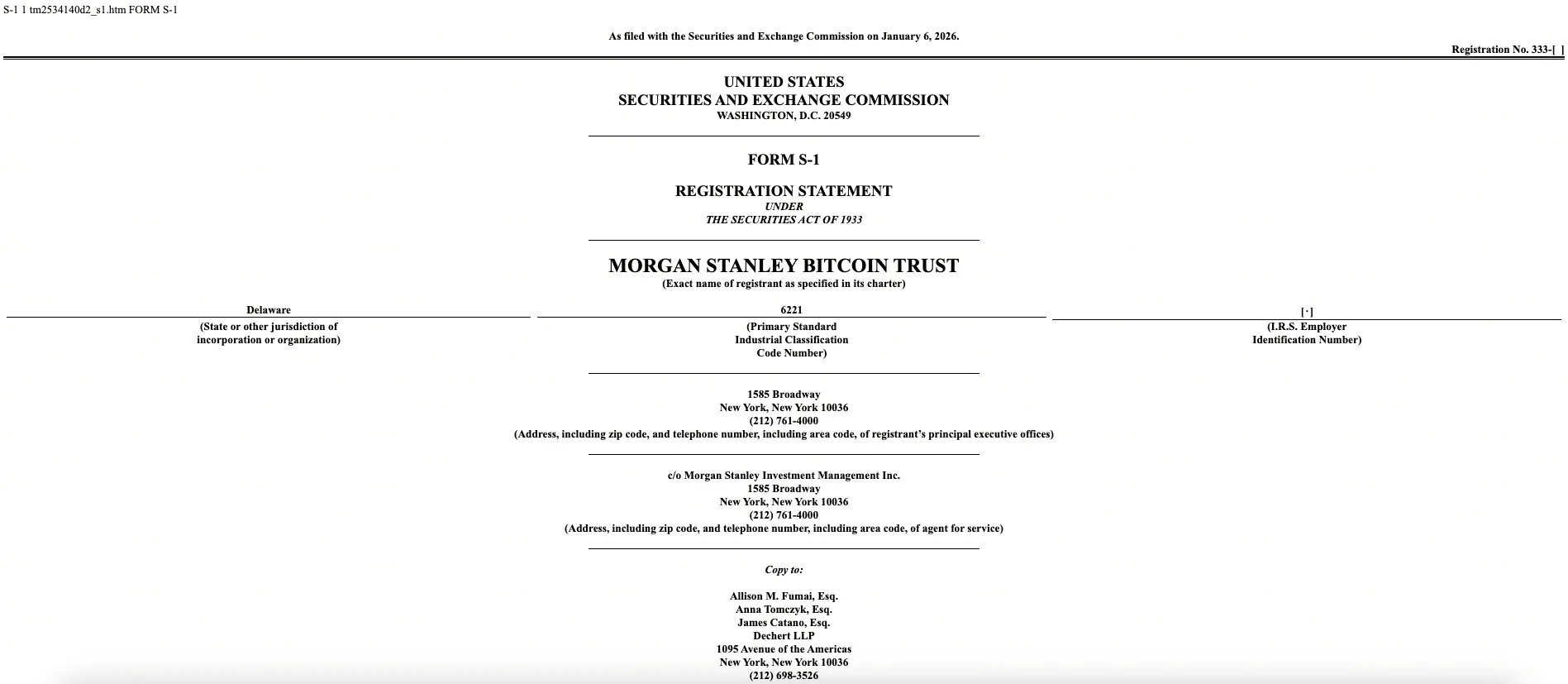
Morgan Stanley has submitted S-1 registration statements to the US Securities and Exchange Commission, planning to launch spot Bitcoin and Solana ETFs, marking the company’s deeper entry into regulated cryptocurrency products. The Wall Street giant separately filed application documents for a Bitcoin Trust Fund and a Solana Trust Fund, with its proposed Solana fund including staking functionality.
Until recently, Morgan Stanley’s financial advisors were prohibited from purchasing crypto ETFs for clients. But that changed in October last year. At that time, the company stated it was recommending limiting cryptocurrency allocation to no more than 4% in its most aggressive client portfolios, a move similar to actions taken by companies like BlackRock and Fidelity. Just months later, Morgan Stanley upgraded from “allowing distribution” to “self-issuance,” a speed of attitude change that is extremely rare among conservative Wall Street giants.
If approved, these applications would position Morgan Stanley alongside major spot crypto ETF issuers like BlackRock and Fidelity, reflecting growing mainstream investment demand for digital assets. This comes as US spot crypto ETFs have recently surpassed $2 trillion in cumulative trading volume, with spot Bitcoin ETFs alone exceeding $123.5 billion in assets under management.
Morgan Stanley’s filings come as the US Securities and Exchange Commission (SEC) operates in a friendlier regulatory environment for cryptocurrencies, with President Trump’s return leading the agency to introduce faster standard listing procedures for crypto ETFs. This further solidifies the company’s broader crypto strategy, including recommending a 4% allocation cap for opportunistic portfolios and expanding cryptocurrency access across all client accounts, including retirement plans.
Morgan Stanley manages approximately 20 ETFs under brands including Calvert and Eaton Vance, but currently only two ETFs are issued under the Morgan Stanley name, highlighting the rarity of such branding decisions. Issuing ETFs under the company’s own brand means higher reputational risk, as poor product performance would directly impact Morgan Stanley’s brand image.
The Business Logic and Competitive Effects of BYOA Strategy
Bloomberg Senior ETF Analyst Eric Balchunas called the move “wise,” stating that Morgan Stanley can use these funds to launch its BYOA (Bring Your Own Assets) ETF strategy, where large asset management companies direct client funds into their own proprietary products rather than into competing funds.
NovaDius Wealth President Nate Geraci wrote on X: “Now they’re also launching their own crypto ETF. Given Morgan Stanley’s massive distribution network, this makes sense. Clearly, they’re seeing enormous client demand for crypto ETFs.” With Morgan Stanley managing over $6 trillion in client assets and employing tens of thousands of wealth advisors, widespread promotion of their own ETFs through this distribution network would create a staggering siphoning effect.
Balchunas wrote on X: “This could spark several other firms to launch their own branded Bitcoin ETFs too. We’ll see.” This chain reaction could include traditional finance giants like Goldman Sachs, Bank of America, and UBS. Once these institutions all launch their own branded Bitcoin ETFs, market competition will intensify, but for investors this means more choices and lower fees.
Three Key Implications of Morgan Stanley’s Dual ETF Applications
Upgraded Mainstream Recognition: America’s sixth-largest bank issuing under its own brand provides stronger trust endorsement than distribution
BYOA Strategy for Customer Lock-in: Directing client funds to proprietary products, reducing capital flowing to BlackRock and Fidelity
Solana Institutional Adoption: First major bank to apply for SOL ETF, marking Solana’s entry into institutional asset class
$150 Billion Annual Inflow Prediction “Roaring Like a Lion”
On Monday, US spot Bitcoin ETFs received net inflows of $697 million, the largest single-day inflow since October, as crypto market sentiment improved in early 2026. This surge pushed two-day inflows close to $1.2 billion, with demand broadly distributed across issuers, with BlackRock’s IBIT ($660 million) and Fidelity’s FBTC ($279 million) leading gains.
Bloomberg Senior ETF Analyst Eric Balchunas stated on X that spot Bitcoin ETFs are “roaring into 2026 like lions,” adding that early inflow speeds would mean approximately $150 billion in annual inflows if momentum continues. This projection is annualized based on the first two days of inflows; while maintaining such high speed year-round is unlikely, even cutting it in half represents an impressive $75 billion scale.
BTC Markets crypto analyst Rachael Lucas stated that ETF repurchases reflect “cautious optimism from major asset allocators,” and while near-term outlook still depends on macroeconomic and regulatory stability, current ETF flows are supporting crypto prices. Institutional investors are upgrading cryptocurrency from tactical allocation to strategic assets, a mental shift that is the fundamental reason for continued inflows.
Bitwise Chief Information Officer Matt Hougan wrote in an X post: “Major institutions are diving into crypto at full speed, viewing it as a critical business priority.” Morgan Stanley’s application is just the beginning, with giants like Goldman Sachs and JPMorgan Chase likely following suit.
Aviso: As informações nesta página podem ser provenientes de terceiros e não representam as opiniões ou pontos de vista da Gate. O conteúdo exibido nesta página é apenas para referência e não constitui aconselhamento financeiro, de investimento ou jurídico. A Gate não garante a exatidão ou integridade das informações e não será responsável por quaisquer perdas decorrentes do uso dessas informações. Os investimentos em ativos virtuais apresentam altos riscos e estão sujeitos a uma volatilidade de preços significativa. Você pode perder todo o capital investido. Por favor, compreenda completamente os riscos envolvidos e tome decisões prudentes com base em sua própria situação financeira e tolerância ao risco. Para mais detalhes, consulte o
Aviso Legal.
Related Articles
Michael Saylor Avisa Que Ameaça Quântica Quebraria a Internet - U.Today
Michael Saylor argumenta que a computação quântica representa um risco universal para além do Bitcoin, ameaçando infraestruturas críticas globais. Em resposta aos pontos de vista de Chamath Palihapitiya sobre IA e perturbações de mercado, Saylor insiste que uma transição para Criptografia Pós-Quântica protegerá o Bitcoin e outros sistemas em conjunto, enfatizando a sua resiliência como "Capital Digital".
UToday8m atrás
Homem Alega que Esposa Roubou $172 Milhões em Bitcoin Após 'Gravá-lo Secretamente'
Em síntese
Uma esposa agora afastada é alegadamente suspeita de ter roubado $172 milhões em Bitcoin do seu marido.
Um documento judicial alega que ela utilizou gravações de CCTV para obter a frase-semente de uma carteira de hardware que continha o Bitcoin.
Depois de ser avisado do potencial roubo, o marido configurou
Decrypt9m atrás
IBM Abre Hardware Quântico para Investigadores enquanto Ameaça de Segurança do Bitcoin se Aproxima
Brevemente
IBM expandiu seu programa gratuito de computação quântica, aumentando o tempo de execução e o acesso ao hardware para pesquisadores.
A empresa abriu seu processador Heron R2 para utilizadores que antes estavam limitados a sistemas de nível inicial.
Os avanços na investigação quântica estão a impulsionar os programadores de Bitcoin a preparem-se f
Decrypt44m atrás
Analista Diz que Indicadores de Bitcoin Mostram Sinais Iniciais de Recuperação do Mercado
A liquidez de Stablecoin aumentou ~$8B desde fevereiro, sinalizando potenciais condições de negociação de mercado melhoradas.
O Inter-exchange Flow Pulse tornou-se positivo, indicando mais Bitcoin a mover-se para plataformas de derivados.
Os detentores de longo prazo retêm ~79% da oferta, mostrando transferências graduais de oferta
CryptoFrontNews1h atrás
Bitcoin Sobe Acima de $74K Após Rali a Partir do Nível de Suporte $60K
Bitcoin subiu de $60K para perto de $74K, ganhando 23% enquanto os compradores mantiveram o impulso, indicado por um RSI positivo e MACD. A resistência chave situa-se em $74K, com níveis de suporte em $72,8K, $71,5K e $70K. Os traders antecipam potenciais ganhos adicionais.
CryptoFrontNews1h atrás
Estratégia de Michael Saylor Adiciona $1.57B em Bitcoin, Tesouro Aumenta para 761K BTC
A Strategy anunciou na segunda-feira que comprou outro grande lote de Bitcoin, adicionando 22.337 BTC, uma compra que a empresa diz ter custado aproximadamente $1,57 bilhões a uma média de cerca de $70.194 por moeda, aumentando as suas participações totais para 761.068 BTC. A divulgação, apresentada como um Formulário 8-K e partilhada pela empresa
BlockChainReporter1h atrás


