Discussions around HPP's utility usually focus on three questions: whether the HPP token has real use cases, how network participants earn rewards through contributions, and whether the token economic model can support the protocol's operation.
This topic can be understood from six angles: HPP token functions, fee model, incentive structure, governance rights, staking mechanism, and allocation data. Among these, the allocation structure is an important foundation for evaluating the token economic model. According to official disclosures, the total supply of HPP is 1,700,000,000 tokens, with allocations covering Instant Swap, ecosystem, community, reserve, team and advisors, investors, and other categories.
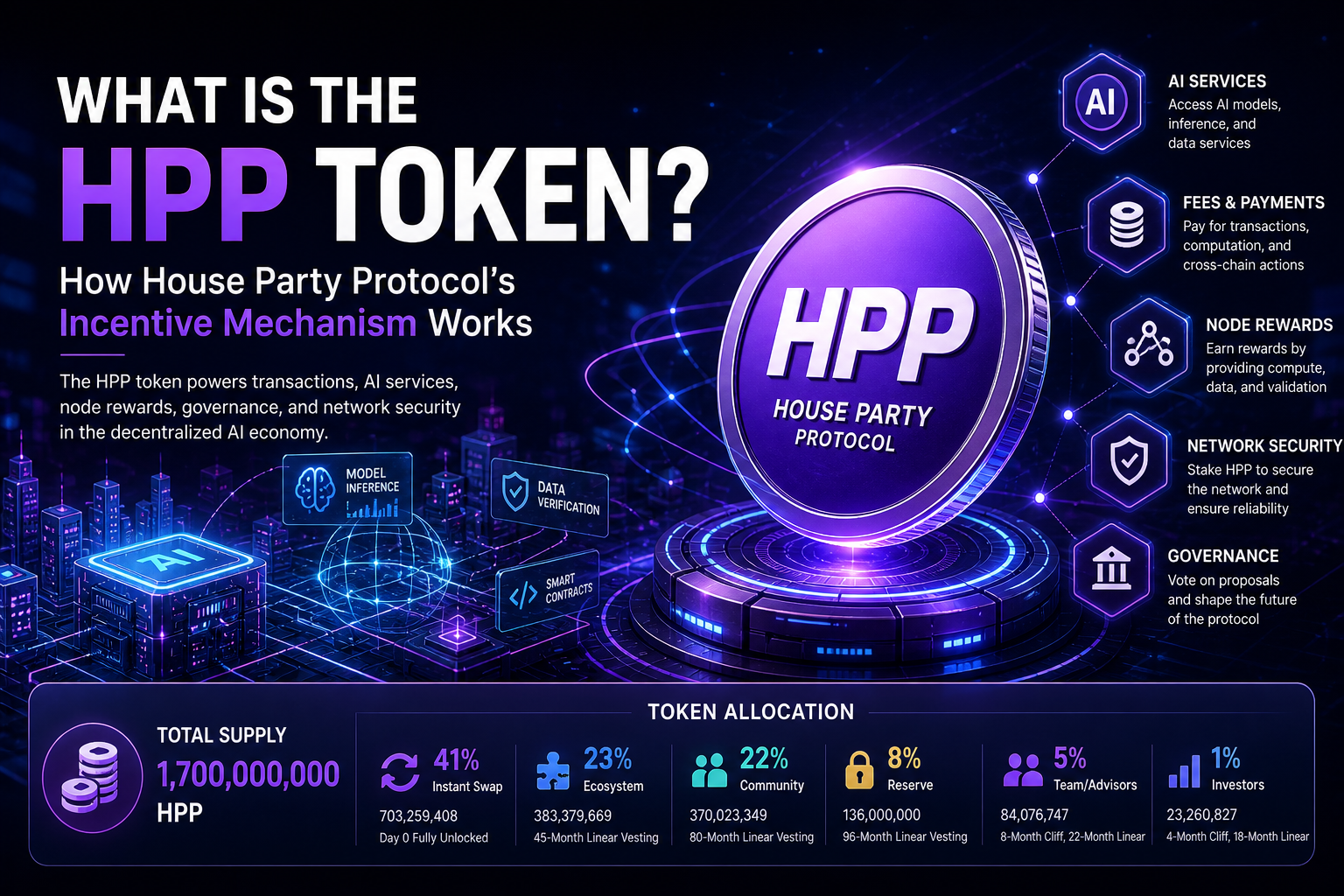
What Is the HPP Token
As the native utility token of the House Party Protocol mainnet, HPP's core role is to provide a unified settlement medium for AI model deployment, inference tasks, smart contract execution, data verification, and cross chain interaction.
Structurally, HPP is not just a simple payment tool. It is a foundational asset that connects AI services, on chain operations, and ecosystem participants. First, when users initiate AI inference, call data verification, or use on chain services within the HPP network, they need to pay fees in HPP. The system then allocates resources based on the specific service type, such as computing power calls, model verification, or cross chain interaction. Next, the relevant fees enter the network incentive system and are used to reward validators, compute nodes, or service providers. Ultimately, the HPP token forms the basis for value circulation inside the protocol.
The impact of this design is that HPP ties AI service usage and blockchain network operation into the same token model, creating a direct link between token demand and network activity. According to official information, AI model deployment, inference, smart contract execution, data verification, and cross chain interaction on the HPP mainnet all require transaction fees, which are paid by default in HPP tokens.
Core Functions of the HPP Token
The core functions of the HPP token can be summarized as network fees, service access, ecosystem settlement, and governance participation. In practice, HPP plays four roles within the AI protocol: Gas, payment asset, access credential, and governance tool.
Mechanically, developers or users first pay HPP for AI inference, model hosting, data verification, and smart contract execution. HPP native applications and ecosystem partners then use the token to open access to different services, including training datasets, AI asset valuation, and model verification tools. Next, users settle subscriptions, inference, or data services with HPP in modules such as ArenAI and Noösphere. In the end, the token forms a unified payment and access system across different applications.
| Function Category |
Specific Use |
Corresponding Scenario |
| Network fees |
Paying mainnet transaction fees |
Inference, contracts, cross chain |
| Service access |
Accessing AI and data tools |
Datasets, model verification |
| Ecosystem settlement |
Paying subscriptions and usage fees |
ArenAI, Noösphere |
| Governance participation |
Proposals and voting |
Protocol upgrades, standard selection |
| Security staking |
Serving as collateral |
Verification, service commitments |
This table shows that the HPP token's functions are not concentrated in a single module. Instead, they run through network usage, AI services, governance, and the security layer. The white paper also groups its uses into four areas: network usage and access rights, incentive alignment and revenue sharing, governance and ecosystem participation, and cryptoeconomic security and staking.
HPP Incentive Mechanism and Node Rewards
HPP's incentive mechanism is a reward model designed around real service contributions. Its core purpose is to allow compute nodes, model developers, data validators, and service providers to earn income based on what they contribute.
In terms of operation, a user or developer first initiates an AI service request, such as model inference, data verification, or synthetic data generation. The system then calls the corresponding computing resources, data services, or verification process. Next, fees are distributed among different participants according to their service contributions, such as compute node operators, model developers, and data validators. Finally, contributors receive rewards in HPP, creating an economic reason for continued network participation.
House Party Protocol's official materials state that developers pay service fees for AI inference, data verification, synthetic generation, and other services based on actual usage. When dApps are monetized through subscriptions or analytics tools, part of the revenue is shared with compute node operators, model developers, and data validators.
The importance of this mechanism is that it links token incentives to actual service output rather than relying only on static allocation. For an AI protocol, whether node rewards are tied to effective computation, accurate verification, and data quality directly affects whether the network can build a sustainable supply of services.
HPP Fee Payments and the Compute Market
HPP's fee payment mechanism is centered on usage based settlement for AI services. This mechanism can be understood as a compute market for decentralized AI infrastructure, where users pay based on the models, data, or verification services they actually use.
In the specific process, users first choose the AI service they want to call, such as off chain inference, risk scoring, model verification, or data access. The system then matches the task with the appropriate resources, including Noösphere's off chain computation, ArenAI's strategy agents, or data verification services. Next, users pay the fee in HPP, and the system submits the task to the relevant participants for execution. Finally, the task result is returned to the user, while the fee is distributed to network participants according to their contributions.
HPP supports usage based payments for AI inference and model hosting. Developers and enterprises can deploy AI models and run inference tasks on demand, paying only for the computing resources they use. This model directly links AI service fees to resource consumption, which helps reduce inefficient subsidies and improves the efficiency of computing resource allocation.
The impact of this fee structure is that demand for the HPP token is affected by AI service calls, demand for data verification, dApp subscription services, and the frequency of cross chain interaction. The more frequently the network is used, the more apparent HPP's utility becomes in payment and settlement.
HPP Governance Mechanism and Token Utility
HPP's governance mechanism depends on token holders participating in protocol decisions. Its core purpose is to coordinate network parameters, AI standards, protocol upgrades, and ecosystem direction through a governance process.
Structurally, the HPP token is not only used to pay fees but also to participate in broader AI alliance ecosystem governance. First, token holders can submit proposals related to protocol upgrades, adoption of AI standards, or strategic matters. The community then expresses its preferences through voting. Next, the system advances corresponding adjustments based on governance outcomes, such as changes to token mechanisms, selection of interoperability frameworks, or screening of ArenAI strategy providers. Finally, governance activity affects protocol operating rules and ecosystem resource allocation.
The House Party Protocol white paper clearly states that HPP serves as the governance token of the AI alliance ecosystem. Holders can participate in the adoption of new AI standards or protocol upgrades, adjustments to token mechanisms, strategic proposals and voting, and the community selection of ArenAI strategy providers.
The impact of this governance design is that HPP links token holding with the right to participate in the protocol, allowing ecosystem participants to play a role in shaping network rules. However, governance quality still depends on participation, information transparency, and proposal execution mechanisms.
HPP Incentive Mechanism and Network Security
HPP's network security mechanism essentially depends on staking, verification, and penalty constraints. By requiring key participants to stake HPP, the protocol ties service quality to economic responsibility.
In the security process, model trainers, data providers, or validators first need to stake HPP as a performance guarantee. Participants then carry out inference verification, data certification, or service delivery tasks. Next, the system evaluates task performance, and participants who are accurate, timely, and neutral receive rewards. Finally, if participants fail to meet service level requirements, their staked tokens may be penalized.
HPP is used for staking in key protocol operations, especially in the Proof of Inference system. Validators participate in verifying the reliability of data and AI models by staking tokens, and they receive rewards for maintaining trust, accuracy, and accountability in AI infrastructure. If participants fail to meet service level agreements, they may face token slashing.
Token allocation also affects network security and incentive cycles. The total HPP supply is 1,700,000,000 tokens. Of this, Instant Swap accounts for 703,259,408 tokens, or 41%; Ecosystem accounts for 383,379,669 tokens, or 23%; Community accounts for 370,023,349 tokens, or 22%; Reserve accounts for 136,000,000 tokens, or 8%; Team/Advisors accounts for 84,076,747 tokens, or 5%; and Investors accounts for 23,260,827 tokens, or 1%. Ecosystem and Community together account for 45%, representing 76% of the newly issued tokens, reflecting a long term allocation toward ecosystem development and community participation.
| Allocation Category |
Amount |
Share |
Unlock Schedule |
| Instant Swap |
703,259,408 |
41% |
Fully unlocked on Day 0, for legacy token holders |
| Investors |
23,260,827 |
1% |
4 month lockup, 18 month linear release |
| Reserve |
136,000,000 |
8% |
96 month linear release |
| Team/Advisors |
84,076,747 |
5% |
8 month lockup, 22 month linear release |
| Ecosystem |
383,379,669 |
23% |
45 month linear release |
| Community |
370,023,349 |
22% |
80 month linear release |
This allocation structure shows that HPP's token economy includes both a relatively high initial unlock ratio and longer term release schedules for the ecosystem, community, and reserve allocations. Its impact is that short term circulation mainly comes from Instant Swap, while long term incentives rely more on the continuous release of the ecosystem, community, and reserve portions.
Summary
Within House Party Protocol, the HPP token is used for fee payments, service access, node incentives, governance participation, and network security maintenance. Its operating logic centers on AI service requests, system resource calls, HPP fee payments, service contribution distribution, and staking based security constraints.
From a token structure perspective, HPP has a total supply of 1,700,000,000 tokens. Ecosystem and Community together account for 45%, Instant Swap accounts for 41%, while Reserve, Team/Advisors, and Investors are subject to different release schedules. Overall, the role of the HPP token is directly connected to AI computation, data verification, model services, governance mechanisms, and the Proof of Inference security framework.
FAQ
What Is the HPP Token?
The HPP token is the native utility token of the House Party Protocol network. It is used to pay mainnet fees, access AI services, participate in governance, stake, and support network activities such as AI inference, data verification, and cross chain interaction.
What Is the Total Supply of HPP?
According to officially published allocation data, the total supply of HPP is 1.7 billion tokens.
How Is the HPP Token Allocated?
HPP token allocation includes Instant Swap at 41%, Ecosystem at 23%, Community at 22%, Reserve at 8%, Team/Advisors at 5%, and Investors at 1%. Ecosystem and Community together account for 45%.
How Is the HPP Token Used for Node Rewards?
HPP incentivizes compute nodes, model developers, data validators, and validators through usage fees, revenue sharing, and staking rewards. Participants receive corresponding income based on the computing, verification, or data services they provide.
What Is the Relationship Between the HPP Token and Network Security?
HPP maintains network security through a staking mechanism. Validators and service participants need to stake tokens to take part in key operations. Those who complete tasks accurately can receive rewards, while those who fail to meet service requirements may be penalized.







