As RWA and multi-chain ecosystems develop rapidly, the limitations of traditional DAO governance in permission management, cross-chain coordination, and automated execution are becoming more apparent. Through its AI Governance Layer, Quack AI enables AI Agents to participate in governance analysis, risk identification, and on-chain execution under preset rules, reducing the cost of manual coordination in multi-chain governance.
As the AI Agent Economy continues to expand, Quack AI’s governance architecture is not only suitable for DAO management, but can also be applied to Treasury Coordination, RWA Governance, on-chain automated operations, and related scenarios.
What Is RWA Governance?
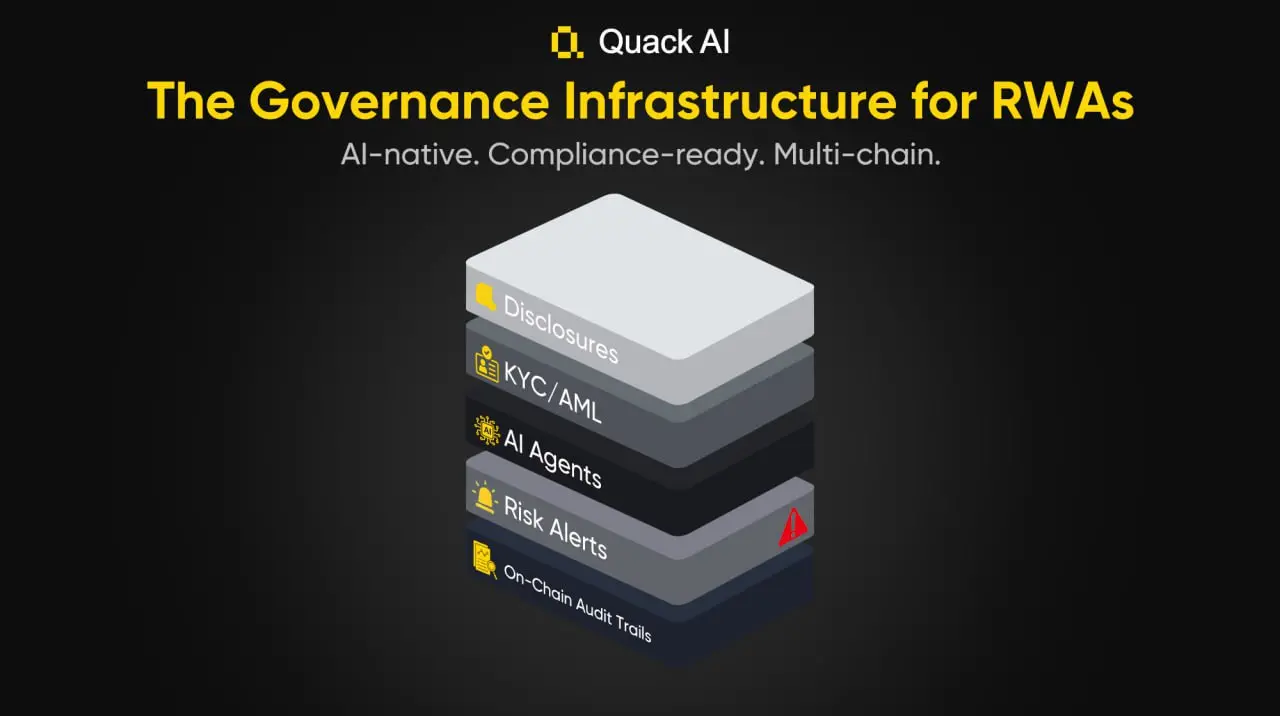
RWA Governance refers to the on-chain governance and management processes built around real-world assets, or Real World Assets.
RWAs usually include on-chain representations of bonds, real estate, notes, fund shares, or other real-world assets. When these assets operate on-chain, they often require more complex governance rules, such as asset custody, permission approval, income distribution, and compliance review.
Compared with ordinary DeFi protocols, RWA Governance places greater emphasis on transparency, rule control, and multi-party coordination. As a result, when DAOs manage RWAs, they need more complete governance infrastructure and stronger automated execution capabilities.
How Does Quack AI Support Multi-Chain Governance?
One of Quack AI’s core strengths is its ability to support cross-chain governance and multi-chain execution.
In a multi-chain ecosystem, a DAO often needs to manage assets and protocols across different networks such as Ethereum, BNB Chain, Arbitrum, or Polygon at the same time. Traditional governance tools are usually limited to single-chain environments, while Quack AI places greater emphasis on cross-chain collaboration.
Through the AI Governance Layer, AI Agents can synchronize governance processes across multiple blockchains. For example, after a DAO completes proposal voting on its main chain, an Execution Agent can automatically synchronize parameter updates or fund coordination operations on other chains.
This mechanism can reduce the complexity caused by manual cross-chain operations and improve consistency in governance execution.
What Role Does the Policy Engine Play in RWA Governance?
The Policy Engine is an important component of Quack AI’s governance architecture. It is mainly used to define the permission scope and execution rules of AI Agents.
In RWA scenarios, asset management usually requires strict rule control. For example, a DAO can set asset transfer limits, approval workflows, or income distribution conditions to ensure that automated governance complies with preset requirements.
The role of the Policy Engine is to allow AI Agents to execute operations within clearly defined rules, rather than interacting freely on-chain without constraints.
This mechanism helps reduce the potential risks introduced by automated governance and strengthens the transparency and verifiability of RWA Governance.
How Do AI Agents Participate in RWA and Multi-Chain Governance?
Within Quack AI’s governance system, AI Agents can participate in multiple governance stages.
A Proposal Agent can be used to generate governance summaries and analyze proposal content, helping community members quickly understand governance information.
A Risk Agent is responsible for monitoring governance risks, such as abnormal fund permissions, asset management issues, or on-chain execution conflicts.
At the execution stage, an Execution Agent can automatically complete cross-chain operations based on rules set by the DAO. For example, after a Treasury Proposal is approved, an AI Agent can automatically coordinate assets and update parameters across multiple chains.
This model helps improve governance efficiency and reduces the cost of manual operations in multi-chain environments.
How Does Quack AI Optimize Treasury Coordination?
Treasury Coordination is a key component of DAO and RWA management.
As the scale of assets managed by DAOs continues to grow, treasuries are often distributed across multiple chains and protocols. Traditional management methods usually require manual coordination of asset scheduling and income distribution, which increases governance complexity.
Quack AI uses its AI Governance Layer and automated execution system to allow some Treasury management processes to be completed automatically.
For example, a DAO can use the Policy Engine to set Treasury management rules, while AI Agents automatically execute fund allocation or income distribution operations according to preset conditions.
This automated governance model can reduce coordination costs and improve Treasury management efficiency.
Traditional multi-chain governance tools usually focus on vote synchronization and basic cross-chain execution, while Quack AI places greater emphasis on AI Agents and automated governance logic.
In traditional governance systems, most governance analysis and execution work still needs to be done manually. Quack AI, by contrast, uses Governance Intelligence and the Policy Engine to enable AI Agents to participate in proposal analysis, risk identification, and automated execution.
The biggest difference between the two lies in the level of governance automation and AI collaboration capability.
| Dimension |
Traditional Multi-Chain Governance Tools |
Quack AI |
| Proposal analysis |
Manual |
AI Agent |
| Risk identification |
Manual review |
AI Risk Agent |
| Execution method |
Manual coordination |
Automated execution |
| Permission control |
Mainly multisig |
Policy Engine |
| Cross-chain collaboration |
Basic synchronization |
AI collaborative governance |
What Does Quack AI Mean for the Agent Economy?
As the AI Agent Economy develops, more AI Agents are beginning to participate in on-chain analysis, trading, and governance processes.
However, without rule control and governance infrastructure, large-scale collaboration among AI Agents may create permission management and execution security issues.
One of Quack AI’s goals is to provide governance-layer infrastructure for the Agent Economy, allowing AI Agents to complete on-chain collaboration under verifiable rules.
This model is not only suitable for DAO and RWA management, but may also become one of the important directions for the future development of AI and blockchain collaboration.
Conclusion
Quack AI is an AI Governance Infrastructure that combines AI Agents, a Policy Engine, and automated execution mechanisms. It can be used in scenarios such as RWA Governance, multi-chain collaboration, and Treasury Coordination.
As multi-chain ecosystems and real-world assets gradually enter Web3, the limitations of traditional governance models in execution efficiency, permission management, and cross-chain coordination are becoming more visible. Through its AI Governance Layer, Quack AI enables some governance processes to run automatically under transparent and rule-bound conditions.
In the future, AI Governance may gradually become a core component of multi-chain ecosystems and the Agent Economy. The automated governance architecture represented by Quack AI may also play a more important role at the Web3 infrastructure layer.
FAQs
How Can Quack AI Be Used for RWA Governance?
Quack AI can help DAOs manage on-chain governance processes related to real-world assets through its AI Governance Layer, Policy Engine, and automated execution mechanisms.
What Is Multi-Chain Governance?
Multi-chain governance refers to the mechanism by which a DAO or protocol coordinates governance, asset management, and execution processes across multiple blockchains.
What Role Does the Policy Engine Play in RWA Management?
The Policy Engine is used to limit the execution permissions of AI Agents and ensure that automated governance complies with preset rules.
Can AI Agents Automatically Execute Cross-Chain Operations?
When permissions and rules allow, AI Agents can automatically complete some cross-chain governance and on-chain coordination operations.
How Does Quack AI Optimize Treasury Coordination?
Quack AI can coordinate Treasury management processes through automated rules and AI Agents, improving the efficiency of multi-chain asset management.
Quack AI places greater emphasis on AI Governance, automated execution, and AI Agent collaboration, while traditional DAO tools mainly rely on manual governance processes.
Risk Disclaimer:
Crypto asset prices can fluctuate significantly, and RWA and AI-themed projects may be affected by market conditions, technological development, regulatory policies, ecosystem adoption, and other factors. This article is for informational purposes only and does not constitute investment advice.







