A company that once ran a love hotel now positions itself as Japan’s gateway to Bitcoin, which has a distinctly Japanese twist.
The journey of Metaplanet transforming from the hotel industry to holding digital assets reads like a boardroom thriller — the protagonist swapped the key to the room for a private key.
In just over a year, Metaplanet has transformed from a struggling hotel company to the largest publicly listed company holding Bitcoin in Asia, ranking 11th in the world.
Although the headlines focus on the purchase of Bitcoin, the real core of the story is how a traditional Japanese company responds to regulatory constraints, shareholder skepticism, and market fluctuations, implementing what may be the boldest corporate strategic transformation in recent years.
Origin: A Company in Search of a Goal
The story of Metaplanet does not begin with grand ambitions, but with ordinary reality. As a hotel company, it operates hotels across Japan.
The business model is very simple: provide accommodation, collect income, and then repeat the cycle.
It is neither revolutionary nor groundbreaking.
It is just the kind of stable and predictable business that Japanese companies have excelled at for decades.
However, the company’s financial performance tells a different story. Metaplanet’s stock price has been sluggish for a long time, hotel assets are underperforming, and management is looking for a new direction. By early 2024, the company has reached a time for reformation.
Simon Gerovich, a veteran investment banker, joined Metaplanet with a seemingly absurd vision for hotel guests: to transform the company into Japan’s MicroStrategy.
Bitcoin’s Awakening
Metaplanet’s Bitcoin journey began in May 2024, when the company announced its first purchase of 117.7 Bitcoins, valued at approximately $7.2 million. This marks a strategic transformation announced with the solemnity of a corporate declaration.
The company has adopted the so-called “Bitcoin reserve strategy,” positioning cryptocurrency as its main reserve asset. This decision comes with a comprehensive restructuring of the company’s operations and philosophy.
They now hold more Bitcoin than El Salvador.
Think about it, a Japanese hotel company holds more Bitcoin than a country that has made Bitcoin legal tender.

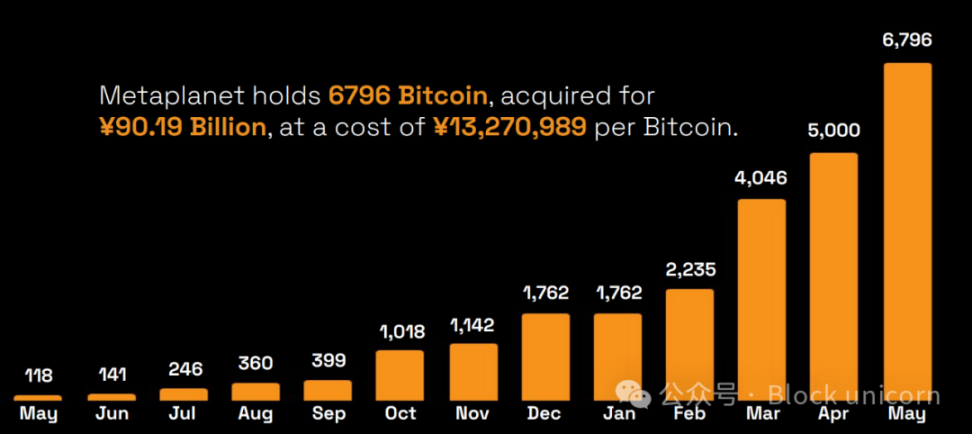
Since the first purchase, Metaplanet has been very stable in Bitcoin accumulation:
- May 2024: Additional purchase of 23.35 Bitcoins
- July 2024: Purchase of 20.381 Bitcoins again
- August 2024: Increase holding of 21.88 Bitcoins
- September 2024: Multiple purchases, totaling over 100 Bitcoins
- December 2024: Holdings reach 1,762 Bitcoins (start taking it seriously)
- Q1 2025: Accumulated 5,034 Bitcoins in three months (full throttle)
- May 2025: After purchasing 1,241 Bitcoins, the holding amount reaches 6,796 coins.
Their average cost? About 89,492 dollars per Bitcoin. Considering the current price, this timing is quite good.
Metaplanet has now become the largest corporate Bitcoin holder in Japan and one of the most important Bitcoin holders among publicly listed companies worldwide.
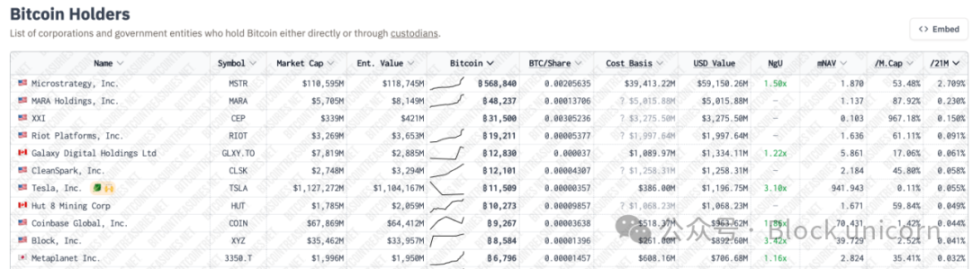
The increase in Bitcoin prices in 2024 means that the value of Metaplanet’s holdings has risen significantly, with unrealized gains far exceeding its traditional hotel revenue.
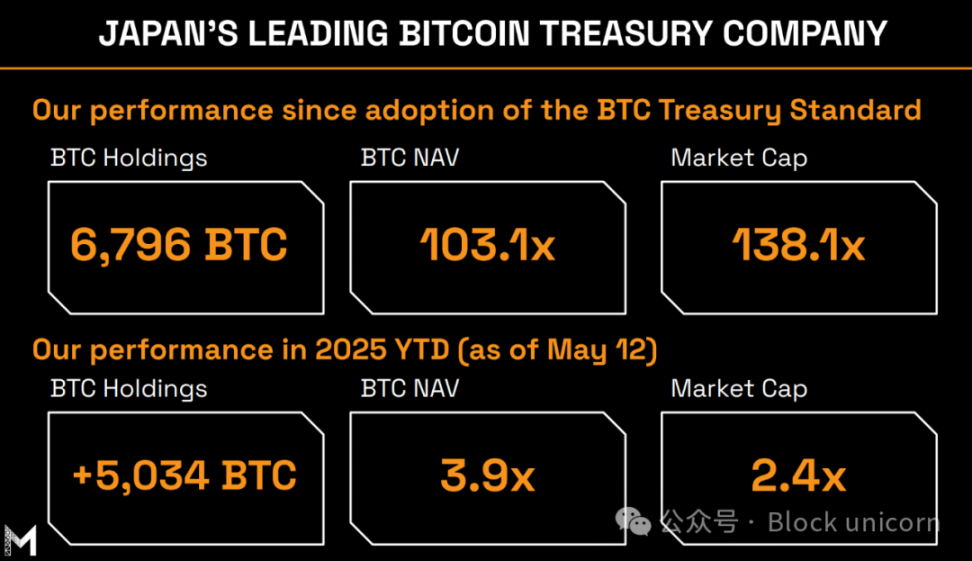
Q1 2025 Data
- Record Operating Profit: Revenue of 877 million yen brought in a profit of 592 million yen
- Bitcoin revenue: Harvested 770 million yen through option premiums (accounting for 88% of total revenue)
- Hotel operating income: only 1.04 billion yen (accounting for 12% of income)
- Bitcoin holdings: 6,796 coins (1,762 coins by the end of 2024)
- Unrealized Bitcoin losses: 7.4 billion yen in the first quarter, but reversed to a gain of 13.5 billion yen by May 12.
What is Bitcoin income generation? Simply put, they sell cash-secured Bitcoin put options, collecting premiums while buying more Bitcoin at a lower price when the options are exercised.
Their stock price? It has risen by 3000% since starting the journey of Bitcoin. Meanwhile, traditional hotel stocks may still be struggling to recover from the lows of 2020.
Although Bitcoin itself performed well during this period, the over 3000% increase of Metaplanet far exceeded Bitcoin’s returns, indicating that investors are willing to pay a premium for the following factors:
- Their innovative financing mechanism
- Execution of the “BTC Yield” strategy
- Opportunity to gain exposure to Bitcoin within the Japanese regulatory framework
- The company’s ability to amplify Bitcoin exposure
Where does the money come from?
Let us explain simply.
- Dynamic Exercise Price Warrants (The Essence)
- They sold 210 million “warrants” to investors.
- These warrants will only convert to shares when the Metaplanet stock price rises.
- Result: Shareholders will only be diluted when everyone makes a profit.
- They raised 76.6 billion yen in this way, without issuing at a price lower than the market price.
- Zero-Coupon Bond (Free Capital)
- They borrow money and pay 0% interest
- Why are some people willing to lend money for free? Because if Bitcoin rises significantly, they have potential for appreciation.
- Breaking News: Borrowed 3.6 billion yen at 0% interest
- Bitcoin Revenue (Let Bitcoin Earn Money on Its Own)
- They sell Bitcoin’s “insurance” (cash-backed put options).
- If Bitcoin crashes, they are forced to buy more (which is exactly what they want).
- If Bitcoin does not plummet, they retain the option premium.
- In the first quarter of 2025, 88% of the revenue came from this strategy.
- Hotel Business Cash Flow
- They still own some hotels, generating 104 million yen in revenue each quarter.
- All this cash is directly used to purchase Bitcoin.
Positive feedback loop
- Use the raised funds to buy Bitcoin.
- Bitcoin price rises → stock price rises.
- The stock price is rising → More warrants can be sold.
- Use warrant funds to purchase more Bitcoin.
- Repeat the above process.
Why does this work?
- They only issue new shares (warrants) when the stock price rises.
- They borrow money at zero interest (zero-coupon bonds).
- They make money from the fluctuations of Bitcoin (options trading).
- Everything feedbacks into the cycle of buying more Bitcoin.
If Bitcoin plummets and stock prices fall, the entire mechanism will cease to function. No one will purchase warrants, bonds become difficult to sell, and they will also be unable to provide funds for buying more Bitcoin.
When asked about concerns regarding stock prices, Grovich’s response was: “We have only just begun.” Given that their current holdings exceed those of an entire country, their confidence is undoubtedly strong.
Metaplanet also announced plans to issue another $21 million bond to EVO FUND. This is their 14th bond issuance to date. These bonds? Naturally zero interest, because who needs such returns when you have Bitcoin?
The company is establishing a wholly-owned subsidiary, Metaplanet Treasury Corp, in Florida, planning to raise $250 million to expand its Bitcoin purchasing power outside of Japan. Clearly, one country is no longer enough to satisfy their purchasing desires.
Comparison with MicroStrategy
Metaplanet has not engaged in hedging operations. They do not have a strategy of 50% Bitcoin and 50% hotels, but instead are fully betting on the orange currency (Bitcoin) strategy. Their entire business model now is:
- Raise funds
- Purchase Bitcoin
- Profiting from Bitcoin volatility
- Repeat the above process
Metaplanet’s strategy is clearly inspired by MicroStrategy’s transformation under the leadership of Michael Saylor. However, this Japanese company operates in different regulatory and cultural environments, which brings both opportunities and constraints.
Metaplanet has introduced their own key performance indicator (KPI) called “BTC Yield” - which measures the growth of Bitcoin holdings per share over time. The first quarter of 2025 showed a BTC Yield of 170%. This means that, despite the company issuing more shares, the amount of Bitcoin held by each shareholder has increased by 170%.
In comparison, Metaplanet achieved its milestones in 3 months, while MicroStrategy took 19 months to complete them. Their market net asset value growth rate is 3.8 times faster than that of MicroStrategy.
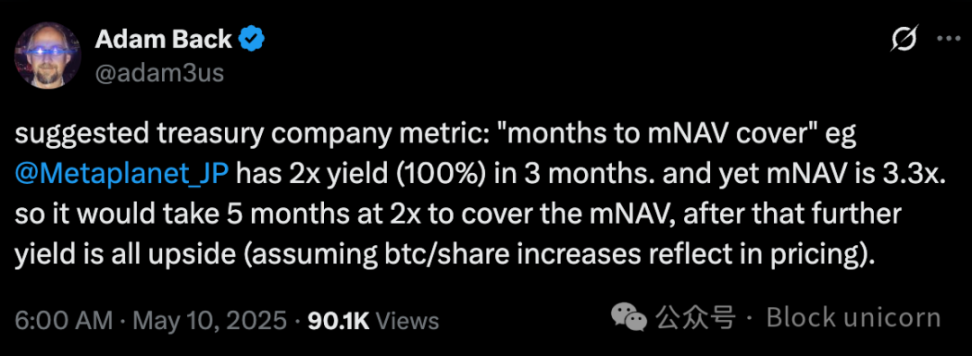
Unlike MicroStrategy, which benefits from the mature U.S. capital markets and a complex convertible bond market, Metaplanet must contend with Japan’s more conservative financial environment. Japan’s corporate bond market is underdeveloped, and retail investors may have more limited interest in leveraged Bitcoin investments.
Metaplanet also benefits from being the first to layout in the Japanese market. As a major Bitcoin broker among publicly listed companies in Japan, it attracts domestic and foreign capital seeking exposure to Bitcoin in Japan.
The company’s hotel business background also provides a narrative buffer. Unlike pure Bitcoin companies, Metaplanet retains operational businesses that can theoretically support the company in the event of a Bitcoin strategy failure. This may offer some comfort to more conservative investors.
Our Viewpoint
The transformation of Metaplanet represents the profound significance of the evolution of businesses in the digital age. This is a company that has realized that traditional business models are about to become obsolete and has decisively placed a bold bet on an emerging asset class.
Metaplanet essentially picked up the script of MicroStrategy and optimized it for the Japanese market. MicroStrategy issued convertible bonds, while Metaplanet pioneered dynamic exercise price warrants that only dilute shareholders when the stock price rises. What is the result? A more efficient Bitcoin accumulation engine, favored by the regulatory advantages in Japan.
This bold move is eye-catching. Most corporate transformations involve incremental changes—retailers moving online, media companies embracing streaming. However, Metaplanet completely abandoned its core competencies and staked the company on an asset that did not exist at the time of its establishment.
The success or failure of this strategy largely depends on the long-term trajectory of Bitcoin. If Bitcoin continues to be adopted by institutions and governments, Metaplanet’s early positioning may prove to be visionary. The company will essentially transform into a leverage company that capitalizes on Bitcoin’s popularity.
If Bitcoin stagnates or faces regulatory pressure, Metaplanet’s strategy could have catastrophic consequences. The company would be left with only a shrinking hotel business, and its cryptocurrency holdings would face significant unrealized losses.
It is certain that Metaplanet has created a template for businesses to adopt Bitcoin, which other companies will study—whether as inspiration or a warning. In a world where traditional business models are being constantly disrupted, perhaps the most rational strategy is to fully embrace this disruption.
Sometimes, survival requires not just adaptation, but a complete transformation. The management of Metaplanet bets that Bitcoin represents the future of value storage. Time will tell whether they are visionary or acting recklessly.
But in an era where stagnation often means regression, a company daring to take all risks to uphold its beliefs shows a commendable courage. Whether this transformation leads to prosperity or peril remains one of today’s most compelling corporate stories in Japan.


