Author: Frank, PANews
The cryptocurrency investment sector is undergoing a profound transformation. On one hand, traditional institutions are entering the market, bringing more funds and new strategies. On the other hand, native crypto investors are also facing stronger competitors, with strategies like “holding altcoins,” contract trading, and DeFi lending becoming increasingly difficult, raising the cognitive requirements for users.
The crypto market is becoming increasingly unfriendly to novice users.
In the strategy choices for investment, there is a classic dilemma known as the “impossible triangle” of profitability, safety, and liquidity. Throughout past cycles, DeFi protocols have often forced investors to make tough trade-offs among these three: the pursuit of astonishing annual percentage yields (APY) often comes with huge risks from smart contracts and the permanent loss of principal; while the quest for absolute safety means that funds can only remain dormant in wallets, missing out on growth opportunities.
Therefore, combination-based financial strategies are increasingly favored by investors. As a leading exchange, Binance’s types of financial products have always been at the forefront of the industry and are also one of the most used platforms by crypto investors. However, the various types of financial products can often be dazzling. This article aims to provide a comprehensive review of Binance’s high-yield financial products, in order to offer a new investment perspective for reference.
Binance’s high-yield financial products can be broadly divided into two categories. One category includes dollar stablecoin-related products represented by RWUSD and BFUSD, which have stable sources of income, such as RWA tokenized U.S. Treasury bonds or futures funding rates. The other category consists of structured products such as discounted coin purchases and dual-currency investments.
Products based on USD stablecoins are relatively conservative, have low thresholds, and are principal-protected with stable yields. Structured products generally come with higher potential returns but also involve greater risks, requiring some strategies.
“Discounted Coin Purchase”: Institutional-level options strategies made accessible to retail investors with one click.
“Discounted Coin Purchase” is Binance’s latest structured financial product, which, like the previously launched “Dual Currency Investment”, relies on options as its underlying asset. These two are the “Twin Stars” among Binance’s structured products.
For many investors, the current market situation is perplexing: they want to build positions at a lower cost during a pullback, but are afraid of bottom-fishing at the “halfway up the mountain.” Binance’s newly launched “Discount Buy” is designed to address this pain point.
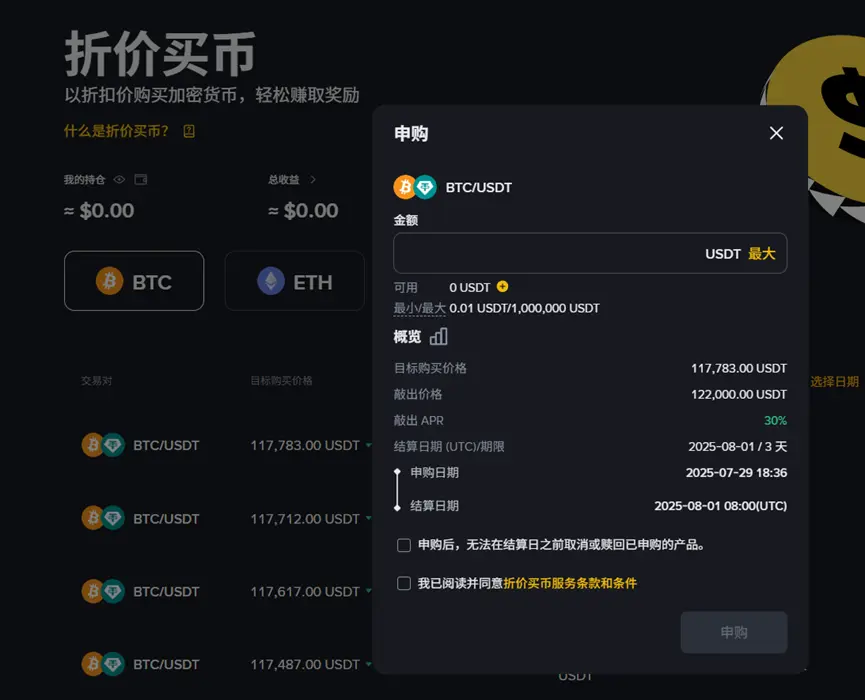
The essence of “buying coins at a discount” is a complex “exotic options” model. The main feature of this product is that users can accumulate coins (such as BTC, ETH) at prices lower than the market price or obtain high annualized returns. In traditional simple accumulation or low-price bottom-fishing strategies, users often encounter the problem of setting their entry points too low, resulting in unsuccessful bottom-fishing. In this process, not only do they fail to establish their positions, but they also waste funds while waiting, leading to more opportunity costs.
“Discount Coin Purchase” perfectly resolves this issue, allowing users to select a target purchase price along with the corresponding APR and knockout price. If the settlement price on the settlement day (taking the average price of half an hour on that day) is lower than the target purchase price, the user can successfully complete the position. If the settlement price is between the knockout price and the target purchase price, the user will complete half of the position at the “target price,” with the other half of the principal returned. If the price exceeds the knockout price, although the coin is not purchased, the principal will be fully returned along with the previously agreed APR. This acts as a “missed opportunity protection,” paying interest for the user’s opportunity cost while waiting.
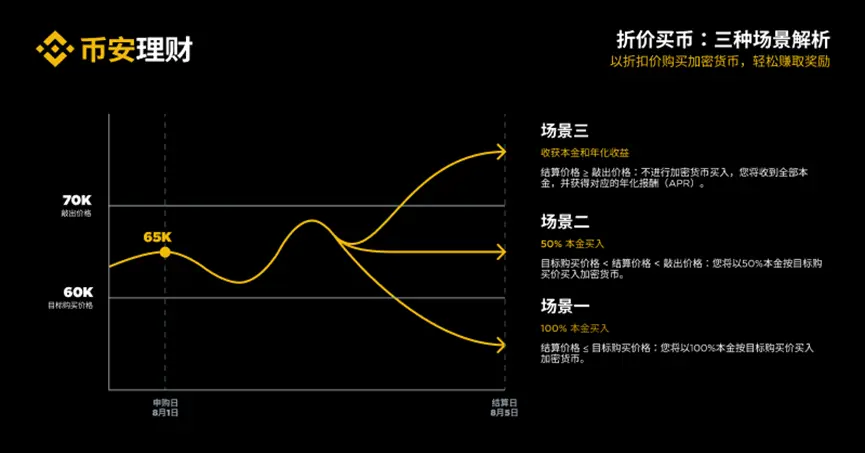
The true value of “discounted coin buying” lies in helping users who wish to build positions in the future at prices lower than the current market price to complete automated position building, or to ensure a certain investment return (the current knock-out APR can reach 30%) even if they fail to build a position. Similar to “discount coin buying”, “dual currency investment” is also based on options. Its core logic can be simply understood as: “Place a limit order for your future self; if the order is executed, you successfully buy low/sell high; if not executed, you can still earn some extra interest during the waiting period.”
Typical scenario: Suppose you plan to buy when the Bitcoin price pulls back to 60,000. If you place a direct spot limit order and it does not get filled, your funds will be idle during this period. However, if you use the “dual currency investment” “buy low” strategy, setting 60,000 as the target price, even if it does not get filled, your funds will continue to generate high interest.
“Dual Currency Investment” is more suitable for “planned traders” who have clear buy or sell points for the future. It transforms the cost of waiting time into tangible returns. Users can choose the settlement date and APR based on their investment preferences. Many investors tend to choose a settlement date that is further away or a target price that differs significantly from the current price, with the aim not being to complete a transaction but rather to obtain stable high returns. There are also many users who choose to continuously buy low and sell high within a range.
On August 14, the “Dual Currency Investment” also underwent an important functional upgrade, adding daily settlement functions for BTC and ETH, allowing users to choose working days within 7 days as the settlement date. Additionally, a custom automatic reinvestment plan has been introduced, supporting automatic reverse reinvestment, meaning that when the original subscription order reaches the target price, reinvestment can be made in the opposite direction of the original subscription order. These two upgrades further enhance the utilization of funds and the flexibility of strategies.
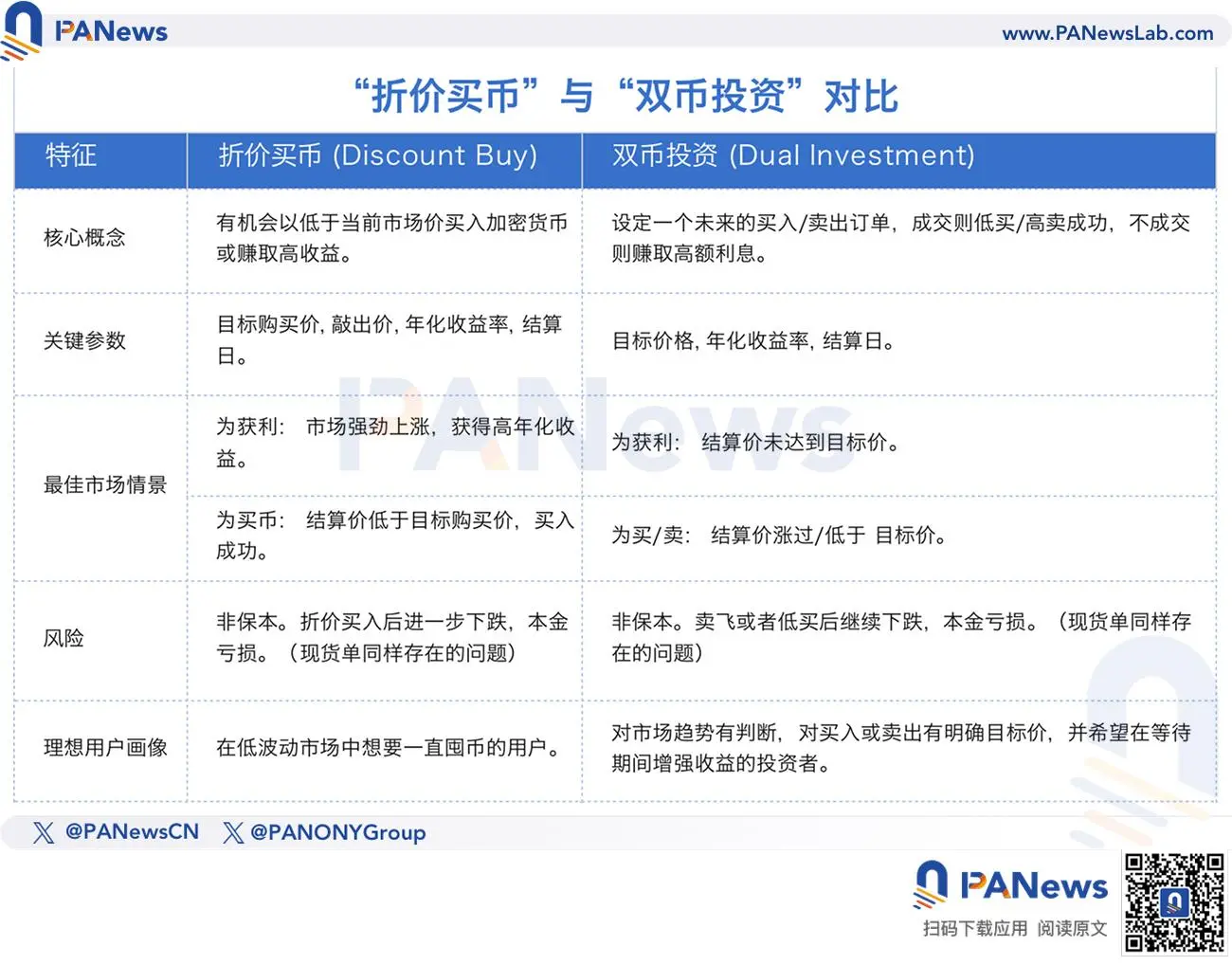
If “dual currency investment” is the basic “spot limit order + interest,” then “discount buying coins” is more like a “smart bottom-fishing robot” with buffers and various outcomes.
RWUSD: A bridge linking real-world assets (RWA) with retail investors.
If structured products are suitable for more professional crypto investors, then products based on USD stablecoins are more suitable for users with a low risk appetite who also wish to enhance the utilization of their assets.
In 2025, RWA and stablecoins are undoubtedly the hottest narratives of this cycle. Boston Consulting even predicts that the RWA market size will reach $16 trillion by 2030, and the stablecoin market size has already surpassed $2.6 billion. However, when giants like BlackRock rush into the market, their high-threshold RWA and stablecoin products will keep the vast majority of retail investors out.
The RWUSD and BFUSD launched by Binance seem to be such a bridge.
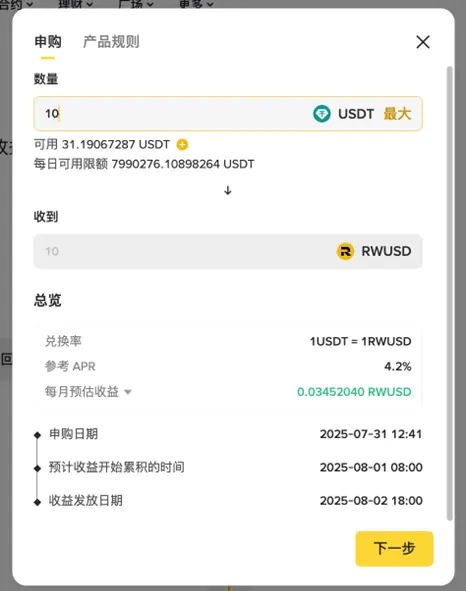
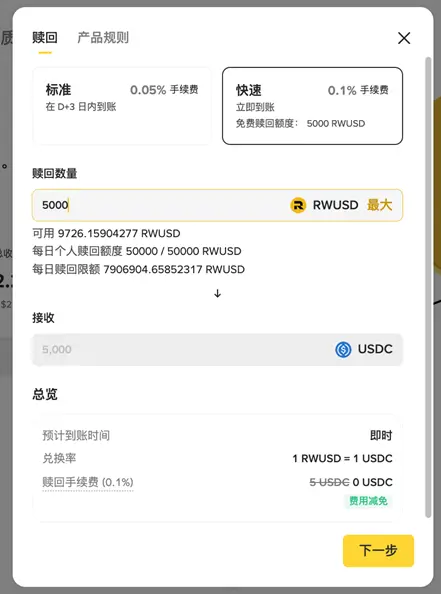
RWUSD is essentially a principal-protected financial product supported by the yields of real-world assets such as U.S. Treasury bonds. Although the official statement emphasizes that RWUSD is not a stablecoin or the Treasury bonds themselves, its innovative significance lies in the fact that it combines the native attributes of cryptocurrency with principal-protected financial management of U.S. Treasury RWA. RWUSD has the following characteristics:
-
Break through the investment threshold for RWA, with a minimum investment amount of 0.1U and a flexible redemption mechanism (a free quick redemption limit of 5000U per person per day).
-
Investment options suitable for low-risk preferences, with a reference annualized return of approximately 4.2%. Although this cannot be compared to high-risk DeFi projects, it offers a more reliable and stable choice for investors with lower risk appetites compared to native crypto yields.
-
Compliance and capital protection. Compared to previous capital protection financial products in the cryptocurrency sector, RWUSD, which relies on US Treasuries or stablecoins, has achieved a truly meaningful capital protection design in its underlying logic for the first time. This may attract a large number of institutions that are currently taking a wait-and-see approach to the cryptocurrency industry.
Unlike RWUSD, BFUSD, as a yield-generating financial product, targets another large pool of idle funds—the margin in contract accounts. For many investors keen on participating in contract trading, margin is often a fund that must remain idle. Typically, to ensure the safety of contract orders, the scale of the margin is not insignificant.
BFUSD fills this gap, allowing users to earn returns directly on the BFUSD they hold while also being able to directly deposit it into contract margins, enabling the stablecoin to serve a secondary purpose. Currently, the annualized return of BFUSD can reach 9.9%, and recently the TVL of BFUSD has seen a significant surge, surpassing 1.3 billion USD as of July 29.
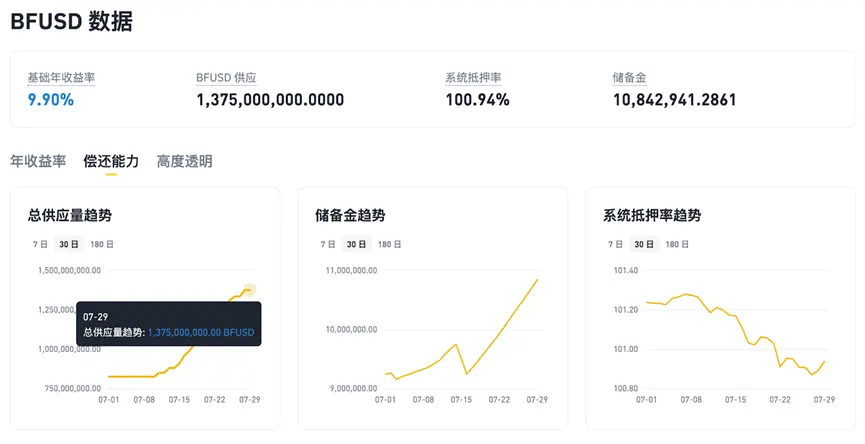
In general, both RWUSD and BFUSD are capital-preserving financial assets. Their relative annualized returns are not high compared to DeFi, but they significantly improve capital utilization and provide higher security for capital safety. For individuals and institutions new to cryptocurrency investments, they are undoubtedly a relatively safe choice.
BTC Staking: Activate idle capital to capture on-chain native yields.
In addition to the two types of financial products mentioned above, Binance also offers stable on-chain investment products. For example, “On-chain Earnings” takes BTC staking as an example.
Unlike public chains such as Ethereum that use the Proof of Stake (PoS) mechanism and can earn network security rewards through staking native tokens, Bitcoin, which uses the Proof of Work (PoW) mechanism, does not have the ability to “generate interest”. This has resulted in a large amount of BTC being idle, unable to create passive income for its holders. To address this issue, the BTCFi ecosystem has emerged. One of the key innovations within it is liquid staking.
Binance has provided a value-added channel for traditional “non-yield” assets like BTC by collaborating with third parties such as Solv Protocol. Users can stake BTC through their Binance account to earn SOLV token rewards based on their selected lock-up period, with annualized returns ranging from 0.6% to 1.6%. The product supports various lock-up periods and allows for early redemption at any time (though accumulated rewards will be forfeited). During this process, users can stake BTC on the Binance platform with just one click, capturing native yields from the BTCFi ecosystem without the need for complex on-chain operations. For users, this means they can capture native yields from on-chain innovations without leaving the familiar and trusted Binance environment.
In comparison, Binance’s BTC staking has the following features:
-
Assets are custody by Binance and related operations are completed to ensure the safety and reliability of funds.
-
No need to set up a wallet or understand DeFi knowledge; you can participate using your Binance account.
-
Provide multiple staking periods and sufficient quotas to meet the different users’ yield and liquidity needs.
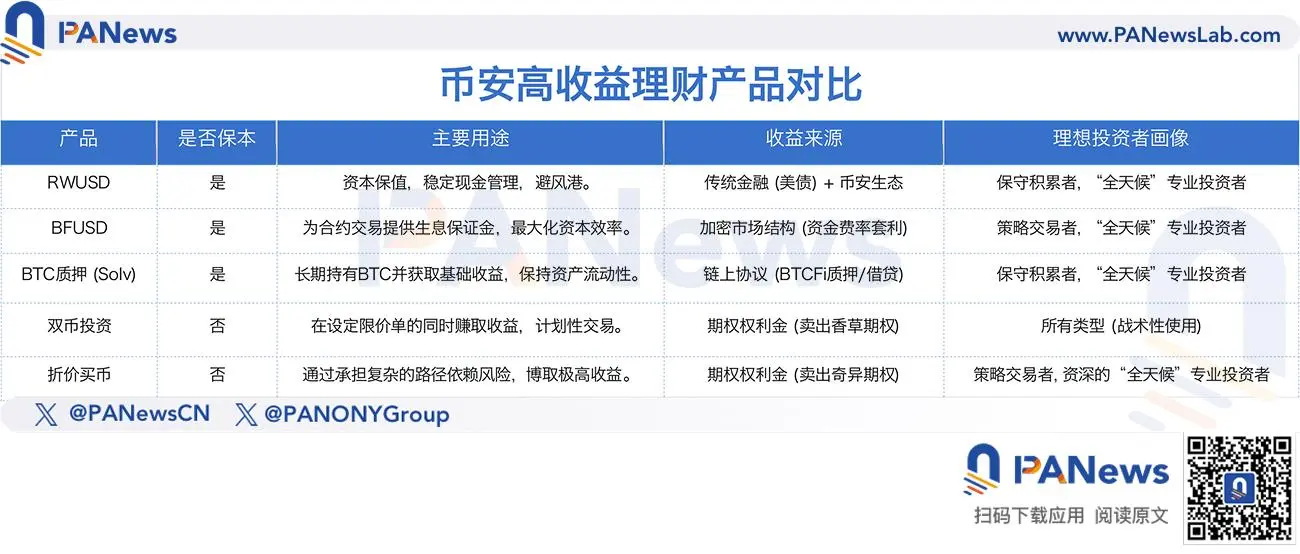
Returning to the original topic, there is no perfect product in the market that can simultaneously satisfy high yield, high security, and high liquidity. However, a mature investor knows how to build a diversified asset allocation portfolio to dynamically balance these three factors according to the market environment and their own needs.
By “productizing” and “one-clicking” complex financial strategies, Binance is lowering the threshold for ordinary users to participate in advanced investment games. This is not only a revolution in tools but also a profound evolution of investment concepts. An era that belongs to all crypto investors, focusing more on strategy and allocation, has already arrived.


