The Walrus Token Airdrop triggered a massive dumping after its launch on the BNB Alpha platform, with WAL falling over 32% within 24 hours, and a cumulative drop of 41% for the Walrus Token over the week, from $0.3897 to a low of $0.0781. The 150 WAL airdrop attracted users to immediately cash out for arbitrage, with daily trading volume skyrocketing to $25 million, but there is immense profit pullback pressure.
BNB Alpha Airdrop design triggers chain dumping
The BNB wallet announced the official launch of the BNB Alpha platform Walrus (WAL) and introduced an incentive airdrop program. Eligible users can redeem Alpha points on the BNB Alpha event page to receive 150 WAL Tokens.
· Details of the Two-Stage Airdrop Mechanism
Walrus Token Airdrop is divided into two phases to reward early participants:
Stage 1 (First 18 Hours):
Users need at least 210 Alpha points to qualify for rewards.
Reward amount: 150 WAL Tokens
Target audience: earliest participants
Phase 2 (Next 6 hours):
-
The threshold starts at 195 points and gradually decreases by 15 points every hour.
-
Dynamically lower the threshold to expand the participation scope.
-
Until the rewards are fully distributed.
Although the event successfully attracted a lot of attention and trading activity, it also triggered a rapid demand for the Token and subsequent immediate dumping, which is a common phenomenon after an Airdrop, putting significant downward pressure on the Token price.
Analysis of Behavior Patterns After Completion
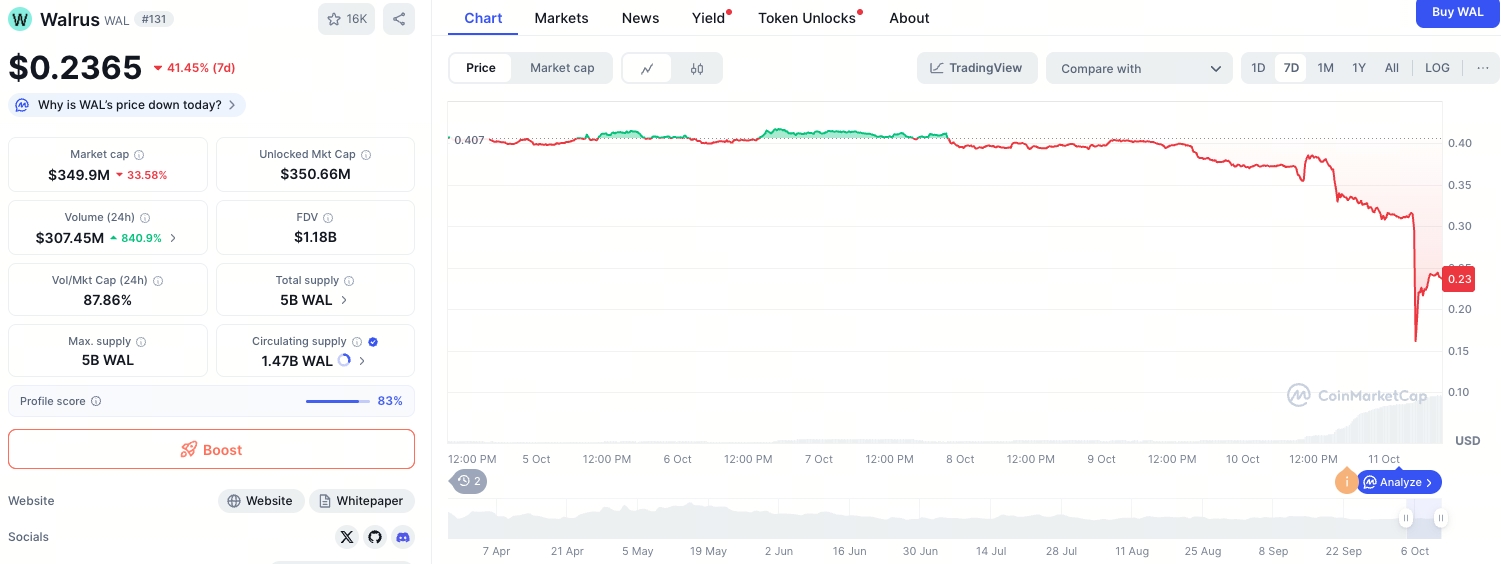
According to CoinMarketCap data, the volume surged over 25 million dollars in a single day, indicating an increase in trading activity, but there was also a general pullback in profits.
Walrus Token big dump data statistics:
Opening price: 0.3897 USD
Lowest point: around 0.0781 USD
24-hour fall: over 32%
Weekly fall: 41.45%
Volume Surge: Over 25 million dollars
The cryptocurrency market saw increased volatility on October 11, with the Walrus Token experiencing a significant drop following its listing on BNB Alpha and the Walrus Token Airdrop event. The value of the token fell by over 32% within 24 hours, underperforming the overall cryptocurrency market, which only declined by 1.11% during the same period.
Analysts say that this significant fall highlights the impact of dumping triggered by Airdrops and the short-term sentiment weakness across the entire altcoin market. Users immediately dump the free Tokens received in the market to lock in quick profits, creating a short-term imbalance with a surge in supply and insufficient demand.
Technical resistance levels have been completely breached
After the initial surge in trading, Walrus encountered strong technical resistance at its 7-day Simple Moving Average (SMA) of $0.404 and the Fibonacci 23.6% retracement level of $0.433. The failure to break through these levels accelerated the dumping momentum.
· Key Technical Level Sorting
Resistance Level Analysis:
7-day SMA: $0.404 (has fallen below, becoming new resistance)
Fibonacci 23.6% pullback level: 0.433 USD (not reached)
Psychological barrier: $0.40 (multiple failed tests)
Support Level Analysis:
Current Price: 0.379 USD
Key support: 0.36 USD (analyst focus)
· Target below: If it loses 0.36 USD, it may test the 0.30-0.32 USD range
The technical chart shows that WAL lacks volume support when breaking through $0.40, with each upward attempt facing selling pressure from Airdrop recipients. This supply and demand imbalance makes it impossible for the price to form an effective breakthrough, instead triggering a technical breakdown.
Shanzhai coin quarterly index big dump 13.8%
In addition, the general shift in sentiment in the altcoin market has intensified the fall. The altcoin quarterly index, which measures the strength of non-Bitcoin tokens, has dropped from 51 to 44 within 24 hours, a decrease of 13.8%, indicating that traders are pulling back from higher-risk assets.
Overall Pressure in the Altcoin Market:
Shanzhai Coin Quarterly Index: fell from 51 to 44 (-13.8%)
Bitcoin Dominance: Funds Flowing Back to BTC for Hedging
Overall market fall: 1.11% (WAL performs worse)
· Investor Behavior: Withdraw from High-Risk Altcoins
In addition to short-term technical and market pressures, some analysts believe that algorithmic traders have taken advantage of high volume conditions, further amplifying volatility and pushing the price of WAL below the critical support area. High-frequency trading robots executed automated selling strategies after detecting dumping signals, exacerbating the downward spiral.
Walrus Fundamentals: Storage Protocol Technical Advantages
Despite the recent weak performance, the fundamentals of Walrus (WAL) remain solid. The project is a decentralized data storage protocol built on the Sui blockchain, focusing on secure, efficient, and economical data management.
· Erasing coding technology reduces costs by 95%
Walrus significantly reduces storage overhead using erasure coding technology, achieving a ratio as low as 5 times the blob size, while the cost multiplier commonly seen in traditional blockchain storage systems is 100 times.
Technical advantages comparison:
Walrus storage cost: 5 times the size of the blob
Traditional Blockchain Storage: 100 times the size of a blob
Cost advantage: Reduce storage costs by 95%
Technical Foundation: Erasure Coding
This technological innovation gives Walrus a significant competitive advantage in the decentralized storage arena, demonstrating better cost efficiency compared to established storage projects like Filecoin and Arweave.
· Market Capitalization and Circulation Data
Currently, the total supply of the project is 5 billion WAL tokens, with a circulating supply of 1.47 billion. The market capitalization of Walrus is approximately 565.8 million USD, and the 24-hour trading volume exceeds 25 million USD.
Token economics data:
Total supply: 5 billion WAL
Circulation: 1.47 billion coins (29.4% circulation rate)
Market Cap: approximately 565.8 million USD
24-hour volume: over 25 million USD
Market capitalization ranking: Entering the top 200
These numbers indicate that advanced technological design supports a robust ecosystem—once speculative activities cool down, this factor can ultimately stabilize the Token. The relatively low circulation rate (29.4%) means that a large number of Tokens will still enter the market in the future, necessitating attention to the unlocking timetable.
Analyst Perspective: Typical Airdrop Adjustment
Market analysts have described the recent fall of Walrus as a typical Airdrop reaction. Such dumping is common when early recipients immediately cash out their free Tokens, leading to temporary price distortions in the market before finding a balance.
· Airdrop dumping is a common phenomenon
Coinverse Research blockchain market strategist Jacob Liu explained: “Investors often view airdrops as short-term opportunities. After users receive the tokens, many will immediately sell to lock in quick profits. However, these events rarely change the project's long-term fundamentals.”
Historical Case Comparison:
Arbitrum (ARB) Airdrop:
The first Airdrop saw a big dump of over 50%.
Gradually rebounding after weeks as speculative pressure eases.
Long-term fundamentals support price stability
Optimism (OP) Airdrop:
The initial experience is similar to dumping.
Technical rebound after natural demand recovery
Ecological development drives value reassessment
Historical cases also support this view. Tokens like Arbitrum (ARB) and Optimism (OP) experienced similar falls after their initial airdrops, but they only rebounded in the following weeks as speculative pressure eased and natural demand recovered.
· 0.36 USD support becomes key
If Walrus can maintain above the key support level around $0.36, analysts believe that a technical rebound could occur once traders re-enter at a discounted price.
Rebound Conditions:
Hold the 0.36 USD support
Airdrop dumping pressure has been digested.
The volume has returned to normal levels.
The sentiment in the altcoin market has improved.
CryptoScope senior analyst Sarah Martinez pointed out: “The current selling pressure is more due to market behavior than project flaws. Walrus still has one of the most efficient decentralized storage frameworks on the market. Once traders take profits, the project may regain momentum, especially in the case of securing new partnerships or expanding use cases.”
Macroeconomic Environment: Altcoins Face Overall Resistance
The timing of the Walrus Token's big dump coincides with the overall cooling of the altcoin industry. Bitcoin has recently been consolidating around $121,000, slowing the speculative inflow into smaller tokens. Meanwhile, Ethereum and BNB have maintained moderate gains, attracting liquidity away from newer or less mature projects.
· Risk aversion sentiment drives capital inflow
The uncertainty of the macroeconomy has also intensified the risk-averse sentiment, including the recent concerns about persistent inflation indicated by U.S. economic data and potential interest rate adjustments. These factors collectively impact investor confidence, especially in volatile assets such as altcoins.
Macro Factors Impact:
Inflation Concerns: U.S. economic data shows persistent inflationary pressures
Interest Rate Policy: The Federal Reserve may adjust the pace of interest rate cuts.
Hedging demand: Fund flows back to Bitcoin and US Dollar
Liquidity contraction: High-risk assets under pressure
Nevertheless, some analysts remain optimistic about the mid-term recovery of the altcoin market, citing the increasing institutional participation and the ongoing integration of Layer 2 scaling solutions, which enhance blockchain efficiency and reduce transaction costs.
Investment Strategy: Temporary Pain or Long-term Opportunity?
In the short term, investors will closely watch WAL's performance at the key resistance levels of $0.40 and $0.43. A successful retest could signal a trend reversal, while continued weakness may extend the correction phase into next week.
· Short-term strategy recommendations
Conservative Investors:
Waiting for the support test results at 0.36 USD
Observe whether the airdrop dumping has been digested.
Pay attention to whether the trading volume returns to normal.
Aggressive Investor:
Test small positions on dips in the $0.36-$0.38 range.
Set the stop loss below $0.34
Target technical rebound at 0.43-0.45 USD
· Long-term value assessment
The big dump of Walrus Token highlights the inherent volatility of the cryptocurrency market, especially during the Airdrop event and exchange listing of Walrus Token. Although short-term traders have intensified recent dumping, the token's strong fundamentals, innovative storage model, and evolving ecosystem suggest that it may recover once the speculative forces subside.
As the market stabilizes and sentiment towards altcoins improves, Walrus may become stronger with the support of its real-world utility and an expanding developer base. The integration with the Sui modular blockchain architecture offers scalability advantages, enabling faster and cheaper data verification compared to traditional storage chains.


